


पौराणिक संदर्भ असलेल्या व हिंदू, जैन,बौद्ध संस्कृतींचा संगम असणाऱ्या बदामीमध्ये चालुक्यकालीन म्हणजे इसवीसन सहाव्या ते बाराव्या शतकातील बरीच मंदिरे पहायला मिळतात.आज हे ठिकाण चालुक्यांच्या पुरातत्त्वीय स्मारकांसाठी प्रसिध्द आहे. इ. स. ५४० मध्ये चालुक्य साम्राज्याची स्थापना झाल्यानंतर सम्राट पुलकेशी पहिला याने बदामी येथे किल्ला बांधला व बदामीला राजधानी म्हणून घोषित केले.जवळपास सतराशे- अठराशे वर्षांचा ऐतिहासिक वारसा जपणारे हे ठिकाण आहे. या परिसरात अश्मयुगातील आदिमानवाची वसतिस्थाने व अवजारेही सापडली आहेत.
बदामी हे कर्नाटक मधल्या बागलकोट जिल्ह्यातलं एक शहर. बदामी छोटेसे गाव आहे. बदामीला स्वतःचे असे छोटे स्टेशन आहे. चालुक्यकालीन लेण्या आणि मंदिरे यांसाठी प्रसिद्ध. बदामीची ट्रिप आपण फक्त बदामी,पट्टदक्कल, ऐहोळे किंवा त्याला जोडून विजापूर , अलमट्टी, कुडलसंगम, हंपी अशीही करू शकतो. काही लोक एक ते दीड दिवसात बदामी ट्रिप करतात. पण त्यामध्ये खूप घाई होते. जर तीन दिवस काढले तर आपण आरामात बदामी व आसपासचा परिसर पाहू शकतो. बदामीला जायला एक मार्ग NH 4 ने निपाणी-चिकोडी- मोहोळ – लोकापूर – बदामी, दुसरा मार्ग NH4 नेच संकेश्वर – गोकाक – लोकापूर – बदामी व तिसरा मार्ग सोलापूर- विजापूर- अलमट्टी – बदामी असा आहे. सर्व मार्गांवरचे रस्ते चांगले आहेत, पण कर्नाटकात जागोजागी असलेल्या स्पीड ब्रेकरचा त्रास खूप होतो.

एका बाजुला नितांतसुंदर असा अगस्त्य तीर्थ तलाव. तीर्थाच्या चहूबाजूंनी ताशीव कड्यांचे लाल पहाड रखवालदारांसारखे उभे तर दक्षिणेकडच्या पहाडात बदामीची सुप्रसिद्ध गुंफा मंदिरे कोरलेली दिसतात. शहराच्या बाजूने एक विस्तीर्ण घाट तीर्थात उतरताना दिसतात. त्याच्या समोरच्या बाजूला उभारलेले सुबक असे भूतनाथाचे मंदिर साऱ्या परिसराचे सौंदर्य एका वेगळ्याच उंचीवर नेऊन ठेवतात. ईथल्या लेण्या, भुतनाथ मंदिर व किल्ला पहाण्यासारखा आहे. ईथे आसपास पण पहाण्यासारखे बरेच काही आहे. जसे पट्टडक्कल, ऐहोळे, लाक्कुंदी ईत्यादी. हा सर्व परिसर पहायचा म्हणजे कमीतकमी ३ दिवस हवेत. बदामीला मुक्कामाला राहिलात तर ईथल्या KTDC च्या "मयुरा चालुक्य" ह्या हॉटेलमध्ये जरूर रहा. अतिशय शांत, रम्य व स्वच्छ परिसर आहे.
सुरवातीला आपण बदामीच्या लेण्यांची माहिती घेउया.


दोन हजार वर्षांपूर्वी भक्कम कातळामध्ये कोरलेल्या लेण्या हे आपल्या महाराष्ट्राचे एक अत्यंत प्राचीन आणि अभिमानास्पद वैभव आहे. महाराष्ट्रातील विविध ठिकाणी विखुरलेल्या अनेक लेण्यांना आपण भेटी देतो आणि तिथला इतिहास समजून घेण्याचा प्रयत्न करतो. यांतील बहुतांश लेण्या या प्रामुख्याने बौद्धकालीन वास्तूरचनेचा आणि शांततेचा अप्रतिम नमुना आहेत. परंतु, महाराष्ट्राच्या सीमेबाहेर जाऊन लेण्यांच्या जगात डोकावण्याचा आणि एक वेगळी स्थापत्यशैली अनुभवण्याचा योग बदामी आणि अश्याच इतर ठिकाणी येतो.


इतका काळ लोटल्यावर आजही इथली मूर्तिकला आणि त्या शिल्पकारांचे कौशल्य अबाधित आहे. नटराजाची शिल्पे विशेष भाव खाऊन जातात. बदामीची लेणी व त्याचे स्थापत्य अप्रतिम आहे. दगडांचा रंग, लेण्यांची कलाकुसर, वरून दिसणारा विस्तीर्ण अगस्ती तलाव असं सारं दृश्य मनाला मोहवतं..

पुरातत्वखात्याची प्रवेश फि भरुन तिकीट घेउन पायथ्याकडून वर चढायला सुरुवात केल्यावर सर्वात आधी लागते ती लेणी क्रमांक एक.
लेणी क्रमांक १ ( शैव लेणे ) :-


महिषासुरमर्दिनी


 |


 |

बदामीचे कडे

लेणी क्रमांक २:-


 |
वामनावतार  |

त्रिविक्रम संपूर्ण पट

वामन, मध्ये शुक्राचार्य आणि वामनाला अर्ध्य देतांना बळीराजा
यासोबतच याच लेणीमध्ये त्रिविक्रम म्हणजेच वामन अवताराचे अतिशय सुंदर शिल्प कोरलेले आहे. वामनाने आपला एक पाय उचलून आकाशाला कसा गवसणी घातली आहे, हे या शिल्पातून अत्यंत प्रभावीपणे मांडले आहे. खालच्या बाजूला बटूरूपातील छत्रीधारी वामन उभा असून त्याच्या हातावर उदक सोडून तीन पावले मावतील इतकी भूमी देणार्या बळीराजाची मूर्ती कोरलेली आहे तर त्याच्या बाजूला दैत्यगुरु शुक्राचार्य उभा असून तो बळीला त्यापासून परावृत्त करतो आहे. पण बळीने अखेर दानाचे उदक सोडल्यावर विष्णूने आपले त्रिविक्रमाचे मूळ रूप प्रकट केले. एक पाय अतिशय उंच करून त्याने जणू स्वर्गच पादाक्रांत केला आहे तर दुसर्या पायाने त्याने सर्व पृथ्वी व्यापून टाकिली आहे आता जणू तो बळीला तिसरा पाय कुठे ठेऊ असे विचारत आहे. बळीचे सेवक त्रिविक्रमावर धावून जात आहेत तर गरुड एका पायाला धरुन बसला आहे.


छतावरच एका बाजूला गरुडारूढ विष्णूची मूर्ती कोरलेली आहे.
व्हरांड्यातील छतावर अप्रतिम कोरीवकाम असून चक्र, स्वस्तिकचिन्हरुपी भुलभुलय्यासारखी कमालीची मोहक नक्षी कोरलेली आहे. त्याच्या आजूबाजूस समुद्रमंथनासारखे देखावे आहेत.
गर्भगृहात विष्णूपीठ असून त्यावरची मूर्ती मात्र आज नष्ट झालेली आहे.

लेणी क्र. २ आणि तीनच्या मध्ये वरच्या किल्ल्यावर जाणारा खोदीव प्रवेशमार्ग आहे मात्र इथे पुर्वी एक हत्या झाल्याने पुरातत्व खात्याने आज तो बंद ठेवला आहे. येथे किल्ल्यावर जायचे असल्यास बनशंकरी रस्त्यवरुन एका पायवाटेने जाता येते.

दुसर्या गुंफेसमोरुन दिसणारे दृष्य
लेणी क्रमांक ३:-


लेणी क्र. ३ चे मुखदर्शन
मुखमंडप हा ६ पूर्णस्तंभ आणि दोन अर्धस्तंभांवर तोलला गेलेला असून सर्व बाजूस कमालीचे देखणे मूर्तीकाम आहे.
 |


लेणीत जायचा कोरीव जीना


मुखमंडपातील उजव्या बाजूस त्रिविक्रमाची मूर्ती कोरलेली असून त्याची रचना लेणी क्र. २ मधील त्रिविक्रमासारखीच आहे, मात्र येथील मूर्ती अधिक देखणी आणि अधिक भव्य आहे.त्रिविक्रम स्वरुपातील विष्णुच्या हातात शंख, चक्र, नंद्क नावाची तलवार कौमुदकी गदा, शारंग धनुष्य, बाण आनि ढाल असा शस्त्रसज्ज आहे.

त्रिविक्रमाच्या उजव्या खालच्या बाजुला हे गण उभे दाखवले आहेत, त्यात छत्रॉ धारंण केलेला वामन , त्याच्या पुढे सपत्नीक बळी राजा, त्याच्या पुढे शुक्राचार्य दाखवले आहेत. शुक्राचार्यांच्या डोक्यावर जे बुध्दासारखे उष्णीष दाखवले आहे ते म्हणजे बुध्द धर्माचा प्रभाव ओसरून पुन्हा वैदि़क धर्माचा प्रभाव वाढत असल्याचे प्रतिक आहे.


तर नृसिंहाच्या शेजारी हरिहर आहे.


शेषावर बसलेला महाविष्णू

नृसिंहाच्या बरोबर समोर अष्टभुज विष्णू असून मुखमंडपाच्या आतील बाजूस शेषनागाच्या वेटोळ्यावर बसलेला महाविष्णूची अतीव देखणी मूर्ती आहे. मुखमंडपात विष्णुच्या मुर्ती असणे हे चालुक्यांच्या मंदीर शैलीचे प्रमुख वैशिष्ट्य म्हणता येईल.बदामी लेण्यातील ३ क्रमांकाच्या गुंफेत असणारी हो महाविष्णुची मुर्तॉ त्याच वैशिष्ट्याचे उदाहरण म्हणता येईल. इथे वैकुंठ नारायण विश्णु हा पाच फण्याच्या अनंताच्या शेपटीच्या वेटोळ्यांनी बनलेल्या आसनावर आरुढे आहे. विष्णुच्या वरच्या दोन्ही हातात चक्र आणि शंख आहेत तर खालचे दोन्ही हात मांडीवर ठेवलेले आहेत. दोन्ही बाजुला नाग देवता दाखवल्या आहेत तर गरुड लक्ष्मी मातेसह बसलेला दाखवला आहे.


तर त्याच्या बाजूस वराहावतार आहे.इथे वराहमुर्ती लेणे क्रमांक दोन मधील वराह मुर्तॉसारखीच आहे. फक्त फरक इतकाच आहे कि वराहाच्या वरच्या उजव्या हातात शंख धारण केला आहे तर डाव्या वरच्या हाताने भुदेवीला आधार दिला आहे आणि डाव्या खालच्या हातात प्द्म पीठावर अभ्या असलेल्या भुदेवीला धारण केले आहे.


गरुड
मुखमंडपातील प्रवेशद्वाराच्या आतील बाजूस गरुडाची अतिशय भव्य मूर्ती आहे जी अगदी आवर्जून पहावी अशीच. प्रत्यक्षाहूनी प्रतिमा उत्कट असे म्हणतात, इथे मात्र प्रतिमेपेक्षा प्रत्यक्षच उत्कट असे म्हणावेसे वाटते. ह्या मूर्तीची भव्यता छायाचित्रात कदापिही येणार नाही.
 |
| Bracket couple |


 |
 | ||
|


येथील छतांवर रंगीत नक्षीकाम आहे तर स्तंभशिल्पे देखणी आहेत. या गुंफेतील बहुतेक स्तंभावर युगुल शिल्प आणि फुला, पानांनी बहरलेले झाड दिसते. इथे फुला,फळांनी बहरलेले झाड म्हणजे प्रजननक्षमतेचे प्रतीक आहे
यातील एक विशेष शिल्प म्हणजे मद्याच्या नशेत चूर झालेली तरुणी आणि तिला सावरणार्या तिच्या प्रियकराचे शिल्प.

लेण्याच्या जमीनीवर दगडात खेळ कोरलेला दिसतो आहे

रंगांचे नमुने
या लेणीचे आणखी एक वैशिष्ट्य म्हणजे पूर्वी या लेणीच्या छतावर आणि भिंतींवर अतिशय सुंदर रंगीत चित्रे काढलेली आहेत. आजही छताच्या काही भागांवर या रंगकाम केलेल्या चित्रांचे पुसटसे अवशेष पाहायला मिळतात, जे आपल्याला अजिंठा लेण्यांमधील चित्रांची आठवण करून देतात. लाल दगडावर कोरलेली ही भव्य शिल्पे आणि त्यावरील ती पुसटशी रंगीत चित्रे हा सगळाच अनुभव एका वेगळ्या जगात घेऊन जाणारा असतो.

मुखमंडप आणि सभामंडपातील छतांवर अष्टदिक्पाल, कार्तिकेय, ब्रह्मादिक देवता कोरलेल्या आहेत.

इंद्र

ब्रह्मा

शिव आणि वरुण

येथेही गर्भगृहात मूर्ती नाही.

लेणी क्रमांक ४ :-


लेणी क्रमांक ४ चा तलविन्यास
 |
गुंफा मंदिर क्रमांक चार  |


लेणी क्रमांक ५ :-


या गुंफेजवळच शयन अवस्थेतील विष्णु मुर्तॉ आहे, विष्णुच्या जवळच लक्ष्मी आणि गरुड दाखवले आहेत. त्याच्या वर दशावताराच्या दहा शिल्प तसेच ब्रह्मा, विष्णु, महेश हे त्रिमुर्ती आणि त्याच्या उजव्या बाजुला एक जोडपे ( जे कदाचित ) लेण्यासाठी दान देणारे असावेत, तसेच वासराला पाजणारी गाय ( जे जमीनीचे दानाचे प्रतिक आहेत ) दाखवले आहेत.
बदामी किल्ला :-

 |
| बुरुजावरून दिसणारे अप्रतिम दृश्य |
 |
| बदामीचे चित्र रेखाटण्यात गुंतलेले चित्रकार आणि त्यांचे सुंदर कलाविष्कार |


बदामी किल्ल्याचे सर्वात मोठे वैशिष्ट्य म्हणजे त्याचे नैसर्गिक संरक्षण होय. लाल वालुकाश्माच्या दोन अवाढव्य टेकड्यांच्या मध्ये हा किल्ला वसलेला आहे. या टेकड्यांमधील नैसर्गिक दऱ्या आणि खडकांमधील खोल भेगांचा उपयोग किल्ल्याच्या संरक्षणासाठी अतिशय खुबीने करण्यात आला आहे. किल्ल्यावर जाण्यासाठी खडकांमधूनच नागमोडी पायऱ्या कोरल्या आहेत. काही ठिकाणी दोन खडकांमधील वाट इतकी अरुंद आहे की एका वेळी एकच व्यक्ती तिथून जाऊ शकते. प्रवेशद्वारावर असलेले भक्कम बुरुज आणि जाड तटबंदी आजही या किल्ल्याच्या अभेद्यतेची साक्ष देतात.
बदामी किल्ल्याचा इतिहास सांगताना मराठा साम्राज्याचा या किल्ल्यावरील अंमल आणि पराक्रम प्रकर्षाने सांगावा लागतो. अठराव्या शतकात हा किल्ला मराठे आणि म्हैसूरचा टिपू सुलतान यांच्यातील संघर्षाचे एक प्रमुख केंद्र बनला होता. इसवी सन १७८६ मध्ये सवाई माधवराव पेशवे आणि नाना फडणवीस यांच्या मार्गदर्शनाखाली, हरिपंत फडके आणि तुकोजीराव होळकर यांच्या नेतृत्वाखालील विशाल मराठा फौजेने टिपू सुलतानाच्या ताब्यात असलेल्या या अभेद्य बदामी किल्ल्याला कडाडून वेढा घातला. अत्यंत निकराच्या आणि प्रखर युद्धानंतर मराठ्यांनी हा किल्ला फत्ते केला आणि या लाल मातीच्या दुर्गावर मराठा साम्राज्याचा भगवा अभिमानाने फडकला. या ऐतिहासिक विजयानंतर प्रदीर्घ काळ हा किल्ला मराठ्यांच्या भक्कम ताब्यात होता. मराठ्यांनी या किल्ल्याचे भौगोलिक आणि लष्करी महत्त्व अचूक ओळखून त्याचा एक महत्त्वाचे लष्करी ठाणे म्हणून उपयोग केला. किल्ल्यावर फिरताना या वास्तूच्या कणाकणात दडलेला मराठ्यांचा हा देदीप्यमान इतिहास आणि त्यांचा पराक्रम आजही जाणवतो.
ह्या प्रवेशद्वारातून आत जाताच आपला इथल्या अद्भूत जगात प्रवेश होऊन आपण त्यात जणू हरवूनच जातो. चालुक्यांचा राजा पुलकेशी(पहिला) याने इसवी ५४३ मध्ये हा बळकट किल्ला बांधला. ह्याची तटबंदी पार अगस्ती तलावाला भिडली आहे. पर पहिल्या प्रवेशद्वारातून पुढे जाताच प्रचंड मोठ्या प्रस्तरखंडांमधून एक प्रशस्त रस्ता पुढे जाताना दिसतो. हाच ह्या किल्ल्याचा राजमार्ग मात्र येथे डावीकडे एक लहानशी वाट एका बेचक्यात जाताना दिसते ही वाट न चुकवण्याजोगीच. ह्या वाटेतच लपला आहे किल्ल्याच्या टेहळणी मंडपाकडे जाण्याचा मार्ग. एकमेकांना अगदी चिकटलेल्या दोन प्रचंड खडकांच्या बेचक्यातून जेमतेम एक माणूस घसटत घसटतच कसाबसा जाऊ शकेल इतकीच अरुंद असणारी पायर्यांची वाट आपल्याला किल्ल्याच्या टेहळणी मंडपाकडे घेऊन जाते.


त्या वाटेवरुन वर आल्यावर एकदम प्रशस्त असे दोन टेहळणी मंडप दृष्टीस पडतात. येथून बदामीच्या कड्याचे, बदामी गावाचे, वरचे आणि खालच्या दोन्ही शिवालयांचे सुंदर दर्शन होते.

 |


बेचक्यातून वर आल्यावर दिसणारे टेहळणी मंडप, उजवीकडे खालच्या बाजूस किल्ल्यावर जाणारा राजमार्ग


 |
 |

अगदी समोरच दिसणारे खालचे शिवालय

कड्याच्या वर असणारे वरचे शिवालय
हे सगळे निवांत पाहून बेचक्यातून खाली येऊन परत राजमार्गाला लागलो. अतिशय भव्य कड्यांच्यामधून जाणारी वाट काही पायर्या चढून डावीकडे वळावे. लाल, गुलाबी, काळ्या, करड्या, निळसर इत्यादी रंगांच्या विविध छटा सकाळच्या कोवळ्या उन्हात निसर्गाचे अनोखे विभ्रम दाखवत असतात.


प्रवेशद्वार
वारातून पुढे येताच दोन रस्ते फुटलेले दिसतात. डावीकडचा रस्ता खालच्या शिवालयाकडे जातो तर उजवीकडील रस्ता किल्ल्याच्या वरील भागात असलेल्या शिवालयाकडे जातो. दोन्ही रस्त्यांच्या मध्यभागी एका भग्न इमारतीचे अवशेष आहेत. हे बहुधा दारुकोठार किंवा शस्त्रागार असावे.


तिठा


खालचे शिवालय
इथून आधी खालच्या शिवालयाकडे जावे. किल्ल्याची चढाई सुरू केल्यानंतर अर्ध्या वाटेवर एका मोठ्या खडकाच्या सपाट भागावर 'निम्न शिवालय' लागते. मूळतः हे मंदिर भगवान गणेशाला समर्पित असावे, असा काही तज्ज्ञांचा कयास आहे. पल्लव राजांनी जेव्हा बदामीवर हल्ला केला, तेव्हा त्यांनी या मंदिराची मोठी नासधूस केली. तरीही, मंदिराचा उरलेला गाभारा आणि द्रविड शैलीतील शिखराचा काही भाग आजही शिल्लक आहे. ह्या शिवालयाचा काल इसवी सनाच्या सहाव्या शतकातला आहे. एक छोटा प्रवेशमंडप, सभामंडप आणि प्रदक्षिणापथासह असलेले गर्भगृह अशी याची रचना, मात्र कालौघात इतर भाग पडून गेल्यामुळे आज फक्त गर्भगृह त्याच्या शिखरासहच शिल्लक राहिलेले दिसते. गर्भगृहाच्या द्वारशाखेवर नक्षीकाम असून द्वारपाल आहेत. या मंदिराचे काही काम किंवा जीर्णोद्धार विजयनगरच्या राजवटीत देखील झाले आहे.


बुरुजाच्या अलीकडे जमिनीतच अंतर्गत खोदलेली एक कोठी नजरेस पडते. हे बहुधा शस्त्रागार, दारुकोठार किंवा खजिन्याची खोली असावी.


ध्वजस्तंभाचा बुरुज


मलिगेट्टी शिवालय

बुरुजावर असलेल्या जंघ्यांमधून बदामीचा परिसर आणि खालच्या बाजूस असणार्या मलिगेट्टी शिवालयाचे अप्रतिम दर्शन घडते. किल्ल्याच्याच एका वेगळ्या खडकाळ कड्यावर मालेगिट्टी शिवालय उभे आहे. बदामीमधील सर्वात प्राचीन आणि पूर्णपणे सुरक्षित असलेल्या मंदिरांपैकी हे एक आहे. हे मंदिर सातव्या शतकात बांधले गेले असून ते द्रविड वास्तुकलेचा एक उत्कृष्ट नमुना मानले जाते. ह्या शिवालयास जाण्याचा मार्ग गावातून असून एका विशाल प्रस्तरावर उभारलेले हे चालुक्यकालीन शिवालय अत्यंत देखणे आहे.


आलो तसाच परत मागे येऊन किल्ल्याच्या वरच्या भागाकडे निघावे. थोडे पुढे जाताच वाट उजवीकडे वळून खडकातच असलेल्या अजून एका प्रवेशद्वारापाशी येते.


धान्यकोठारे
प्रवेशद्वारातून आत आल्यावर या अरुंद वाटेने वर येताच आपण पोहोचतो ते इथल्या धान्यकोठारांपाशी. वाटेत खडकातच गणपती, नंदी आदी मूर्ती कोरलेल्या दृष्टीस पडतात.या गोलाकार वास्तू या टिपू सुलतानाच्या काळातील धान्याची कोठारे म्हणून ओळखल्या जातात. इथली धान्यकोठारे एकदम वेगळ्या शैलीची. निमुळत्या घुमटाकार आकारात खालच्या बाजूस मोठ्या प्रस्तरखंड लावून आणि वरच्या भागात लहानलहान प्रस्तरखंड खुबीने बसवून ही निर्माण केलेली आहेत. आत जाण्यास लहानसे खिडकीवजा प्रवेशद्वार असून आतून ती पोकळ आहेत


वरच्या भागात जाण्यासाठी प्रस्तरांच्याच खुंट्या केलेल्या आहेत. येथे बाजूलाच काही भग्न इमारतींचे अवशेष देखील आहेत.
धान्यकोठारे पाहून वर जाताच आपला किल्ल्याच्या माथ्यावर प्रवेश होतो व वरच्या शिवालयाचे दर्शन घडते. वाटेत एक भग्न इमारत असून आतमध्ये एक बांधून काढलेली एक खोल चौकोनी विहिर आहे. विहिरीवर एक छत देखील आहे.

भग्न इमारत आणि त्यापुढे शिखर दृश्यमान असणारे वरचे शिवालय


किल्ल्याच्या काही बुरुजांवर जुन्या आणि जड तोफा आजही पाहायला मिळतात, ज्या या किल्ल्याच्या बदलत्या सत्तांची लष्करी आठवण करून देतात.


येथून पुढे जातात पूर्णरुपात सामोरे येते ते शिवालय.
खालच्या शिवालयापेक्षा काहीसे मोठे असे ते शिवालय एखाद्या ध्यानमग्न ऋषीस्तव त्या पहाडावर विराजले आहे, जणू काही साऱ्या संसाराची तिथून स्थितप्रज्ञतेने पाहणी करत असावे. तिथून खालचे शिवालय करंगळीएवढे भासत होते. अगदीच कड्याच्या टोकावर असलेल्या पूर्णपणे द्राविड शैलीत असणार्या ह्या शिवालयाच्या सभामंडपाचा एका बाजूचा भाग आज अस्तित्वात आहे. मंडपातून गर्भगृहाचा प्रदक्षिणापथ आहे. प्रदक्षिणापथात उजेड येण्यासाठी चक्राकार नक्षी असणार्या सुरेख खिडक्या आहेत.

शिवालय
शिवालयाच्या सभामंडपावर हत्ती, सिंह आदींच्या प्रतिकृती असून पट्टीकांवर यक्षमूर्ती तसेच कृष्णाच्या जीवनातले काही प्रसंग कोरलेले आहे. एकूणातच वैष्णव मूर्तींचे येथे प्राबल्य असल्याने हे शिवालय मूळचे विष्णू मंदिर होते की काय अशी शंका घेण्यास येथे पूर्ण वाव आहे. सभामंडपालाही प्रदक्षिणापथ आहे. असे दुहेरी प्रदक्षिणापथ असणे ही चालुक्यकालीन शैलीची विशेषता.
मंदिराच्या गाभाऱ्यात शिरलो कि एक अनामिक गारवा जाणवू लागतो. तिथली गूढ शांतता कमालीची प्रसन्न वाटते. मंदिर म्हणजे देवाशी संवाद साधण्याची जागा. पण त्यासाठी आधी स्वतःशी निःसंदिग्ध संवाद हवा. तो साधण्यासाठी आवश्यक ती वातावरण निर्मिती करणे हा मंदिराचा मूळ उद्देश. एखाद्या नास्तिकाला जरी त्या शिवालयात नेलं तरी तो अंतर्मुख होईल असे वातावरण त्या शिवालयात अनुभवास येते. किल्ल्याच्या अगदी सर्वोच्च टोकावर स्थित असलेले 'उर्ध्व शिवालय' म्हणजे बदामी किल्ल्याचा मुकुटमणीच आहे. हे मंदिर भगवान शिवाला समर्पित असले तरी, याच्या भिंतींवर भगवान विष्णूच्या दशावतारांच्या आणि श्रीकृष्णाच्या बाललीलांच्या सुंदर कथा कोरलेल्या आहेत. कालिया मर्दन आणि गोवर्धन पर्वत उचलणे यांसारखे प्रसंग यावर असल्याने हे मूळचे वैष्णव मंदिर असावे असे मानले जाते.


सभामंडपातील मूर्ती


 |
| एका दृष्टीकोनातून दिसणारी शिवालये |

शिवालयाचे समोरून दर्शन


वरुन दिसणारे खालचे शिवालय

मंदिराच्या बाह्य भागावर कोरलेला विदारण नृसिंह

गर्भगृहाच्या प्रदक्षिणापथात असणार्या चक्राकार देखण्या खिडक्या
शिवालयाच्या उत्तरेस सोळाव्या शतकातील टिपू सुलतान काळाची तोफ आहे जी १६व्या शतकातील टेहळणी बुरूजाप्रमाणे दिसते. हा किल्ला त्या प्रदेशातील प्रमुख आकर्षणे म्हणून गणला जातो ज्यामध्ये दोन धान्य कोठार , एक खाजगी खोली, चौकाच्या भिंती आणि एक गुप्त भूमिगत कक्ष आहे.
 |
| शिवालयाच्या बाजूने दिसणारे विहंगम दृश्य |

बदामी किल्ल्याचे सर्वात मोठे आकर्षण म्हणजे त्याच्या सर्वोच्च टोकावरून दिसणारे निसर्गरम्य दृश्य होय. येथून खाली पाहिल्यावर पूर्ण बदामी गाव एका छोट्या चित्रासारखे दिसते. त्याचबरोबर, निळ्याशार पाण्याचा अगस्त्य तलाव आणि त्याच्या किनाऱ्यावर वसलेले भूतनाथ मंदिर यांचे दृश्य भान हरपून टाकते. अगस्त्य तलावाच्या अगदी पलीकडच्या टेकडीवर कोरलेल्या बदामीच्या जगप्रसिद्ध लेण्या येथून स्पष्टपणे दिसतात. लाल खडक, हिरवीगार झाडी आणि तलावाचे निळे पाणी यांचा हा त्रिवेणी संगम पाहणे हा एक स्वर्गीय अनुभव असतो.


हा किल्ला पाहण्यासाठी साधारण दोन ते तीन तास लागतात. तीव्र चढ आणि असंख्य पायऱ्या असल्यामुळे आरामदायक पादत्राणे वापरणे आणि स्वतःजवळ पुरेसे पिण्याचे पाणी ठेवणे अत्यंत आवश्यक आहे. तसेच, किल्ल्यावर माकडांचा खूप मोठा वावर असल्याने खाण्याच्या वस्तू उघड्यावर न ठेवण्याची काळजी पर्यटकांनी घ्यावी लागते. थोडक्यात सांगायचे तर, बदामीचा किल्ला ही केवळ दगडांची तटबंदी नसून तो चालुक्यांच्या सुवर्णयुगाचा आणि मराठ्यांच्या धगधगत्या पराक्रमाचा एक जिवंत इतिहास आहे. इथल्या लाल मातीत, खडकांच्या भेगांत आणि मंदिरांच्या शिखरांवर तो इतिहास आजही गुंजत असल्याचा भास येथे येणाऱ्याला नक्कीच होतो.
बदामीचे पुरातत्त्व संग्रहालय


संग्रहालयची इमारत आणि किल्ल्याचे टेहळणी मंडप


 |
A sandstone sculpture of Lajja Gauri or Aditi, also called uttānapad ("she who crouches with legs spread"), 650A.D CE in Badami Museum |
चालुक्यकालीन शिल्पांव्यतिरिक्त या संग्रहालयाने प्रागैतिहासिक काळातील एक वेगळाच इतिहासही जपून ठेवला आहे. बदामी आणि आजूबाजूच्या मलप्रभा नदीच्या खोऱ्यात मानवी वस्ती अगदी अश्मयुगापासून होती, याचे पुरावे येथे मिळतात. एका स्वतंत्र दालनात या परिसरातील उत्खननात सापडलेली प्रागैतिहासिक काळातील दगडाची हत्यारे आणि अवजारे प्रदर्शनासाठी ठेवलेली आहेत. हे सर्व पाहताना मानवाच्या उत्क्रांतीपासून ते चालुक्यांच्या प्रगत स्थापत्यकलेपर्यंतचा एक मोठा कालखंड आपल्या डोळ्यांसमोर उभा राहतो.
कोणताही गाजावाजा नसलेले हे संग्रहालय खऱ्या अर्थाने बदामीच्या प्रवासातील एक अत्यंत महत्त्वाचा दुवा आहे. बदामीच्या लेण्या आणि किल्ला पाहण्यापूर्वी किंवा पाहिल्यानंतर या संग्रहालयाला भेट दिल्यास, त्या ऐतिहासिक वास्तूंचा संदर्भ आणि तिथल्या कलेचे गांभीर्य अधिक चांगल्या प्रकारे समजण्यास मदत होते. अतिशय शांत आणि हवेशीर असलेल्या या संग्रहालयातील प्रत्येक मूर्ती जणू स्वतःचा इतिहास सांगण्यासाठी तिथे उभी आहे. जवळपास एका तासाच्या या संग्रहालय भेटीत आपल्या बदामीच्या प्रवासाला एक परिपूर्ण आणि अभ्यासपूर्ण किनार मिळवून दिली जाते.
कप्पे अरभट्ट शिलालेख
बदामी किल्लयावरुन अंजनेय गुहामंदिरावरुन किल्ल्याला वळसा घालूनही हा शिलालेख पाहता येतो किंवा भूतनाथ मंदिराकडे जाताना डावीकडे वळूनही हा शिलालेख बघता येतो. ही जी डावीकडची वाट दिसते ती बदामीच्या डोंगरातून थेट जाते महाकूट मंदिर समूहाला. येथून महाकूट समूह आहे जेमतेम पाच किलोमीटर अंतरावर मात्र ही फक्त पायवाट आहे. भरपूर वेळ असल्यास येथून चालत जाऊन महाकूट मंदिर समूह बघता येतो, अन्यथा गाडीवाटेने दहा/बारा किमी फिरुन महाकूटला जाता येते. महाकूट ह्या डाव्या वाटेने वळलो, उजवीकडे एक वस्ती आहे आणि डावीकडे बदामीचा कडा, येथून साधारण दिडशे मीटर अंतरावर कड्यात आहे इसवी सन ७०० मधील कप्पे अरभट्ट शिलालेख. कप्पे अरभट्ट हा एक योद्धा आणि कवी. हा शिलालेख आहे एक कन्नड काव्य. दहा ओळीत असलेल्या ह्या कन्नड लेखात ५ कडवी आहेत पैकी तिसरी आणि चौथी ओळ मिळून एक संस्कृत श्लोक आहे तर इतर ही कन्न्डमध्ये आहेत. पहिली ओळ सोडली तर इतर सर्व त्रिपदीत आहेत. हा लेख म्हणजे प्राचीन कन्नड काव्याचा एक नमुनाच. काही जण ह्याला पहिले कन्नड काव्य असेही मानतात. शिलालेखाच्या शेवटी एक चक्र आणि त्याच्या मध्ये आणि खालच्या बाजूस नक्षीकामही केलेले आढळते.
कप्पे अरभट्ट शिलालेख (जिथे कुंपण संपतं तिथेच वरील बाजूस आहे)


कप्पे अरभट्ट लेख पाहून परत मागे येऊन अगस्ती तलावाच्या काठाने भूतनाथ मंदिराकडे निघालो कि वाटेतच एक सुंदर मंदिरसमूह आहे तो म्हणजे मल्लिकार्जुन समूह. त्याच्या आधी अगस्त्य तलावाची माहिती घेउया.
अगस्त्य तलाव :-


पाचव्या शतकात चालुक्य राजांनी या कृत्रिम तलावाची निर्मिती केली. या तलावाचे नाव महान 'अगस्त्य ऋषी' यांच्या नावावरून ठेवण्यात आले आहे. पुराणकथांनुसार, अगस्त्य ऋषींनी वातापी आणि इल्वल या दोन क्रूर राक्षसांचा वध याच परिसरात केला होता. या तलावाच्या पाण्यामध्ये औषधी आणि रोगनिवारक गुणधर्म आहेत, अशी स्थानिक लोकांची आणि भाविकांची श्रद्धा आहे. यामुळेच येथे येणारा प्रत्येक पर्यटक आणि भाविक तलावाच्या पाण्याला अत्यंत पवित्र मानतो. तीन बाजूंनी लाल दगडांच्या टेकड्या आणि एका बाजूला गाव, अशा या तलावाच्या सभोवताली असलेली शांतता मनाला एक वेगळीच भुरळ घालते.
 |
 |
 |


 |
| कलत्या सूर्याच्या प्रकाशातले भूतनाथ मंदिर |
मल्लिकार्जुन मंदिर


उतरत्या छपरांचा मुखमंडप, त्यापुढे आयताकार बंदिस्त सभामंडप आणि त्यापुढे गर्भगृह आणि त्यावर फांसना पद्धतीचे शिखर अशी याची रचना. ह्या मंदिरात मूर्तीकाम नाही मात्र फांसना पद्धती समजण्यासाठी हे मंदिर आवर्जुन बघावे असेच. या मंदीर समुहात विरुपाक्ष आणि दत्तात्रय मंदीरे आहेत


मुखमंडप, सभामंडप आणि फांसना शिखर रचना

स्तंभयुक्त सभामंडप आणि गर्भगृहातील शिवलिंग
मल्लिकार्जुन मंदिर पाहून झाल्यावर आता जाउया ते येथील एका सुंदर मंदिराकडे अर्थात भूतनाथ मंदिराकडे

भूतनाथ मंदिर
अगस्त्य तलावाला लागूनच असलेल्या मंदिरास "भूतनाथ मंदिर" म्हणून ओळखले जाते. भूतनाथ म्हणजे "आत्मांचा देवता". भूतनाथ मंदिर हे भूतनाथ समूह मधील एक आहे. बलुआ नामक दगडापासून बनविले गेलेले हे मंदिर भगवान शंकराच्या भक्तांमध्ये खूप लोकप्रिय आहे. ह्या मंदिरात शंकराच्या भूतनाथ अवतारात पूजा केली जाते. मंदिराचे बांधकाम हे दक्षिण भारतीय द्रविड़ियन आणि उत्तर भारतीय नागर शैलीची आठवण करून देते.

 |
 |
 |


 |
| भूतनाथ मंदिरे आणि अगस्त्य तीर्थ |
 |
| डोंगरकड्यावरून दिसणारे विलोभनीय दृश्य |

 |
 |


भूतनाथ मंदिर

भुतनाथ मंदीराचा तलविन्यास
हे बदामीतील सर्वांगसुंदर मंदिर. अगस्ती तलावाच्या ऐन काठावर वसलेले हे मंदिर पुढ्यातील विशाल तलावामुळे अधिकच खुलून दिसते. मंदिराच्या मागेच असलेला बदामीचा लालगुलाबी पहाड अगदी उठून दिसतो. भूतनाथ मंदिर देखील येथील इतर मंदिरांप्रमाणेच एकूटवाणे नसून एका समूहाच्या स्वरुपात आहे. मुख्य मंदिराची रचना काहीशी संमिश्र आहे. अंतराळ आणि गर्भगृहाचे शिखर हे द्राविड शैलीत असून ते बदामीच्या चालुक्यांनी सातव्या शतकात बांधलेले आहे, तर उतरत्या छपरांचा सभामंडप हा कल्याणी चालुक्यांनी अकराव्या शतकात वाढवला. याच कल्याणी चालुक्यांच्या काळात जवळ असलेला मल्लिकार्जुण मंदीराचा समुहाची आणि यलम्मा मंदीराची बांधणी झाली असाची.

 |
| मंदिरातला सुबक नंदी |
गर्भगृहाच्या बाहेर नंदी असून आतमध्ये शिवलिंग आहे.
 |
| अर्धवट बांधला गेलेला मंदिराचा कळस |
सभामंडप हा विविध स्तंभांवर तोललेला आहे आणि सभामंडपाच्या दोन्ही बाजुला पडव्या आणि मधोमध मोठा प्राकार तयार झाला आहे. छतावर कमळाच्या फुलांची नक्षी बघायला मिळते. सभामंडपाला असलेल्या खिडक्यातून मंद प्रकाश आत येत असतो. गर्भगृहाच्या प्रवेशद्वारावर शैव द्वारपालांची अपूर्ण राहिलेली शिल्पे आहेत तर त्यांच्या खालील बाजूस मकरवाहिनी गंगा आणि कूर्मवाहिनी यमुना अशी सरिताशिल्पे आहेत. मात्र ललाटबिंब नसल्यामुले मुळ मंदीर नेमके कोणत्या देवाचे होते हे समजायला वाव नाही. अर्थात दोन काळात बांधण्यचा प्रयत्न होउनही या मंदीराचे बांधकाम अपुर्णच राहीले. कदाचित हे मंदीर जैन पंथीयासाठी बांधले असावे असे इथली अपुर्ण शिल्पकला बघून अंदाज करता येतो. मात्र नंतर लिंगायत पंथीयानी या मंदीरात सभामंडप बांधून शिवलिंग आणि नंदीची स्थापना केली असावी.


. तलावाच्या अगदी काठावर असूनही पुढ्यातील अगस्ती तलाव संपूर्ण भरला तरीही भूतनाथ मंदिरात पाणी शिरत नाही याचे कारण म्हणजे तलावाचा लेणीकडील बाजूस अतिरिक्त पाणी वाहून नेण्यासाठी एक वाट निर्माण केली आहे. मुख्य मंदिराची भोवती काही उपमंदिरे असून एकात लकुलिश शिवाची एक मूर्ती आहे.


द्राविड पद्धतीचे शिखर असलेले भूतनाथ मंदिर व त्याच्या बाजूस असलेली उपमंदिरे
भूतनाथ मंदिर समूहाच्या मागेच असलेल्या एका विशाल प्रस्तरावर आहे विष्णूगुडी अर्थात विष्णूचे मंदिर.
विष्णूगुडी
मागच्याच प्रचंड खडकावर फांसना शैलीतले एक लहानसे मंदिर आहे, हौशी लोक त्या खडकावर जाऊन तलावात उड्या मारत असल्याने तेथे जायची वाट पुरातत्त्व खात्याने बंद केली आहे तरी हे लहानसे मंदिर विलक्षण सुंदर दिसते.

खडकावरील लहानसे मंदिर
ह्या प्रस्तराजवळ गेलो असता खडकातच उंचावर विविध देवतांच्या मूर्ती कोरलेल्या दिसतात. जणू मूर्ती कशी खोदावी ह्याचा सराव करण्यासाठीच ह्या कोरण्यात आल्या असाव्यात. ह्या मूर्तींमधे आहेत वराह, गणेश, ब्रह्मा, विष्णू, महेश, महिषासुरमर्दिनी आणि हिरण्यकश्यपूचे विदारण करणारा उग्र नृसिंह.


 |
| भुतनाथ मंदीराच्या मागच्या खडका वर हि शिल्प कोरली आहेत |


उग्रनृसिंहाच्या बाजूलाच द्राविड पद्धतीचे एक मंदिर कोरलेले दिसते.

ब्रह्मा, विष्णू, महेश


डाव्या बाजूस प्रस्तरावर जाणारी वाट आहे जी सध्या बंद केलेली आहे.
हे बघून परत मागे न फिरता प्रस्तराला उजव्या बाजूने वळसा घालून थोडक्या पायर्या उतरल्यावर दिसते एक अनंतशयनी विष्णूचे मंदिर अर्थात विष्णूगुडी. अर्धे बांधीव आणि अर्धे खडकात कोरलेले शिखरविहिन असे हे मंदिर अगदी न चुकवण्याजोगेच. ह्या मंदिरात अनेक आश्रर्ये दडून बसलेली आहेत.


अनंतशयनी विष्णू मंदिर
मंदिरात समोरच अनंतशयनी अर्थात शेषावर शयन करणारी मूर्ती आहे मात्र ती बघण्याआधी आपण ह्या मूर्तीच्या डाव्या बाजूस असलेली त्रिमूर्ती मूर्ती बघू. ही त्रिमूर्ती विराजमान झाली आहे ती द्राविड पद्धतीने कोरलेल्या मंदिरात. विष्णू, शिव आणि ब्रह्मा अशा ह्या मूर्तींचा क्रम. विष्णूच्या खाली गरुड पूर्णपणे कोरला आहे तर शिवाच्या आणि ब्रह्माच्या मूर्तीखाली अनुक्रमे नंदी आणि हंसाची फक्त बाह्यरेषा कोरलेली आहे. हे काम अर्धवटच राहिलेले दिसते.

त्रिमूर्ती

आता मुख्य अनंतशयनी विष्णूची मूर्ती पाहूयात.
प्रथमदर्शनी येथील मूर्ती ओबडथोबड दिसेल आणि संगमरवरात कोरल्यासारखी वाटेल पण ती तशी नसून आतल्या खडकात ती कोरलेली असल्याने खडकांमधील रेषा मूर्तीवरही आलेल्या दिसतात.
शेषावर पहुडलेला विष्णू अतिशय देखणा असून विष्णूच्या उशापाशी एक सेवक आहे तर लक्ष्मी त्याचे पाय चुरत आहे. लक्ष्मीच्या शेजारी गरुड नमस्कारमुद्रेत उभा आहे. विष्णूच्या नाभीतून कमळ उमललेले आहे. कमळाचा देठ हा विष्णूच्या हातामागून मोठ्या खुबीने कोरलेला आहे. विष्णू हा आराम करत असल्याने शंख, चक्र, गदा ही त्याच्या बाजूस ठेवलेली असून त्याने फक्त पद्म धारण केले आहे. विष्णूच्या वरील बाजूस दशावतार कोरलेले आहेत.


अनंतशयनी विष्णू
मत्स्य, कूर्म, वराह, नृसिंह, त्याच्या बाजूला नाभीकमलाच्या वरील बाजूस असलेला ब्रह्मा त्याच्या शेजारी परशुराम, वामन, राम, कृष्ण, बुद्ध आणि सर्वात शेवटी घोड्यावर आरुढ कल्की देखील आहे.

दशावतार

बदामीस आलात तर हे मंदिर अजिबात चुकवू नये असेच.

इथे यावे आणि तलावाच्या पाण्यात पाय सोडून तासनतास बसावे.
यल्लमा मंदीर :-


 |
 |
जांबुलिंग मंदिर :-


मालेगित्ती शिवालय :- ( Malegitti Shivalaya )
Badami fort and Arali Theerta
Badami Fort is spread over the hills in two parts, North and South, with the Agasthya Teertha in between. I had explored the Northern fort two times, according to a source Tipu Sultan's treasury was housed here. I had seen Southern fort long time back... during my first visit, early 80s. I cannot remember much except climbing the crazily narrow, high and steep steps. During my second visit late 90s I was disappointed to see the doorway locked. Guides told that a tourist had a fatal accident on the steps. And I ended up seeing this view during past four visits.

I
was determined to go up and see the fort. There has to be another way,
it's such a big hill. I checked Google Maps and found a way but decided
to check with locals is if anyone could guide me up.
View of both Northern and Southern parts of Badami fort.

Closer look at North fort.

The South fort- my destination.

We had reached Badami Caves by 7-15. We inquired one of the locals about the way up and a guide. Fortunately the person was encouraging... said it's not difficult to reach up, you can go on your own but would be better to take someone who nows the way around. I opted for the latter option. Soon we were introduced to a lady who in turn found the guide- Avanesh. I was skeptical if I would get along with Avanesh, he had a frown and he had woken up after a late night celebrating India's victory in the World Cup Cricket. Never mind.
Avanesh lead and I followed... first couple minutes the path was filty. Then it was fine but I got stuck at a bend, a very tricky crossing. The part of the rock had neither proper foot hold nor hand hold. To add to my dilemma, rock was slippery and a fall will end 10 feet below on a bed of thorns- Peek-Jaali-Mullu. Actually this path is often used by locals regularly and Avanesh just went around the bend as though he walked on plain land. I made Avanesh demonstrate three times and I was successful the third time. I asked him if any more circus ahead. No. The path ahead was through a cleft in the rock hill, climb was steep, over mounds of stones, had to step carefully. We might have climbed less than 10 minutes, we reached the top and the fort was in view.
Masons who built forts like this one must have been real brave characters.

The first cave is right below this wall.

The lonely cannon. You can see it's nose from down below.

Way to the steps leading down to the caves. Note how steep and narrow the stairway is. I wanted to go closer but Peek-Jaali-Mullu blocked my path. In fact the entire fort is littered with thorns. If not for the villagers gathering them, the place would be out of bounds.

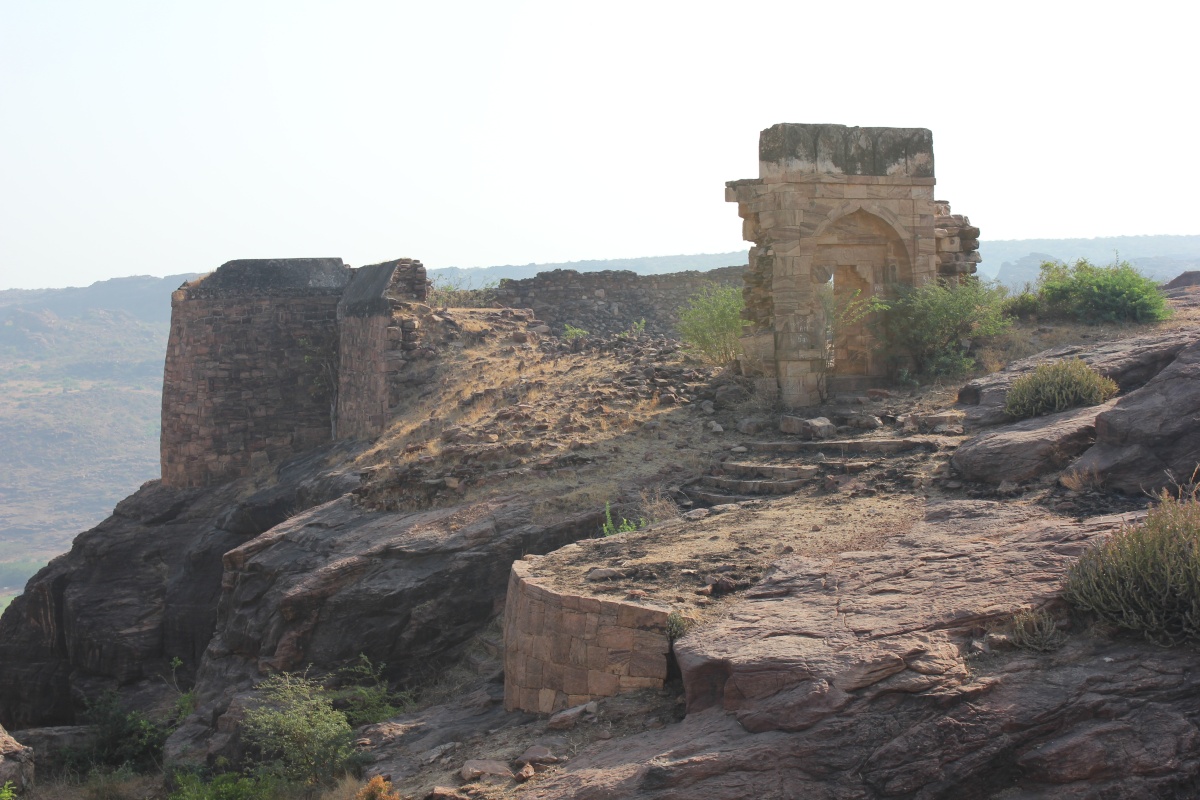
The walls are well preserved but nothing inside them is left standing. to the left you can ruins... of a small palace?

Looks like a doorway to a royal home.

This part of the fort is built on the edge of a sheer cliff, two or three bastions and walls.

We were done and ready to head down. I asked Avanesh if there's anything else to see. Do you want to see old images? Yes! I imagined seeing some pre-historic paintings. Again, Avanesh lead and I followed. The view from above was great. Sun was bright but the breeze cooled me. 500m further rocks had strange shapes like inverted ice-cream bowls.

During rainy season a stream would be flowing very close where we are now. The stream would dive down the hill and flow into Agastya Threertha. The place would be stunning during rainy season.

Probably the biggest ice-cream bowl.

We must have walked a kilometer to reach this little cave temple with a neat row of standing figures, an inscription in Devanagari script, a pond of it's own and a small room. I asked for the name, Avanesh told and I forgot to make a note of it... some Theertha. PS- this place is called Arali Theerta.

Part of the pond. Water was pretty clean but plastic a dozen bags floated in it.

Row of standing figures.

The largest figure. Is that Suryadeva? If you look below, it looks like a chariot drawn by seven horses.

The inscription in Devanagari.

The place is great, one can sit and mediate without anyone to disturb.
We
had go back, Praveen and Suresh Mama did not want to join me in the
climb, they were waiting at the car park. And we had to go to Aihole, I
wanted to spend few hours this time... last time it was a rush, hardly
saw anything. We head back towards the fort.
White building standing on the horizon are ruins of Badami Sugar Factory.

The climb down was not very difficult... only I had to choose firm stones to step on. Back at our tricky bend, I managed in one go. It was easier in this direction. I felt good. Finally I did see the fort. Thanks to Avanesh. We did get along fine :) There he is.

Later in the day, at Aihole, I learn about pre-historic rock paintings around Badami. I want to come back one day, get someone who's seen them and see them. Hope the day comes soon.
We head towards Banashankari.
.........रंगनाथ गुड्डा – बदामी मे प्रागैतिहासिक रॉक आर्ट

बादामी केरऽ संबंध प्रारंभिक चालुक्य स॑ एतना भारी छै कि ई बात क॑ बिसरना बहुत आसान छै कि ई असाधारण लाल बलुआ पत्थर केरऽ पहाड़ी के बीच मानवीय गतिविधि वातापी केरऽ राजराजधानी बनला स॑ हजारों साल पहलें शुरू होय गेलऽ छेलै । चट्टानऽ में मंदिरऽ के खुदाई स॑ बहुत पहलें, ओकरऽ सतहऽ में शिलालेख काटलऽ जाय आरू अगस्त्य झील के आसपास तीर्थ के निर्माण होय स॑ बहुत पहलें ही लोगऽ न॑ पहल॑ स॑ ही ई परिदृश्य के प्राकृतिक आश्रय के उपयोग करी रहलऽ छेलै आरू अपनऽ आरू अपनऽ आसपास के जानवरऽ के छवि चट्टान प॑ छोड़ी रहलऽ छेलै ।
एहि बहुत पहिने के बादामी सं एकटा उल्लेखनीय बचल चीज अछि रंगनाथ गुड्डा में, जे शहर के दक्षिण-पूर्वी बाहरी इलाका में श्री गुड्डे रंगनाथस्वामी मंदिर के नजदीक अछि.
ई एकटा असाधारण स्थान अछि। बलुआ पत्थर केरऽ अपेक्षाकृत छोटऽ क्षेत्र में पसरलऽ दर्जनों लाल-ओचर केरऽ आकृति छै : लम्बा मनुष्य, जंगली सुअर, एक गौर, अज्ञात जानवर, लघु लोक, जिज्ञासु नाचतें या मुड़लऽ आकृति आरू जे कि संपत्ति स॑ घिरलऽ आश्रय के भीतर पड़लऽ व्यक्ति केरऽ प्रतीत होय छै । किछु आब चट्टान पर भूत सँ कनि बेसी अछि, मुदा दुनू मिलिकय उत्तरी कर्नाटक केर सबसँ पेचीदा प्रागैतिहासिक चित्रित रचना मे सँ एक बनैत अछि |
रॉक कला के खोज
रंगनाथ गुड्डा बदामी सँ मोटा-मोटी १ किमी दक्षिण-पूर्व, बादामी–बनाशंकारी सड़कक नजदीक अछि । लक्ष्य के स्थलचिह्न श्री गुड्डे रंगनाथस्वामी मंदिर अछि |


दाहिना : पटरी मंदिर दिस बढ़ैत अछि, मंदिरक समीप एकटा तेज बामा मोड़ पर पहुँचला पर एहि बाट पर जे दक्षिण-पूर्व दिस वनस्पति में जाइत अछि
अतः मंदिर स्वयं चित्र सब के खोजय के प्रयास करय वाला के लेल सबस आसान संदर्भ बिंदु अछि. जेना-जेना पटरी मंदिर के नजदीक आबै छै ई चौड़ा सीढ़ी के श्रृंखला बनी जाय छै, जे भवन में पहुँचै स॑ ठीक पहिलें बायां तरफ तेज झुकी जाय छै । एतय नीचा देबाल पर चढ़ि दक्षिण-पूर्व दिस जायबला बाट पर चलू.
एतय सं कोनो सुस्थापित बाट नहिं छैक, तें, सब सं नीक तरीका बस, मोटा-मोटी एकहि स्तर पर बनल रहब आ सोझे आगू बढ़ब, चट्टानक चेहरा कें लगातार बामा कात राखब. जमीन ठाम-ठाम कनेक खुरदुरा होइत छैक, मुदा जा धरि ढलान सं नीचा खसबा सं बचब आ चट्टानक आधार सं दक्षिण-पूर्व आ पूब दिस बढ़ब ता धरि चट्टानक आश्रय दिस सही रेखा पर रहबाक चाही.
बदामी के गुफा मंदिर के तरीका में ई कोनो विकसित पुरातात्विक आकर्षण नै छै। एहि ठाम कोनो टिकट ऑफिस, व्याख्या केंद्र वा सुविधाजनक स्थान पर कोनो बोर्ड नहिं अछि जाहि सं ई बुझना जाय जे अहाँक ऊपर कोनो महत्वपूर्ण प्रागैतिहासिक चित्रित आश्रय स्थल अछि.
सेटिंग महत्वपूर्ण छै, कैन्हेंकि पेंटिंग बेतरतीब ढंग स॑ उजागर चट्टान केरऽ चेहरा प॑ नै होय छै । ई सब आसपास के जमीन स॑ ऊँचऽ पर्याप्त प्राकृतिक आश्रय स्थल प॑ बैठै छै । पुरातात्विक सर्वेक्षणऽ म॑ ई स्थल समुद्र तल स॑ लगभग ६२० मीटर, प्राकृतिक जमीनी स्तर स॑ लगभग ९० मीटर ऊपर, आरू आश्रय दक्षिण-पूर्व के तरफ दर्ज करलऽ गेलऽ छै । चट्टान केरऽ द्रव्यमान केरऽ नाप खुद लगभग १५ × १३.५ × १२ मीटर छै ।

मंदिर के पास तीन झरना भी छै, जेकरा स॑ आश्रय स्थल स॑ मात्र लगभग १०० मीटर दूर प्राकृतिक जल स्रोत छै । एहि परिदृश्य मे घुमैत प्रागैतिहासिक समुदाय लेल जल, आश्रय, दृश्यता आ पशु संसाधन क संयोजन एहि स्थान कए आकर्षक बना दैत ।
आश्रय स्थल पर आबि गेलाक बाद शुरू मे स्वयं पेंटिंग खोजब आश्चर्यजनक रूप सं कठिन भ सकैत अछि. आँखि केँ एडजस्ट करबाक समय दियौक। एक बेर पहिल ओचरक आकृति स्पष्ट भ गेलाक बाद धीरे-धीरे दोसरो आकृति चट्टान सं निकलय लगैत अछि.

चित्रित पैनल
ई दक्षिण भारत केरऽ सबसें जटिल मेसोलिथिक रॉक आर्ट रचना के प्रतिनिधित्व करै छै ।
मुख्य संरचना लगभग 3.64 मीटर चौड़ा आ 2.46 मीटर ऊँच क्षेत्र पर छै आ आश्रय स्थल कें वर्तमान मंजिल सं लगभग 3.5 मीटर ऊपर स्थित छै. संभावना लगै छै कि जब॑ ई पेंटिंग सब बनलऽ छेलै त॑ फर्श केरऽ स्तर काफी अधिक छेलै, जेकरा म॑ बाद म॑ वू सामग्री केरऽ बहुत हिस्सा क्षीण होय गेलऽ छेलै या ढहला के माध्यम स॑ हेरा गेलऽ छेलै । विरोधाभासी बात ई छै कि ई मूल मंजिल के गायब होय के कारण पेंटिंग के संरक्षण में मदद मिललऽ होतै । आब जमीनी स्तर सं काफी ऊपर स्थित ई सब बहुत हद तक मानव आ जानवर दुनू के हस्तक्षेप के पहुंच सं बाहर अछि. एक हद तक छवि के सुरक्षा भी धूसर-पारदर्शी प्राकृतिक पैटीना स॑ करलऽ गेलऽ छै, लेकिन ई स॑ पेंटिंग बहुत फीका होय जाय छै आरू शुरू म॑ देखना मुश्किल होय जाय छै ।
प्रकाशित अध्ययनऽ म॑ ६९ व्यक्तिगत छवि रिकॉर्ड करलऽ गेलऽ छै, जेकरा म॑ मनुष्य, जानवर, ज्यामितीय रूप आरू लघु आकृति शामिल छै । एहि मे 21टा मानव आकृति आ बारहटा जंगली सुअर, संगहि एकटा गौर, तीनटा हिरण, छहटा अज्ञात जानवर आ विभिन्न डिजाइन सेहो अछि।


संशोधित संस्करण मूल रूप से इरविन न्यूमेयर एंड आर.मोहाना द्वारा निर्मित
बड़े प्रारूप में देखने के लिए छवि पर क्लिक करें |
प्रधान पिगमेंट लाल ओचर छै, जे पूरा मालाप्रभा बेसिन में बहुत रास प्रागैतिहासिक चित्रचित्र के विशेषता छै ।
एहि मे सँ कोनो बातक व्याख्या करबाक प्रयास करबा सँ पहिने एकटा महत्वपूर्ण चेतावनी अछि । ई सब प्रागैतिहासिक बिम्ब अछि जकर संगक ग्रंथ नहि अछि । एकर पाछूक नाम, कथा वा मान्यता हमरा लोकनि केँ नहि बुझल अछि। “शिकारी”, “नर्तकी” वा “कुटी” सन प्रत्यक्षतः सोझ पहचान मे सेहो व्याख्या शामिल अछि |
अतः जे किछु आगू अछि ताहि मे पहिने जे चित्रित बुझाइत अछि ओकर वर्णन कयल गेल अछि आ फेर जतय उचित हो ताहि पर विचार कयल जाइत अछि जे ओ छवि की प्रतिनिधित्व क' सकैत अछि ।
| छवि | व्याख्या |
|---|---|
| एको | दू टा प्रमुख “बदामी शैली” मानव आकृति मे सँ एक, जकर विशेषता अछि एकटा अत्यंत लम्बा धड़, पैघ आँखि आ विस्तृत माथ | |
| ख | एकटा प्रमुख आकृतिक टांगक नीचाँ स्थित दू टा जंगली सुअर |
| ग | दोसर प्रधान बदामी शैलीक मानव आकृति; एक संग a/c पैघ पुरुष/स्त्री आकृति प्रतीत होइत अछि | |
| घ | संभवतः छोटका आदमी आगू झुकि गेल, प्रत्यक्षतः जमीन छूबाक प्रयास क' रहल छल |
| ई | एकटा सिरहीन मानव आकृति |
| च | संभवतः लम्बा मनुक्ख जेकरा मोटगर, दाढ़ीबला, आगू झुकल आ लाठी ल' क' चलैत वर्णित कयल गेल अछि |
| छ | संभावित रूप स एकटा बुना तीर पाउच आ चटाई (?) |
| ज | बहुत ऊँच तना आ ऊँच गर्दन वाला छोट-छोट मानव आकृति के जोड़ी |
| हम | छोट-छोट रूपरेखाबला जानवर जकर माथ पाछू घुमाओल गेल अछि |
| जे | अज्ञात प्राणी |
| के | दौड़ैत मनुक्ख, हाथ कनेक उठौने आगू झुकल; जेना जिज्ञासु प्राणी द्वारा पीछा कयल जा रहल हो |
| एल | छोट-छोट लाठी सन मनुक्ख, कनेक दहिना दिस झुकल |
| म | जानवर, लगभग निश्चित रूप स जंगली सुअर |
| पुं० [सं०] १ | केन्द्रीय समूह से संबंधित मानव आकृति |
| ओ | एकटा आओर छोट जानवर, संभवतः जंगली सुअर |
| पृष्ठ 10 | केन्द्रीय समूह में मानव आकृति |
| प्र | लम्बा मानव आकृति (आकृति) 1.1. |
| आर | छोट-छोट, अस्पष्ट मोटिफ |
| स | घुमावदार या “S” आकार के आकृति के समूह में मानव | |
| टी | एक ही एस आकार के समूह में मानव |
| उ | बड़का जानवर के नीचा मानव आकृति |
| वि.वि | बामा दिस बढ़ैत पैघ अज्ञात जानवर |
| डब्लू | पैघ आकृतिक बीच/बीच छोट-छोट मानव, शायद प्रतीत होइत “खेल” वा हाथ पकड़ने दृश्य मे शामिल आकृति | |
| एक्स | छोट मानव/लघु आकृति |
| वाई | चारि टा छोट-छोट मनुक्खक आकृति शायदे देखबा मे अबैत अछि, तीन टा लाठीक आकृति हाथ पकड़ने बुझाइत अछि |
| z | छोट-छोट मनुक्खक पंक्तिक ठीक ऊपर जंगली सुअर |
| za | गौर ( Bos gaurus ) २. |
| zb | गौर के पीछे सिल्हूट में दिखाया मानव |
| zc | गौर के नीचे अज्ञात डिजाइन |
| zd | छह जंगली सुअरक समूह/झुंड |
| ज़े | जे कुटी बुझाइत अछि ओकर भीतर सुपाइन पड़ल मनुक्ख, दू टा पात्र आ अन्य सामानक संग |
| zf | बहुत छोट/लघु मोटिफ के समूह |
| zg | मृग, “बदामी शैली” मानव आकृति, आ अज्ञात जानवर |
| zh | दू टा छोट-छोट जानवर, संभवतः कछुआ |
असाधारण “बादमी-शैली” के लोग
सबसँ तत्काल हड़ताली आंकड़ा अछि ( क ) आ ( ग ) ।

ई सब एगो विशिष्ट क्षेत्रीय सम्मेलन स॑ संबंधित छै जेकरा शोधकर्ता न॑ “मानव आकृति केरऽ बदामी शैली” कहल॑ छै, जेकरऽ उदाहरण क॑ मालाप्रभा बेसिन म॑ हमसनूर आरू हिरे गुड्डा सहित अन्य जगहऽ प॑ भी पहचानलऽ गेलऽ छै ।
ई सभ पारंपरिक लाठीक आकृतिसँ भिन्न अछि । एकरऽ सबसें उल्लेखनीय विशेषता छै असाधारण रूप स॑ लम्बा धड़ । शरीर लंबवत खिंचल देखाइत अछि जखन कि माथ आश्चर्यजनक रूप सँ व्यक्तिगत विशेषता बरकरार रखैत अछि । उल्लू सन आँखि के प्रमुखता सॅं प्रतिनिधित्व कयल गेल अछि, केश के भेद कयल जा सकैत अछि आ एकटा आकृति मे दाढ़ी बुझाइत अछि ।


चित्र ( ग ) महिला प्रतीत होइत अछि, जकर स्तन संकेत कयल गेल अछि आ एकटा अत्यंत लम्बा, धीरे-धीरे घुमावदार तना । एक टांगक ठीक नीचाँ दू टा जंगली सुअर (ख) अछि ।

पड़ोसी आकृति ( क ) के व्याख्या पुरुष के रूप में कयल गेल अछि आ रचना में सबसँ लंबा मनुक्ख अछि | चेहरा के केश के प्रतिनिधित्व करलऽ गेलऽ प्रतीत होय छै, जबकि स्ट्रोक आरू लहरदार रेखा शरीर के कुछ हिस्सा क॑ सजाबै छै या भर॑ छै ।
ई निशान शरीर केरऽ सजावट, कपड़ा, छलावरण या खाली कलात्मक रूढ़ि के प्रतिनिधित्व करै छै कि नै, ई स्थापित करना असंभव छै ।
एकटा पेचीदा सुझाव ई छै कि अतिरंजित मानव रूप कोनो तरह के शिकार के वेश या छलावरण के प्रतिनिधित्व करी सकै छै, जेकरऽ उद्देश्य शायद या त॑ शिकारी क॑ छिपाबै के छै या जानवरऽ क॑ डराबै के । जंगली सुअर केरऽ ई विचित्र मनुष्य केरऽ बार-बार निकटता एकरा शिकार स॑ जोड़ै के कुछ समर्थन दै छै, हालांकि छलावरण केरऽ व्याख्या अनुमानित छै ।
आन लम्बा लोक एहि आभास केँ पुष्ट करैत छथि जे हमरा लोकनि केँ मात्र असामान्य अनुपात मे रेखाचित्र नहि अपितु एकटा जानि-बुझि क' कलात्मक रूढ़ि देखबा मे आबि रहल अछि ।
चित्र ( च ) एकटा मोटगर, दाढ़ीबला व्यक्ति आगू झुकल आ प्रत्यक्षतः लाठी ल' क' चलैत देखाइत अछि ।

पास केरऽ ( g ) क॑ अस्थायी रूप स॑ बुनाईलऽ तीर केरऽ पाउच आरू चटाई के रूप म॑ व्याख्या करलऽ गेलऽ छै, हालांकि एकरऽ सटीक कार्य अनिश्चित छै ।

आकृति ( h ) अत्यंत ऊँच तना आ लम्बा गर्दन वाला लोकक एकटा आओर जोड़ी बनबैत अछि |

ई सब मिल क॑ ई सुझाव दै छै कि जे भी रंगनाथ गुड्डा के चित्र बनैलकै, ओकरा पास मानव शरीर के प्रतिनिधित्व करै लेली एगो पहचानऽ योग्य दृश्य भाषा छेलै ।
गति, खोज एवं अंतःक्रिया
आन आकृति बहुत बेसी एनिमेटेड देखाइत अछि।
छवि ( घ ) एकटा छोट व्यक्ति अछि जे नाटकीय रूपसँ आगू झुकल अछि , जे प्रत्यक्षतः जमीनकेँ छूबाक प्रयास कए रहल अछि ।

लगमे ( ई ) एकटा आओर मनुक्ख अछि जकर माथ आब गायब अछि ।

आकृति ( i–k ) पैनल पर सबसँ पेचीदा छोट-छोट प्रकरण मे सँ एक बनबैत अछि ।
( i ) पर एकटा छोट सन रेखांकित जानवर अछि जे पाछू दिस तकैत अछि । एकरऽ नीचें ( j ), एगो विचित्र प्राणी छै जेकरऽ पहचान शोधकर्ता सिनी न॑ आत्मविश्वास स॑ नै कर॑ सकलऽ छै । तत्काल सटल, ( क ) आगू दौड़ैत, कमर पर देह झुकल आ बाँहि कनेक ऊपर उठल व्यक्ति प्रतीत होइत अछि |

एक साथ देखला पर ई सब पीछा करै के आभास पैदा करै छै: अज्ञात जीव स॑ भागै वाला मनुष्य ।
वास्तव में चित्रकार के मंशा से छेलै कि नै, ई त॑ पता नै छै, लेकिन प्लेसमेंट आरू मुद्रा एतना सुझाव दै छै कि दोनों के बीच कुछ संबंध के संभावना प्रतीत होय छै ।
आन ठाम बिम्ब लगभग सामाजिक भ' जाइत अछि । चित्र ( l ) एक छोटऽ लाठी जैसनऽ व्यक्ति छै जे कनी दाहिना तरफ झुकलऽ छै, जबकि ( m–q ) म॑ पैनल केरऽ केंद्रीय भाग प॑ कब्जा करै वाला आरू मनुष्य आरू जानवर शामिल छै । कतेको लोक लम्बा अछि, यद्यपि ऊपरक पैघ-पैघ आकृति सभसँ कम स्मारकीय अछि ।

( s ) आरू ( t ) पर नाटकीय रूप स॑ घुमावदार या S आकार के शरीर वाला मनुष्य प्रकट होय छै । एहि सब के व्याख्या लोक नृत्य मुद्रा अपनाबय के रूप में कयल गेल अछि |

जे लोभनीय अछि। हुनकऽ अतिरंजित वक्रता निश्चित रूप स॑ स्थिर खड़ा होय के बजाय गति के संकेत दै छै । मुदा ओ सभ नाचैत छथि, कोनो संस्कार मे भाग ल' रहल छथि, खेलाइत छथि वा मात्र कोनो अपरिचित कलात्मक सम्मेलन मे प्रतिनिधित्व क' रहल छथि से आब निर्धारित नहि भ' सकैत अछि ।
इएह बात ( w ) पर सेहो लागू होइत अछि, जे अन्य आकृतिक बीच ओहि मे ठाढ़ अछि जे हाथ जोड़ल गेल अंतःक्रिया बुझाइत अछि ।
एकटा प्रागैतिहासिक समुदाय ?
शायद सबसँ तत्काल मानवीय छोट रचना ( y ) अछि ।
एतय चारि टा छोट-छोट लोक एक संग ठाढ़ अछि। पहिलऽ म॑ चेहरा केरऽ विशेषता अधिक विकसित छै, जबकि बाकी तीन म॑ बहुत सरल स्टिक फिगर छै । सबसँ हड़ताली बात ई जे दुनू हाथ पकड़ने देखाइत अछि । पैनल केरऽ ई हिस्सा जमीन प॑ आरू कैमरा केरऽ जूम लेंस के साथ दोनों जगह देखना मुश्किल छै ।

हुनका लोकनिक ठीक ऊपर जंगली सुअर (z) अछि ।
मनुष्य आरू जानवर केरऽ ई बराबरी पूरा रंगनाथ गुड्डा म॑ बार-बार होय छै आरू पैनल क॑ समझै के कुंजी म॑ स॑ एक होय सकै छै । अलग-थलग चित्र के बजाय, बहुत सारा बिम्ब संबंधऽ स॑ संबंधित लगै छै: मनुष्य मनुष्य के साथ, मनुष्य जानवर के साथ, आरू समूह म॑ जमा जानवर ।
चारो जोड़ल आकृति नृत्य, संस्कार गतिविधि, सांप्रदायिक क्रिया वा किछु कहीं बेसी सांसारिक चीजक प्रतिनिधित्व क' सकैत छल । हम सब बस एतबे नहि जानि सकैत छी। लेकिन ई सब प्रागैतिहासिक लोगऽ के एक प्रलोभनकारी झलक दै छै जे खुद क॑ खाली एकांत शिकारी के रूप म॑ नै बल्कि समूह के सदस्य के रूप म॑ चित्रित करै छै ।
गौर, शिकारी आ जंगली सुअर
एकरऽ सबसें स्पष्ट जानवरऽ म॑ स॑ एगो छै ( za ), जेकरऽ पहचान गौर ( Bos gaurus ) के रूप म॑ करलऽ जाय छै , जे आज भी भारत केरऽ कुछ हिस्सा म॑ मिलै वाला विशाल जंगली गोजातीय छै ।
एकरऽ पाछू ( zb ), एक मनुष्य जेकरऽ प्रतिनिधित्व बहुत हद तक सिल्हूट में करलऽ गेलऽ छै, जबकि जानवर के नीचें अज्ञात डिजाइन ( zc ) छै ।

बराबर-बराबर पुनः शिकारक बिम्बक संभावना उठबैत अछि, यद्यपि मात्र निकटता ई सिद्ध नहि करैत अछि जे व्यक्ति गौरक शिकार क' रहल अछि ।
कहीं बेसी नाटकीय अछि ( zd ).

एतय छह सँ कम जंगली सुअर एक संग नहि होइत अछि । हुनका सब के “आक्रामक रूप” के रूप में वर्णित करलऽ गेलऽ छै, आरू ई सब पूरा रचना में सबसें यादगार समूह में से एक के निर्माण करै छै ।
रंगनाथ गुड्डा मे पशु रेपर्टरी मे जंगली सुअरक बोलबाला अछि । पैनल भर म॑ बारह रिकॉर्ड करलऽ गेलऽ छै, जेकरा म॑ ( ख ) , ( m ) , ( o ) , ( z ) आरू ( zd ) शामिल छै ।
ई आवृत्ति आकस्मिक हेबाक संभावना कम अछि । प्रागैतिहासिक शिकारी लेल जंगली सुअर भयंकर जानवर होइत। घायल वयस्क सुअर अत्यंत खतरनाक होइत अछि, आ एकर सफलतापूर्वक शिकार करबा लेल काफी कौशल आ सहयोगक आवश्यकता होइत छल । अतः मनुष्य आरू सुअर केरऽ बार-बार संयोजन शिकार गतिविधि के प्रतिबिंबित करी सकै छै, लेकिन जानवर भी समान रूप स॑ सामाजिक, प्रतीकात्मक या संस्कारात्मक महत्व के वाहक होय सकै छेलै जे अब॑ बरामद नै होय सकै छै ।
पेंटिंग सब जे जरूर दर्शाबैत अछि ओ ई जे एहि पैनल के जिम्मेदार लोक के दृश्य दुनिया के भीतर सूअर के एकटा महत्वपूर्ण स्थान छल.
झोपड़ी के अंदर के व्यक्ति
हमरा लेल एकटा सबसँ आकर्षक छवि अछि ( ze ).

आन ठामक ऊर्जावान मनुक्ख आ जानवरक विपरीत ई रचना शांत आ लगभग घरेलू बुझाइत अछि ।
मनुष्य कुटी या आश्रय के रूप में व्याख्या करलऽ जाय वाला बाड़े के भीतर सुपाइन पड़लऽ रहै छै । व्यक्ति के चारू कात दू टा पात्र आ अन्य वस्तु या सामान देखाइत अछि | जँ व्याख्या सही अछि तँ ई असाधारण रूपसँ उकसाहट भरल छवि अछि । शिकार वा साम्प्रदायिक गतिविधिक बदला हमरा लोकनि एकटा आंतरिक भाग देखि रहल होयब : कोनो व्यक्ति आराम करैत अछि वा सम्पत्तिक बीच सुतल अछि ।
आओर संभावना अछि। की झुकल आकृति बीमारीक प्रतिनिधित्व क' सकैत अछि? मृत्यु? दफन करब ? घरेलू झोपड़ी स बेसी संस्कार संरचना? बिना संदर्भ प्रमाण के निर्णय लेबय के कोनो तरीका नहिं.
एकरऽ बावजूद, प्रतीत होय वाला बाड़े आरू ओकरा स॑ जुड़लऽ वस्तु एकरा रंगनाथ गुड्डा केरऽ दुर्लभ दृश्य म॑ स॑ एक बनाबै छै जे संभावित रूप स॑ हमरा जानवर आरू शिकार केरऽ दुनिया स॑ दूर करी क॑ प्रागैतिहासिक जीवन केरऽ अधिक अंतरंग क्षेत्र म॑ ल॑ जाय छै ।
पास में अतिरिक्त लघु मोटिफ ( zf–zh ) छै, कुछ बहुत अस्पष्ट छै जेकरा आत्मविश्वास सें पहचान नै करलऽ जाब॑ सकै छै, लेकिन एकरा में एगो आरू “बदामी शैली” के मानव आकृति आरू एक हिरण शामिल छै ।

पैनल के की मतलब छै?
शोधकर्ता सब के सुझाव छै कि अधिकांश मुख्य आकृति मोटा-मोटी एक ही कलात्मक परंपरा के छै आरू मनुष्य आरू जंगली सुअर के बार-बार जुड़ाव कोनो तरह के शिकार गतिविधि के प्रतिनिधित्व करी सकै छै । ओ व्याख्या निश्चित रूप स व्यावहारिक अछि। हमरा सब लग जानवर, मनुष्य के समूह, प्रतीत होबय वाला गति आ पीछा, संभावित उपकरण आ खतरनाक खेल के बेर-बेर प्रतिनिधित्व अछि.
मुदा पूरा पैनल के एकटा साधारण सचित्र शिकार के दृश्य में घटा देल जाय त शायद गलती होयत. लोक सभ प्रत्यक्षतः हाथ पकड़ने छथि, आ किछु गोटे जेना नाचैत छथि । जे कोनो संरचना बुझाइत अछि ओकर भीतर पुरुष आ स्त्री आकृति, लघु लोक, अस्पष्ट जीव, ज्यामितीय डिजाइन आ असाधारण झुकल आकृति अछि ।
तेँ रंगनाथ गुड्डा प्रागैतिहासिक जीवनक अनेक पक्षसँ जुड़ल बिम्बक संरक्षण कऽ सकैत छथि : शिकार , समूह पहिचान , कथा कहब , संस्कार , स्मृति आ शायद घरेलू अनुभव ।
आ ने ई मानि सकैत छी जे हर छवि एकहि संग चित्रित भेल छल । समान शैली आ पिगमेंट व्यापक समकालीनता के संकेत द सकैत अछि बिना ई प्रदर्शित केने जे सब 69 आकृति एकटा योजनाबद्ध रचना के निर्माण केलक । सचमुच, समय के संग पैनल जमा भ गेल होयत। एक व्यक्ति कोनो विद्यमान मानव आकृतिक बगल मे कोनो जानवर केँ जोड़ि सकैत छल; दोसर सालों-पीढ़ी बाद लोकक समूह जोड़ि सकैत छल। जे आइ हमरा लोकनि केँ एकटा रचनाक रूप मे बुझाइत अछि से कहियो एकटा निरंतर विकसित सतह छल, जे बेर-बेर एहि आश्रय स्थल पर वापस आबि गेल समुदायक लेल सार्थक छल ।

चित्र कतेक पुरान अछि ?
मुख्य चित्र सब के सामान्यतः ऊपरी पुरापाषाण–मेसोलिथिक कलात्मक परंपरा के कारण मानल गेल अछि, आ फलस्वरूप कखनो काल बदामी के आसपास के रॉक आर्ट के लेल बहुत प्रारंभिक तिथि प्रस्तावित कयल गेल अछि |
एहन दावा मे सावधानी बरतबाक जरूरत अछि। रंगनाथ गुड्डा मे व्यक्तिगत चित्रक लेल वर्तमान मे कोनो सुरक्षित प्रत्यक्ष निरपेक्ष तिथि नहि अछि । शैली, विषय, मौसम, सुपरइम्पोजिशन आरू पुरातात्विक सामग्री के साथ तुलना स॑ रॉक आर्ट के समय निर्धारण व्यापक कालक्रम के संबंध स्थापित करी सकै छै, लेकिन ई सुरक्षित रूप स॑ जुड़लऽ सामग्री स॑ सीधा प्राप्त रेडियोकार्बन तिथि के परिशुद्धता नै प्रदान करी सकै छै ।
अतः सब सं सुरक्षित वर्णन ई छै कि ई प्रागैतिहासिक चित्र छै, जेकरा शोधकर्ता सिनी न॑ एक प्रारंभिक शिकारी-संग्राहक रॉक-कला परंपरा के कारण मानलकै आरू संभावित रूप स॑ ई मेसोलिथिक या ओकरा स॑ पहल॑ के समय म॑ भी फैललऽ छै । एहि सँ हुनका लोकनिक तिथि १०,००० ई.पू.सँ ४,००० ई.पू.
हुनकऽ सटीक उम्र चाहे जे भी होय, ई सब स्पष्ट रूप स॑ एगो सांस्कृतिक परिदृश्य स॑ संबंधित छै जे स्मारकीय वास्तुकला स॑ बहुत बड़ऽ अंतर स॑ पूर्व के छै, जेकरा स॑ अब॑ बदामी जुड़लऽ छै ।

एकटा बहुत पैघ प्रागैतिहासिक परिदृश्य
रंगनाथ गुड्डा सेहो अलग-थलग नहि देखबाक चाही। मालप्रभा बेसिन केरऽ पूरा ऐहोले–बदामी–कुटकानाकेरी क्षेत्र म॑ शोध स॑ कम स॑ कम ३४ शैल-कला स्थल के पहचान करलऽ गेलऽ छै, जेकरा म॑ लगभग ८९ व्यक्तिगत चित्रित या उत्कीर्ण स्थानीयता शामिल छै जेकरा म॑ चित्रचित्र, पेट्रोग्लिफ, क्यूप्यूल, जानवर, ज्यामितीय रूप आरू मानव आकृति शामिल छै ।

संशोधित संस्करण मूल रूप से आर.मोहाना द्वारा प्रकाशित
| निर्माण स्थल | संहिता | अनुमानित क्षेत्रफल | नोट्स |
|---|---|---|---|
| गुगलडी | जीएलडी | मुष्टिगेरी/कराडिगुड्डा के पास | चित्रकला, खास क' एकटा पैघ जंगली सुअर आ मनुक्खक आकृति |
| पिललुन्दु | पीएलजी | करादिगुड्डा के 3km पूर्वोत्तर | कतेको रंगल आश्रय स्थल; जानवर मे हिरण, एंटीलोप, सूअर, बकरी शामिल अछि। |
| तय्यव्व फदी | टाइप | बदामी के पश्चिम में कराडिगुड्डा क्षेत्र | कराडिगुड्डा समूह सं संबंधित रॉक-आर्ट आश्रय; गामक चारूकातक तीनटा स्थल मे सँ एक। |
| रामदेवरुगुण्डु | आरडीजी | करादिगुड्डा क्षेत्र | चित्रचित्र, तलवार & ढाल के साथ एक योद्धा सहित | बदामी चालुक्य शिलालेख लग मे। |
| रंगनाथ गुड्डा–तमिनहल | आरजीटी | बदामी/तमिनहल क्षेत्र | चित्रित रॉक-आर्ट साइट; रंगनाथ गुड्डा समूह से जुड़े। |
| रंगनाथ गुड्डा–बदामी | आरजीबी | बदामी के 1km SE | मानव आ जंगली-पशु आकृतिक संग प्रमुख चित्रित आश्रय। |
| होरगिना दुर्गम्मा गुड़ी | एचडीजी | बादामी, होरगिना दुर्गम मंदिर के सामने | जंगली सुअर आ एकटा नमहर गर्दन बला जानवर सहित चित्रचित्र। |
| बदामी | बीडीएम | बदामी शहर आ आसपासक बलुआ पत्थरक पहाड़ी | चित्र, क्यूप्यूल आ पेट्रोग्लिफ; बाद के सामग्री के साथ-साथ प्रागैतिहासिक पशु बिम्ब। |
| ताताकोटी | टीकेटी | बदामी के 1km पूर्वोत्तर | लाल आ उज्जर चित्र, क्यूप्यूल, उत्कीर्ण आ चित्रित ज्यामितीय डिजाइन, विषमकोण, मानव आकृति आ ऐतिहासिक-काल के बिम्ब | |
| बदामी एएसआई संग्रहालय परिसर | बीडीएमएम | बदामी स्थित एएसआई संग्रहालय के आसपास | पेट्रोग्लिफ, क्यूप्यूल आ उज्जर चित्रचित्र आसपास के गॉर्ज आ चट्टान के सतह में भेटैत अछि । |
| बदामी पूर्वोत्तर पहाड़ी | बीडीएमएच | बदामी के पूर्वोत्तर | प्रागैतिहासिक बिम्ब आ बादक प्रारंभिक चालुक्य चित्र सहित महत्वपूर्ण परिसर; कारी/द्वि-क्रोम रंगक सेहो होइत अछि । |
| सिदला फडी | एसडीपी | बदामी क्षेत्र | जानवर सहित चित्रचित्र; एंटीलोप, गौर आ बकरी। सुस्त उज्जर रंगक पिगमेंट होइत अछि। |
| रामथिर्थ | आरटीटी | बादामी–महाकूटा अंचल | जानवर सहित चट्टानी चित्र; सफेद पिगमेंट दर्ज। एक मेगालिथिक परिसर से जुड़े। |
| सिटी डन / सिटिडोन | एसडीएन | बादामी–महाकुटा मार्ग पर बदामी से 3 किमी पूर्वोत्तर | लाल-ओकर पेंटिंग केरऽ विशाल छत पैनल जेकरा पर सुपरइम्पोज जानवर आरू ज्यामितीय डिजाइन छै । तथाकथित “मास्टर सीलिंग”। |
| कन्नरगवी गुड्डा | केजीजी | बदामी के 5 किमी एसई; बनाशंकारी के उत्तर में | पेंटिंग आ चोट लागल उत्कीर्णन; मवेशी आ एकटा मानव आकृति के विशेष रूप स चित्रित कयल गेल अछि | |
| होसा महाकुटा | एचएमटी | महाकुटा/बदामी क्षेत्र | चित्रित चट्टान आश्रय परिसर, बादामी–महाकुटा एकाग्रता का हिस्सा | |
| मंगलुर गुड्डा | एमजीजी | मंगलुरु गामक दक्षिण, मालाप्रभाक दाहिना कात | रंगल आश्रय स्थल; मानव आकृति आ उज्जर चित्रक रिकॉर्डिंग अछि। |
| दोड्डा जोगर फडी | डीजेपी | निचला मालाप्रभा बेसिन | रॉक आर्ट में घोड़ा शामिल छै जेकरा उभरा पूँछ के साथ प्रत्यक्ष रूप से सरपट दौड़तें देखालऽ गेलऽ छै । |
| डब्बकल | डीबीके | निचला मालाप्रभा बेसिन | कोनो विवरण उपलब्ध नहि अछि। |
| हुलिगेम्मा कोल्ला | एचएमके | ऐहोले–बदामी–कुटकानकेरी पट्टी | रोम्बी आ जीव-जन्तु रेपर्टरी सहित चित्रचित्र : हिरण, गौर, हाइना, भेड़िया आ माछ | |
| गुड्डा भाड़ा पर | मानव संसाधन विकास | बदामी एवं पट्टाडाकल/ऐहोले जोन के बीच | प्रागैतिहासिक चित्रित स्थल; विषमकोण, मृग, एंटीलोप, सूअर, गौर, मवेशी, गैंडा आ मगरमच्छ। |
| केन्दुर केरे गोंडी | केकेजी | केन्दुर के 2.5km पूर्वोत्तर; बदामी के 13km पूर्वोत्तर | सात टा आश्रय स्थल, दू टा रंगल; लाल-ओचर हिरण, ज्यामितीय/रोम्बिक बिम्ब आ एकटा “बादामी शैली” के मानव आकृति | |
| सुरगी फडी | एसजीपी | निचला मालाप्रभा बेसिन | उज्जर रंगक सामग्री सहित चित्रचित्र; प्रागैतिहासिक स्थल के बीच सूचीबद्ध। |
| थिम्मप्पा गुड्डा | टीएमजी | कटपुरा क्षेत्र | महत्वपूर्ण प्रागैतिहासिक चित्र, जाहि में रोम्बी आ एकटा विशेष रूप सं प्राकृतिक धब्बेदार हिरण पाछू दिस देखैत अछि ; बाघक बिम्ब सेहो रिकॉर्ड कयल गेल अछि। |
| अरे गुड्डा | एजीडी | बदामी से ९ किमी उत्तर, कुटकानाकेरी के पास | सबसँ समृद्ध परिसर मे सँ एक, जाहि मे अनेक आश्रय स्थल अछि। लाल आ कारी चित्र, विषमकोण, अनेक सुपरइम्पोजिशन, एकटा असामान्य योजनाबद्ध “नक्शा”, हिरण, एंटीलोप, सूअर, बाघ, कछुआ आ मगरमच्छ | |
| हमसनूर | हम्मन | बदामी के 15km SE | लाल ओचर आ क्यूप्यूल वाला दू टा प्रधान रंगल आश्रय स्थल; विषमकोण आ विशेषता “बदामी शैली” मनुष्य होइत अछि, जंगली सुअरक संग | |
| खानापुरा | केएनपी | लोअर मलप्रभा सर्वेक्षण क्षेत्र के पूर्वी/दक्षिण-पूर्वी भाग | | कोनो विवरण उपलब्ध नहि अछि। |
| दोड्डा दमाली | डीडीएम | अम्बिगरा कटगिनाहल्ली के SW / गुलेडगुड्डा के SE | पृथक बोल्डर पहाड़ी / आश्रय परिसर |
| चिक्का दमाली | सीडीएम | दमाली क्षेत्र | अलग-अलग रॉक-आर्ट लोकलटी भौगोलिक रूप स डोड्डा दमाली क संग जोड़ी। |
| हुली फडी | एचपीडी | ऐहोले–कुटकानकेरी बेसिन का भाग | रोम्बिक बिम्ब आ उज्जर चित्रचित्र; जीव-जन्तु मे कूबड़ मवेशी आ एकटा उल्लेखनीय चिड़ै/माछक रचना शामिल अछि । |
| गूली कट्टे | जीएलके | निचला मालाप्रभा बेसिन | कोनो विवरण उपलब्ध नहि अछि। |
| ऐहोले | एएचएल | ऐहोले के 1km SE, जैन गुफा/मिनू बसदी के पास | | कम सं कम चारि टा चट्टानी आश्रय स्थल जाहि पर पेंटिंग आ पेट्रोग्लिफ; स्मारकक आसपास सेहो क्यूपुल होइत अछि । रोम्बी, हिरण एवं अन्य प्रागैतिहासिक बिम्ब। |
| चिचखण्डी / चिंचखण्डी | — 1999। | निचला मालाप्रभा बेसिन | हाल के खोज, मवेशी के छवि रिकॉर्ड कयल गेल अछि. |
| खाजी गुड्डा | — 1999। | निचला मालाप्रभा बेसिन | हालक खोज, आगूक कोनो विवरण उपलब्ध नहि। |
ई एहि लेल महत्वपूर्ण अछि जे एहि मे सँ बहुत रास स्थान बाद मे प्रारंभिक चालुक्य काल मे असाधारण रूप सँ महत्वपूर्ण भ गेल | प्रागैतिहासिक समुदाय द्वारा आश्रय आरू चट्टान कला के लेलऽ उपयोग करलऽ जाय वाला अद्वितीय भूवैज्ञानिक परिदृश्य न॑ अंततः बाद के समाजऽ क॑ उत्खनन योग्य चट्टान, प्रचुर बलुआ पत्थर संसाधन, आरू मंदिर निर्माण लेली नाटकीय दृश्य के साथ सुसज्जित करलकै । स्थानक एकटा उल्लेखनीय निरंतरता अछि ।

बादामी वाटापी बनने से पहले
रंगनाथ गुड्डा बदामी के कालक्रम के परिप्रेक्ष्य के पूर्ण रूप स बदलि दैत छथि । आइ जे स्मारक लगभग सब गोटे घुमैत छथि से बेसी काल प्रारंभिक चालुक्य आ बादक ऐतिहासिक परिदृश्यक अछि | प्रसिद्ध गुफा मंदिर मुख्यतः ई. छठम आ सातवीं शताब्दी के अछि, जखन वाटापी प्रायद्वीपीय भारत के एकटा शक्तिशाली राज्य के केंद्र में ठाढ़ छल |
मुदा बलुआ पाथरक पहाड़ी स्वयं लोकक लेल बहुत बेसी दिनसँ महत्वपूर्ण छल । ऐतिहासिक स्मारक अक्सर शासक, देवता, राजवंश, धार्मिक संस्था आ अभिजात वर्ग के संरक्षण के बारे में बताबैत अछि | रंगनाथ गुड्डा बिना लिखित अभिलेख के दुनिया के छैथ। ई लोकनि के छलाह, कोन भाषा बजैत छलाह, एहि पहाड़ी केँ की कहैत छलाह वा ई लोकनि चित्रित जानवर आ मनुक्खक आकृतिक संग कोन-कोन कथा छल से हमरा लोकनि केँ नहि बुझल अछि ।
शायद ठीक यही कारण छै कि रंगनाथ गुड्डा क॑ एतना मजबूर करलऽ जाय छै । बदामी केरऽ महान चालुक्य स्मारकऽ के बीच समय बिताबै के बाद ई मंद लाल आकृति के सामने खड़ा होय क॑ अतीत के साथ एकदम अलग मुठभेड़ के प्रस्ताव दै छै । एतय अनुवाद करबाक लेल कोनो शिलालेख नहि अछि, कोनो देवताक पहचान नहि अछि आ कोनो वास्तुकला शैली नहि अछि जाहि सँ आरामदायक कालक्रम स्थापित कयल जा सकय |
बलुआ पाथर पर बस लोक, जानवर आ गूढ़ आकृति चित्रित अछि । ई सब एकदम सं एकटा आओर बदामी के नाजुक दृश्य अभिलेख के गठन करैत अछि-एकटा एहन परिदृश्य जे वाटापी के उदय सं हजारों साल पहिने लोक द्वारा आबाद, बुझल आ चित्रित कयल गेल छल.

अगर अहां सभ के ई ब्लॉग पोस्ट नीक लागल त 'लाइक' करि या कमेंट जरूर करिऔ. अगर अहां कोनो नव सामग्री के बारे मे सूचित करय चाहय छी तं बस 'फॉलो' बटन पर क्लिक करि साइन अप करि लिअ. अगर अहां सभ के ई या हमर कोनो दोसर पोस्ट नीक लागल अछि त हमरा एकटा कॉफी खरीदय पर विचार करिऔ. डेस्कटॉप यूजर के लेल एहि वेबसाइट के दाहिना कात, आओर मोबाइल यूजर के लेल कमेंट सेक्शन के ठीक ऊपर एहन करय के सुविधा अछि. अहां कें धन्यवाद !
अगर अहां हमर कोनो फोटोग्राफी या लेख के उपयोग करय चाहय छी त संपर्क करू. हम दुनिया भर में कोनो फ्रीलांस काज के लेल सेहो उपलब्ध छी, हमर डफल बैग हमेशा पैक भ गेल रहैत अछि जे जाय लेल तैयार रहैत अछि...
केविनस्टैंडेज1@जीमेल.कॉम
केविनस्टैंडेजफोटोग्राफी.वर्डप्रेस.कॉम
मल्लिकार्जुन गुडी एवं पल्लव शिलालेख – बादामी

बादामी एहन जगह अछि जतय इतिहास एकदम शाब्दिक रूप स परिदृश्य मे लिखल गेल अछि । मंदिर बलुआ पत्थर के चट्टान पर कब्जा करै छै, अगस्त्य झील के आसपास तीर्थ के समूह छै, आरू तेरह शताब्दी स॑ भी अधिक समय स॑ उजागर चट्टानी चेहरा प॑ शिलालेख जीवित छै । एहि मे सँ एकटा ऐतिहासिक रूप सँ महत्वपूर्ण शिलालेख पुरातात्विक संग्रहालय सँ ठीक सटल अगस्त्य झील केर उत्तरी तट पर एकटा अपेक्षाकृत कम ज्ञात मंदिरक बगल मे भेटत ।
ई मल्लिकार्जुन गुडी अछि, एकटा छोट सन शिव मंदिर जे आइयो सक्रिय पूजा मे बनल अछि |
मंदिर स्वयं अपनऽ वास्तुकला आरू एकरऽ निरंतर धार्मिक उपयोग लेली ध्यान के योग्य छै, लेकिन जे चीज ई विशेष स्थान क॑ विशेष रूप स॑ महत्वपूर्ण बनाबै छै, वू छै एकरऽ ठीक पाछू के प्राकृतिक चट्टान । एतय नरसिंहवर्मन प्रथम महामल्ल सँ जुड़ल एकटा बहुत क्षतिग्रस्त शिलालेख बचल अछि, जे पल्लव राजा जिनकर सेना 7म शताब्दी मे प्रारंभिक चालुक्य लोकनिक विरुद्ध अपन महान युद्धक दौरान वाटापी-वर्तमानक बादमी- पर कब्जा कएने छल |
ई शिलालेख बदामी केरऽ इतिहास केरऽ एगो सबसें नाटकीय प्रकरण स॑ बची गेलऽ छै ।
मल्लिकार्जुन गुड़ी

मल्लिकार्जुन शिव के एक रूप छै, आरू मंदिर के वर्तमान समर्पण के बारे में बहुत कम संदेह होय सकै छै । प्रवेश द्वार के ऊपर प्रमुख रूप स चित्रित कन्नड़ आह्वान श्री मल्लिकार्जुन प्रसन्न अछि, जखन कि एकटा पाथर के भीतर नंदी भवन के प्रमुख अक्ष पर कब्जा क लेने अछि, जे अभयारण्य के भीतर सीधा शिवलिंग के तरफ मुँह केने अछि |
मंदिर क॑ अगस्त्य झील केरऽ उत्तरी तरफ स॑ दूर पूर्व म॑ स्मारकऽ के एगो आरू समूह स॑ भ्रमित नै करलऽ जाय जेकरा ऑनलाइन अक्सर मल्लिकार्जुन समूह कहलऽ जाय छै । एहि भ्रमक परिणामस्वरूप विभिन्न स्मारकक फोटो, तिथि आ वास्तुकला वर्णन बेर-बेर एक संग मिलाओल गेल अछि ।


एतय चर्चा कयल गेल मल्लिकार्जुन गुडी पुरातत्व संग्रहालयक ठीक बगल में सक्रिय रूप सं पूजित तीर्थ थिक, जे बदामीक उत्तरी पहाड़ीक बलुआ पत्थरक ढलान पर टक अछि.
अपेक्षाकृत मामूली अनुपात के बावजूद बाहरी भाग आश्चर्यजनक रूप स विस्तृत अछि । देबाल सब प्रोजेक्शन आ रिसेस के लयबद्ध क्रम में विभाजित छै, जेकरा पतला पिलास्टर जैसनऽ तत्वऽ द्वारा आर्टिक्यूलेट करलऽ गेलऽ छै । एकरऽ बीच बार-बार लघु वास्तुकला केरऽ आकृति छै-तीर्थ आरू मंदिर केरऽ अधिरचना केरऽ छोटऽ-छोटऽ प्रतिनिधित्व ।


एकटा समतल देबाल के सजाबय लेल मात्र मूर्तिकला के उपयोग करय के बजाय कारीगर सब स्वयं देबाल के लघु वास्तुकला के एकटा उत्तराधिकार में बदलि देलखिन्ह. छोट-छोट एडिकुलस केरऽ ई प्रसार मंदिर क॑ काफी अधिक दृश्य जटिलता दै छै, जेतना कि शुरू म॑ एतना निचला भवन स॑ अपेक्षा करलऽ जाब॑ सकै छै ।
आइ मल्लिकार्जुन गुडीक स्वरूप प्रबल आड़ा अछि । समृद्ध आर्टिक्युलेटेड देबाल सबहक ऊपर एकटा प्रोजेक्टिंग कॉर्निस चलैत अछि, जकर ऊपर एकटा पर्याप्त पाथरक पैरापेट अछि । जे स्पष्ट रूप स अनुपस्थित अछि ओ अछि पूर्ण शिखर, ओ अधिरचना जे सामान्यतः गर्भगृह स ऊपर उठत ।


एकटा मूलतः छल वा नहि से स्थापित करब कठिन अछि । मंदिर केरऽ अधिरचना खास करी क॑ ढहना आरू बाद म॑ विघटन के खतरा म॑ छै, आरू मल्लिकार्जुन गुडी केरऽ दीर्घ जीवन के दौरान स्पष्ट रूप स॑ अनेक मरम्मत आरू परिवर्तन करलऽ गेलऽ छै । अतः ई मानना बुद्धिमानी नै होतै कि एकरऽ वर्तमान छत के रेखा एकरऽ मूल रूप के प्रतिनिधित्व करै छै ।
मंदिर के प्रवेश द्वार पर ही बाद के हस्तक्षेप के स्पष्ट प्रमाण भेटैत अछि | दरबज्जाक अधिकांश भाग उज्जर रंगक आ रंगल गेल अछि, जे एकरा चारूकातक मौसमी ओचर बलुआ पत्थरक संग एकर तीव्र विपरीत अछि ।

भीतर परिवर्तन आओर बेसी स्पष्ट अछि। मंडप मे पाथरक पर्याप्त खंभा अछि जकर गोल आ बल्ब सन शाफ्ट क्षैतिज मोल्डिंग सँ विभाजित अछि | दुर्भाग्यवश एहि चिनाई के बहुत हिस्सा के सेहो उज्जर रंग देल गेल अछि, जाहि सं पाथर के मूल रंग आ बनावट अस्पष्ट भ गेल अछि. केंद्र मे नंदी बैसल छथि, झुकल आ अभयारण्य दिस मुँह केने छथि ।

नंदी स॑ परे गर्भाशय केरऽ प्रवेश द्वार प॑ अपेक्षाकृत हाल केरऽ लाल-सफेद भक्ति सजावट मिललऽ छै । छोट-छोट, अन्हार गर्भगृहक भीतर ओ लिंग ठाढ़ अछि जे पूजाक केन्द्र बनल रहैत अछि |


हमर भ्रमणक क्रममे मंडपक भीतर अभयारण्यक मुँहमे उपासक लोकनि बैसल छलाह । संरक्षण के दृष्टिकोण स॑ आधुनिक रंग आरू सफेदी के बारे म॑ जे भी सोचलऽ जाय, ई सब ई बात के स्पष्ट प्रमाण दै छै कि मल्लिकार्जुन गुड़ी खाली पुरातात्विक स्मारक नै छै, ई एगो जीवित मंदिर बनलऽ छै ।
पल्लव शिलालेख
मल्लिकार्जुन गुडी के पाछु के प्राकृतिक चट्टान पर बादामी के एकटा महत्वपूर्ण ऐतिहासिक शिलालेख बचल अछि, जे आब पाथर के छतरी के नीचा संरक्षित अछि |

एकरऽ दस्तावेजीकरण 19 वीं सदी के दौरान अग्रणी एपिग्राफिस्ट जे.एफ.
1940 में जखन ई शिलालेख दक्षिण भारतीय शिलालेख , खंड ग्यारह के नंबर 1 के रूप में पुनः प्रकाशित भेल छल, तखन एकर स्थान के बदला में एहि तरहे वर्णित कयल गेल छल :
“मल्लिकार्जुनादेवक मंदिरक पाछू एकटा चट्टान पर।”
फलस्वरूप ई शिलालेख मल्लिकार्जुन गुडी केरऽ स्थान स॑ सुरक्षित रूप स॑ जुड़लऽ छै, हालांकि प्रारंभिक अभिलेखऽ म॑ बदलतऽ मंदिर केरऽ नाम पेचीदा छै ।
ई शिलालेख पल्लव-ग्रन्थ अक्षर आ संस्कृत मे लिखल गेल अछि | दुर्भाग्यवश तत्वक संपर्क मे आबि एकर पर्याप्त भाग नष्ट भ गेल अछि । जखन ई शिलालेख औपचारिक रूप स प्रकाशित भेल छल तखनो एकर संपादक एकरा “बहुत समाप्त” बतौलनि ।


मुदा, एतेक बचल अछि जे एकर ऐतिहासिक महत्व स्पष्ट भ' सकैत अछि. राजा केरऽ पूरा नाम गायब होय गेलऽ छै, लेकिन एगो महत्वपूर्ण उपनाम बचलऽ छै – महामल्ल — “महान पहलवान” । ई कांचीपुरम के पल्लव के शासक नरसिंहवर्मन प्रथम के प्रसिद्ध उपाधि छल | एहि शिलालेख मे एकटा आओर अत्यंत महत्वपूर्ण शब्द – वातापी – बदामीक प्राचीन नाम सेहो सुरक्षित अछि |
अंत मे ई शिलालेख पल्लव शासकक 13म शासन वर्षक मानल गेल अछि | पुरातत्व आ ऐतिहासिक आधार पर दक्षिण भारतीय शिलालेखक संपादक लोकनि एहि लेल राजाक पहिचान नरसिंहवर्मन प्रथम के रूप मे केलनि आ एहि अभिलेख केँ 7म शताब्दी मे वाटापी पर पल्लव कब्जा सँ जोड़लनि |
एतय जे किछु भेलैक ताहि लेल एहि सँ बेसी उकसाहट भरल प्रमाणक कल्पना करब कठिन अछि । पल्लव राजाक एकटा शिलालेख हुनक सबसँ पैघ दुश्मनक राजधानीक भीतर चट्टान मे उकेरल गेल छल |
शिलालेख एतेक महत्वपूर्ण किएक अछि से बुझबाक लेल हमरा लोकनि केँ वाटापीक प्रारम्भिक चालुक्य आ कांचीपुरमक पल्लव लोकनिक बीच जे पैघ प्रतिद्वंद्विता छल ताहि पर वापस आबय के आवश्यकता अछि |
7वीं शताब्दी के प्रथमार्ध के दौरान चालुक्य राज्य पुलकेशिन द्वितीय के समय में सबसे अधिक विस्तार में पहुँची | पुलकेशिन मध्यकालीन प्रारम्भिक भारतक सबसँ शक्तिशाली शासक मे सँ एक छलाह | हिनक उपलब्धि कवि रविकीर्ति द्वारा ऐहोले स्थित मेगुटी जैन मंदिर मे लिखल शिलालेख मे प्रसिद्ध रूप सँ मनाओल गेल छल , जे 634 ई. के अछि |
पुलकेशिनक शत्रु मे दक्षिण मे पल्लव लोकनि सेहो छलाह | महेन्द्रवर्मन प्रथम के शासनकाल में पल्लव क्षेत्र में सफलतापूर्वक अभियान चलाया, लेकिन महेन्द्रवर्मन के बाद हुनकऽ पुत्र नरसिंहवर्मा प्रथम के बाद राजनीतिक स्थिति में भारी बदलाव आबी गेलै, जे पल्लव के भाग्य के उलट देलकै ।
चालुक्य सेना के एक श्रृंखला के मुठभेड़ में पराजित करला के बाद पल्लव युद्ध के उत्तर दिशा में चालुक्य क्षेत्र में ल गेलै । अन्ततः हुनका लोकनिक सेना स्वयं भयंकर बुझाइत चालुक्य राजधानी मे पहुँचि गेल, आ वातापी खसि पड़ल |
सटीक कालक्रम पर बहुत दिन स चर्चा भ रहल अछि, मुदा कैप्चर के परंपरागत रूप स 642 ई. के आसपास राखल गेल अछि ।
दक्षिण भारतीय शिलालेख ग्यारहवीं के परिचय में क्षतिग्रस्त बदामी शिलालेख के प्रयोग अन्य कालक्रम के साक्ष्य के साथ मिल क पल्लव कब्जा के 638-647 ई. के भीतर रखै के लेल करलऽ गेलऽ छै आरू ई तर्क देलऽ गेलऽ छै कि ई चीनी तीर्थयात्री ज़ुआनजांग के लगभग 639 ई. के पुलकेशिन के राज्य के यात्रा के बाद घटित होय गेलऽ छेलै । बेड़ा करीब 643 स पहिने क तारीख क लेल बहस क चुकल छल।
पुलकेशिन द्वितीय ऐतिहासिक अभिलेख स॑ लगभग ई समय म॑ गायब होय जाय छै आरू सामान्य तौर प॑ ई मानलऽ जाय छै कि ओकरऽ मृत्यु संघर्ष के दौरान होय गेलऽ छेलै ।
चालुक्य लोकनिक लेल वाटापी केँ हारब एकटा असाधारण अपमानक प्रतिनिधित्व करैत हेतनि । ई खाली दोसर शहर नहि छल। वाटापी हुनका लोकनिक राजधानी आ हुनका लोकनिक राज्यक प्रतीकात्मक हृदय छल | नरसिंहवर्मन के लेलऽ एकरऽ विपरीत एकरऽ कब्जा हुनकऽ सैन्य कैरियर के पराकाष्ठा के प्रतिनिधित्व करै छेलै । बाद के पल्लव अभिलेख में वातापी पर हुनकऽ जीत के गौरव सें याद आबी गेलै, आरू ई विजय हुनकऽ प्रतिष्ठा स॑ अविभाज्य होय गेलै ।
एकटा विजयक स्तम्भ ?
क्षतिग्रस्त शिलालेख मे एकटा विशेष प्रलोभनकारी अंश अछि । बचल ग्रन्थ मे स्तम्भ आ जय शब्द प्रतीत होइत अछि, जकर अर्थ होइत अछि “स्तंभ” आ “विजय” |
दक्षिण भारतीय शिलालेखक संपादक लोकनि एहि अभिलेखक व्याख्या एहि तरहे केलनि जे प्रत्यक्षतः ई कहल गेल छल जे महामल्ल वातापी पर कब्जा कएने छलाह आ संभवतः ओतय ठाढ़ एकटा विजय स्तम्भ पर कब्जा कएने छलाह | ओ लोकनि एकरा बादक पल्लव अभिलेख सँ जोड़लनि जे वाटापीक केंद्र मे एकटा विजय स्तम्भक संदर्भ दैत छल | एतेक रास शिलालेख गायब अछि तेँ एकरा पूर्णतः सुरक्षित अनुवादक रूप मे प्रस्तुत नहि करबाक चाही । अतः ई शिलालेख खाली वाटापी में पल्लव केरऽ उपस्थिति के याद नै करी क॑ चालुक्य केरऽ पराजय के बाद केरऽ स्पष्ट प्रतीकात्मक कार्य के यादगार होय सकै छै ।


मजेदार बात ई जे मल्लिकार्जुन गुडी (ऊपर देखू) केर प्रवेश द्वारक बाहर एकटा खंभा ठाढ़ अछि, मुदा ई बहुत बादक खंडित गहींर स्तम्भ (दीपक खंभा) हेबाक संभावना अछि |
एकहि चट्टान पर चालुक्य आ पल्लव
अंकित चट्टानी चेहराक संबंध में एकटा आओर असाधारण विवरण अछि . पल्लव अभिलेखक नीचाँ ओही व्यापक कालखंडक चालुक्य अक्षर मे लिखल एकटा आओर शिलालेखक अवशेष अछि | एकरऽ पाठ अत्यंत खराब क्षतिग्रस्त छै, हालांकि एक साका तिथि के निशान बचलऽ छै । संपादक सब के सुझाव छेलै कि बचलऽ कालक्रम के टुकड़ा कतहीं साका ५६०-५६९ के भीतर आबी सकै छै, जे ६३८-६४७ ई. के अनुरूप छै ।
तेँ ओही चट्टान पर ओहि दुनू राजवंश सँ जुड़ल शिलालेख सुरक्षित अछि जकर संघर्ष वाटापीक भाग्य निर्धारित केलक |
अनेक ऑनलाइन स्रोतऽ प॑ दोहराबै वाला एगो दावा म॑ कहलऽ गेलऽ छै कि नरसिंहवर्मन न॑ वाटपी प॑ विजय के बाद मल्लिकार्जुन मंदिर के निर्माण करलकै । मुदा एहि दावाक समर्थन करबाक कोनो प्रमाण नहि अछि । पल्लव शिलालेख में मंदिर के निर्माण के कोनो संदर्भ नै छै, नै ही मल्लिकार्जुन में कोनो ज्ञात नींव शिलालेख छै जे भवन के नरसिंहवर्मन स जोड़ सकै छै।


वास्तुकला के दृष्टि स॑ बचलऽ मल्लिकार्जुन गुडी काफी बाद के काल के छै आरू संभवतः अगस्त्य झील के किनारे के आसपास बनलऽ अंतिम प्रमुख मंदिरऽ म॑ स॑ एक छेलै । ओना त ’ संभव अछि जे वर्तमान भवन पूर्वक कोनो तीर्थक स्थल पर अछि , शायद पल्लव कब्जाक समय मे सेहो छल | मुदा, एखन धरि कोनो पुरातात्विक वा एपिग्राफिक प्रमाण सामने नहिं आयल अछि जे ओहि संभावनाक समर्थन करत
मल्लिकार्जुन गुडी केरऽ बदामी केरऽ प्रसिद्ध गुफा मंदिर या सुरम्य भूटानाथ परिसर स॑ आगंतुकऽ के ध्यान लेली मुकाबला करै के संभावना कहियो नै छै । तइयो मंदिर में किछु एहन चीज भेटैत अछि जकर सराहना करब बेसी संरक्षित पुरातात्विक स्थल पर करब कठिन भ सकैत अछि : एकटा प्राचीन पवित्र स्थानक निरंतर धार्मिक जीवन. एकरऽ ठीक पाछू बदामी केरऽ इतिहास केरऽ एगो भी ओतने उल्लेखनीय लेकिन सहजता स॑ नजरअंदाज करलऽ जाय वाला टुकड़ा छै - एक मौसम केरऽ क्षतिग्रस्त चट्टान जेकरा हर साल शहर म॑ आबै वाला हजारों पर्यटकऽ म॑ स॑ तुलनात्मक रूप स॑ कम लोग कहियो रुकी क॑ देखै ल॑ पड़तै । तइयो एकर सतह पर मंद-मंद उकेरल बादामीक इतिहासक एकटा नाटकीय प्रकरणक निशान अछि, जखन वातापी पल्लवक हाथ मे पड़ि गेल आ विजयी महामल्ल पराजित चालुक्य राजधानीक एकदम हृदय मे अपन छाप छोड़ि गेल |
Jambulinga Temple – The Hidden Trikuta Temple of the Chalukyas in Badami

Almost hidden among the narrow lanes and tightly packed houses of old Badami, the Jambulinga Temple is very easy to overlook. It does not have the spectacular setting of the cave temples, the lakeside drama of the Bhutanatha group, or the commanding position of the Malegitti Shivalaya. Instead, it sits within the historic heart of the town, hemmed in by later buildings and approached through streets that give little indication that one of Badami’s most important Early Chalukya monuments lies ahead. Finding the temple is something of a challenge in itself. Completely hidden from the surrounding lanes, Jambulinga can only be reached along an extremely narrow passage running beside the Virupaksha Temple, an active place of worship that remains very much part of the everyday religious life of the local community.
This rather modest setting is deceptive. Jambulinga is exceptional not only for its unusual three-shrine plan and richly carved interior, but because we can date it with unusual precision. An inscription on a pillar in the porch written during the third regnal year of the Chalukya king Vijayaditya, records that in 699 CE the images of Brahma, Vishnu and Maheshvara (Shiva) were installed here. The temple itself is generally placed around 696–699 CE, making Vijayaditya its royal patron and almost certainly the person responsible for its creation, although strictly speaking the inscription records the installation of the images rather than the construction of the building itself.

That date is far more important than it might initially appear. So many Early Chalukya temples can only be dated approximately, usually through comparisons of their architecture, inscriptions and sculpture with other monuments. Jambulinga provides something much rarer: a building whose architectural and sculptural programme can be tied very closely to the final years of the seventh century. It therefore provides an invaluable fixed point against which other Chalukya monuments at Badami, Aihole, Mahakuta and Pattadakal can be compared.
It is also significant because of what was happening to Badami at the time. The city, known to the Chalukyas as Vatapi, had flourished as their capital during the sixth and early seventh centuries, when the famous cave temples and several early structural temples were created. The Pallava capture of Vatapi around 642 CE interrupted that extraordinary period of activity, and although Chalukya rule was subsequently restored, royal patronage increasingly shifted towards other centres. Jambulinga, constructed around 696–699 CE, therefore provides important evidence that major architectural patronage had not entirely abandoned Badami. It is something of an isolated late seventh-century survivor: innovative in its plan, but still strongly rooted in the artistic traditions established by earlier generations of Chalukya craftsmen.
What interested me most once I entered the temple, however, was not the inscription or even its unusual plan. It was the ceiling.
From outside, Jambulinga gives very little warning of what is waiting overhead. The exterior is comparatively restrained and even the pillars inside are relatively conservative in form, but once I entered the mandapa and started looking upwards, the whole character of the building changed. The beams, architraves and ceiling slabs are packed with sculpture, culminating in a remarkable sequence of panels depicting Vishnu, Brahma, and Shiva with Parvati.
A temple for three gods
The images installed within the temple were those of Brahma, Vishnu and Maheshvara (Shiva), and the building itself contains three corresponding sanctums arranged around a common hall.

Adapted from plan first published by Odile Divakaran in Le temple de Jambuliṅga (daté de 699 ap. J.-C.) à Bādāmi
Jambulinga opens to the east through a substantial porch supported by sixteen pillars. Ten form the outer perimeter and are connected by a stone bench, while another six stand inside in two rows of three, creating a raised central passage towards the mandapa. Beyond this lies the main hall, from which sanctums open on the north, west and south sides.


Standing in the centre of the mandapa, the unusual nature of the arrangement becomes immediately apparent. Rather than simply lining up three shrines side by side, the architect placed them around three sides of a common space, with the western sanctuary occupying the main east-west axis. Jambulinga is consequently regarded as perhaps the earliest surviving example of a true trikuta, or triple-sanctuary temple, an architectural arrangement that would become enormously influential in Karnataka during later centuries.
The significance of the three gods is therefore built into the architecture itself. But it does not stop there. Once I started studying the ceiling, it became clear that the same idea had been repeated overhead.
Looking upwards
The interior is where Jambulinga really comes alive. The mandapa is divided into a series of bays, with the central aisle given considerably greater emphasis. Its ceiling is raised and the decoration becomes progressively richer, drawing the eye upwards towards the carved stone panels.


Even the beams separating the panels are decorated. Rows of lotus flowers and other floral ornament run along the main beams, together with medallions containing flying gandharvas. Smaller beams carry lotuses and mithuna, or auspicious couples, while little ganas appear to physically support some of the heavier architectural elements.
There are also beautifully carved architraves. Above the eastern side is Kama, god of love, carrying his sugar-cane bow and accompanied by Priti and Rati. On the western architrave, directly facing anyone entering the temple, a four-armed Nataraja stands between Brahma and Vishnu, accompanied by musicians.
But it is the ceilings themselves that are the real highlight.
The porch ceiling
The first is a rectangular composition divided into twelve framed panels, arranged in three rows of four. These alternate between large lotus flowers and pairs of gandharvas.


Moving further west towards the temple interior is a completely different ceiling showing a Nagaraja, or serpent king. He has a human torso that continues into a coiled serpent body, with five cobra hoods rising protectively above his head. In his hands he holds a beaded garland, while around him runs an outer frieze populated by mischievous ganas, some dancing and others playing musical instruments.


Both designs have strong precedents in earlier Chalukya architecture, particularly at Badami caves. This becomes something of a recurring theme at Jambulinga: the building is remarkably innovative in plan, yet many of the sculptural ideas employed inside consciously continue much older traditions.
Vishnu
The most impressive sequence of ceiling panels occupies the central aisle of the mandapa. Moving from east to west, three large ceiling panels appear in a deliberate order: Vishnu nearest the entrance, Brahma in the centre, and Shiva with Parvati nearest the principal western sanctuary containing the linga.
The first panel depicts Vishnu, seated in a relaxed pose and wearing a tall crown. He has four arms, with his attributes including a citron, discus and conch, while the fourth hand rests at his hip. Beneath his right leg is a tiny Garuda, apparently supporting him.


Vishnu sits within a diamond placed inside a square, with floral decoration filling the corners, while an outer band of large lotus flowers runs around the composition. The tiny Garuda is also significant. His reduced size belongs to an older iconographic tradition that was already disappearing by around 700 CE, making this panel another example of Jambulinga looking backwards stylistically even as the architecture itself was moving in new directions.
Brahma
The next ceiling is devoted to Brahma, who sits in a relaxed pose upon a large lotus throne, formed from two rows of broad petals. The throne curves gently to follow the beaded medallion surrounding the deity. Some details are now difficult to distinguish; the objects in his upper hands are unclear, although the lower right hand probably holds a lotus while the lower left rests upon his leg.


Two smaller figures pay homage on either side. Around the outer square flies an entire celestial entourage of vidyadharas, some carrying offerings, some making gestures of reverence and others playing musical instruments.
Shiva and Parvati
The third panel, positioned closest to the principal western sanctum, is by far the most animated and, for me, probably the most memorable of all Jambulinga’s ceilings.

Here Shiva and Parvati ride together upon Nandi, but this is no static portrait of the divine couple. Nandi appears to be galloping or even flying through the heavens, his movement emphasised by a background of scalloped clouds. Shiva sits with one leg relaxed and his left arm passing around the bull’s hump, while Parvati sits sideways behind him. Below is a lively group of ganas, while others salute the divine couple from above.


Around the central scene runs another wonderfully animated frieze. Ganas play the flute and drum, others dance and leap, while Ganesha and Kala appear among them. The whole panel has a sense of movement that is almost cinematic, with Nandi seemingly surging across the ceiling rather than simply occupying it.
The scalloped clouds are particularly important because they make the location of the scene quite explicit. Shiva and Parvati are not travelling through an earthly landscape; they are moving through the celestial realm.
Three heavens above the mandapa
Once I realised the order of these three panels, the whole ceiling programme suddenly became much clearer. Vishnu, Brahma and Shiva-Parvati are not simply three unrelated divine images chosen to decorate convenient spaces in the roof. Each occupies one of the three principal ceiling compartments representing the heavenly realms of Vishnu, Brahma and Shiva. The flying gandharvas and vidyadharas, together with the clouds behind Shiva and Parvati, reinforce the idea that the ceiling itself represents the heavens.
The ceiling before the Vishnu shrine
The ceiling programme continues in front of the lateral sanctuaries. Before the northern Vishnu sanctum is one of the strangest and most fascinating compositions in the temple: an elaborate representation of the Sudarshana Chakra.
Sadly, this is one image that my camera failed to capture, I have no idea how this happened ! A very similar image can be seen on the ceiling of Cave 2 at Badami. At the centre is a lotus forming the hub, while twenty-four fish radiate outwards to create the spokes of the wheel. In the corners are four guardians of the directions: Yama riding a buffalo, Indra upon an elephant, Varuna on a makara, and Agni on a ram.
It is a wonderful piece of geometric
design. The circular movement of the fish-wheel sits inside the square
ceiling panel, while the directional guardians anchor the four corners.
What initially looks almost decorative turns out to be a carefully
organised cosmic composition associated directly with Vishnu. I may have
a good excuse to return here one day 


Right : Doorway to the northern Vishnu sanctum, also now empty


Right : Within the western sanctum, a shiva linga
The ceiling before the Brahma shrine
The ceiling before the southern Brahma chapel is much more abstract. Here the design is based around swastikas, with one in each corner and another occupying the centre. Between them, pairs of gandharvas appear against backgrounds of clouds.

It is a much quieter composition than the flying Shiva and Parvati or the elaborate Sudarshana Chakra, but the celestial figures and clouds ensure that it still belongs to the same heavenly world established across the rest of the ceiling.
As I spent more time looking around Jambulinga, what became increasingly apparent was how strongly the temple remains connected to the earlier rock-cut architecture of Badami. The Nagaraja, celestial figures, lotus ornament, ganas supporting architectural elements and the very idea of treating the ceiling as a major sculptural surface all have precedents in the caves.
Jambulinga is one of those monuments I could easily have underestimated. Its exterior is relatively modest, its surroundings are crowded, and compared with Badami’s caves or the Bhutanatha temples it initially lacks any real sense of drama. When J.F. Fleet documented the temple inscription in 1874 , Jambulinga was known as the Kallamatha (“religious college built of stone”) and had actually been converted into a dwelling. The temple also escaped Henry Cousens’s attention entirely, perhaps the restrained and conservative exterior didn’t lure him in.
But that changes the moment you walk inside and look upwards. For me, that is what makes Jambulinga so memorable. From the street it is a relatively inconspicuous late seventh-century temple, almost swallowed by the modern town. Inside, however, the roof opens into something altogether more ambitious: an entire Chalukya cosmos carved in stone, securely anchored to a remarkable moment in 699 CE when Brahma, Vishnu and Shiva were installed together at the heart of Badami.
Virupaksha Temple – Badami

Almost completely hidden among the tightly packed houses of old Badami, the Virupaksha Temple is one of those monuments that would be remarkably easy to miss unless you were deliberately looking for it. It stands immediately in front of the much earlier Jambulinga Temple, so close that Jambulinga’s façade is completely masked by Virupaksha. For anyone trying to reach Jambulinga today, Virupaksha is therefore impossible to ignore: the narrow approach to the older temple squeezes alongside it, giving the impression of one historic monument having been swallowed by another, with the modern town subsequently growing around them both.


Virupaksha belongs to a very different chapter in Badami’s architectural history. Jambulinga can be securely placed at the end of the seventh century, while Virupaksha appears to be a considerably later monument, probably dating to the 11th century and the period of the Kalyana, or Western, Chalukyas. Published information about the temple is surprisingly scarce, however, and researching it is complicated enormously by the existence of the much larger and infinitely more famous Virupaksha Temple at Pattadakal. I have yet to find either a dated inscription or a detailed archaeological study that allows the Badami temple to be dated more precisely, so an 11th-century attribution is probably safest.
Hidden in the old town
Neither Virupaksha nor Jambulinga enjoys anything approaching the spectacular setting of Badami’s cave temples or the Bhutanatha group beside Agastya Lake. Instead, both survive within the living fabric of the old town, surrounded by houses, narrow lanes and buildings accumulated over many centuries.

This relationship is particularly interesting archaeologically. When Jambulinga was constructed around 696–699 CE, its substantial porch opened towards the east. Several centuries later Virupaksha was built immediately in front of it, fundamentally changing the way the older temple was approached and experienced.

Rather than preserving Jambulinga as some revered ancient monument, the available sacred space had simply continued to evolve. New buildings appeared alongside older ones, and eventually the two temples became almost inseparable.
A modest Shiva temple
Architecturally, Virupaksha is considerably more modest than its famous namesake at Pattadakal. There is none of the monumental scale or extraordinary sculptural programme encountered there. Instead, the Badami Virupaksha is essentially a compact neighbourhood shrine, hemmed in so tightly by surrounding buildings that obtaining a clear view of the structure as a whole is impossible.
Constructed from the familiar local sandstone, the temple has the heavy pillars, stone beams and horizontal architectural emphasis characteristic of medieval Deccan temple building. Its continued religious use has inevitably changed its appearance, with repairs and later finishes obscuring parts of the original fabric. This is not a monument frozen at the moment of its construction; it has remained part of the religious life of the town.


The dedication to Virupaksha, a form of Shiva, places the temple firmly within Badami’s extraordinarily long Shaiva tradition. Nandi reinforces this identity, and there is an interesting connection with what lies immediately behind. Although Jambulinga was conceived around the worship of Brahma, Vishnu and Maheshvara, its principal western sanctuary was associated with Shiva and still contains a linga today.


Whether the builders deliberately positioned Virupaksha here because of the sanctity of the older temple cannot be demonstrated, but constructing another Shaiva shrine immediately in front of an already ancient sacred building is unlikely to be entirely coincidental.
Rather than standing in isolation, Virupaksha represents another layer in the continuing occupation of this part of Badami. Its builders inserted their temple directly into an existing sacred landscape, so close to Jambulinga that the older monument effectively disappeared behind it.


Today the two remain almost inseparable. To reach the remarkable seventh-century Jambulinga Temple you have to negotiate the narrow space beside its later neighbour, passing quite literally from one phase of Badami’s history into another.
ASI Archaeological Museum – Badami

Tucked beneath the sandstone cliffs of Badami, the ASI Archaeological Museum offers a compact but rewarding introduction to the art and religious traditions of the Early Chalukyan Deccan. Its galleries contain sculptures and architectural fragments recovered from Badami and nearby sites such as Aihole, Pattadakal, Mahakuta and Nagaral, many of them dating between the 6th and 9th centuries CE. Taken together, these objects reveal the remarkable variety of beliefs, myths and artistic conventions that flourished in this region, from powerful forms of Shiva and Vishnu to fertility goddesses, guardian figures and narrative reliefs. This article highlights a selection of the museum’s exhibits.
I last visited this museum nearly ten years ago, and it may well have been the first museum I ever visited in India. At the time I was both surprised and hugely disappointed to discover that photography was not permitted. Thankfully, the Archaeological Survey of India’s rules on photography in its museums changed on 21 November 2024, when the official ASI.GOI Instagram account posted the following announcement:

Unfortunately, the message does not always seem to have filtered down to staff on the ground. During my travels in 2026 I was repeatedly challenged in ASI museums and told that photography was still prohibited. Fortunately, I had the foresight to keep a copy of the above post on my phone, which proved extremely useful whenever I was confronted — on a few occasions even by members of the public!
These days, with almost everyone having Instagram on their phone, it is equally easy simply to direct them to the official ASI.GOI account and the post dated 21 November 2024, so they can see the revised policy for themselves.
With that useful piece of advice out of the way, let’s move on to the museum itself…
Markandeya Anugraha Murti – Kaalaari Murti
The sage Mrikandu and his wife remained childless for many years and devoted themselves to the worship of Shiva. Pleased by their devotion, Shiva offered them a choice: they could have a highly intelligent and virtuous son who would live only a short life, or a son of average ability who would enjoy a long life. The couple chose the gifted but short-lived child, who was named Markandeya.
As Markandeya grew, his parents became deeply attached to him and the condition attached to his birth was gradually pushed from their minds. When the appointed time of his death arrived, Yama, the god of death, came to claim him. Terrified, Markandeya sought refuge in Shiva, clinging to a linga and praying for protection.
In this depiction, Markandeya appears in the lower left, recoiling in fear as Yama approaches. Shiva bursts forth from the linga to defend his devotee and attacks Yama with his trishula, or trident. Shiva also carries the damaru, the small hourglass-shaped drum associated with his cosmic power.

In this manifestation Shiva is known as Kaalaari Murti—literally the “enemy of Kala,” or Time and Death. Yama himself appears unexpectedly serene, perhaps acknowledging Shiva's supreme authority and the extraordinary devotion of Markandeya.
The episode ultimately celebrates Shiva’s protection of his devotee and the triumph of devotion over death. Markandeya is granted immortality, becoming one of the chiranjivis, the beings destined to live through the ages.

10th – 11th Century CE
Chalukya Dynasty

7th – 8th Century CE
Chalukya Dynasty

7th Century CE
Chalukya Dynasty
Tripurantaka Shiva – Shiva as Destroyer of the Three Cities
According to the legend, a group of powerful demons had once worshipped Shiva and, pleased with their devotion, he granted them great boons. Empowered by these gifts, they eventually became arrogant and began to threaten the gods and disturb the order of the world.
Unable to defeat them, the gods appealed to Shiva for help and offered him their divine weapons. Shiva prepared for battle in a magnificent chariot created by Vishvakarma, the celestial architect. In this depiction, Shiva stands in the chariot with Parvati seated beside him. Her presence represents Shakti, the divine feminine energy and power without which Shiva cannot act.
Shiva draws his bow and aims towards Tripura, the three fortified cities of the demons, shown in the upper right of the scene. Brahma serves as his charioteer, while the wheels of the chariot are formed from the chakra, or flaming discus, of Vishnu. The bowstring itself is Vasuki, the great divine serpent.

8th Century CE
Chalukya Dynasty
The demons possessed another source of protection: within Tripura was a tank filled with amrita, the nectar of immortality. Whenever the demons were struck down in battle, they could drink from this reservoir, recover their strength and return to the fight.
To overcome this advantage, Vishnu and Brahma assumed the forms of a cow and calf, entered the cities and drank the nectar from the tank. Deprived of the means to revive themselves, the demons could finally be defeated.
Shiva then destroyed the three cities with a single devastating arrow. In this form he is known as Tripurantaka—“the Destroyer of Tripura,” or the destroyer of the Three Cities..

8th Century CE
Chalukya Dynasty

11th – 12th Century CE
Chalukya Dynasty

7th Century CE
Chalukya Dynasty

18th Century CE
Chalukya Dynasty

8th Century CE
Chalukya Dynasty

7th Century CE
Chalukya Dynasty


7th Century CE
Chalukya Dynasty

9th Century CE
Chalukya Dynasty

7th Century CE
Chalukya Dynasty
Lajja Gauri – The Lotus-Headed Goddess of Fertility
Lajja Gauri is one of the most distinctive and enigmatic forms of the Indian mother goddess. Usually shown nude, with her legs drawn up and spread apart, she is closely associated with fertility, childbirth, abundance and regeneration.
The name Lajjagauri has often been interpreted in relation to the Sanskrit word lajja, meaning modesty or shame, although the precise origin of the name remains uncertain. Unlike many better-known Hindu deities, she is not clearly described in the major Shilpashastra texts, and inscriptions identifying her are extremely rare. This has encouraged the view that her cult may have developed from older regional or folk traditions of mother-goddess worship before being absorbed into the wider Hindu religious landscape.
Her iconography is immediately recognisable. Lajja Gauri is generally shown lying or squatting with her legs raised and bent at the knees, a posture strongly suggestive of childbirth. Her body is emphatically female, with prominent breasts and exposed genitalia, while in place of a human head she bears a fully opened lotus. In many examples she also holds lotuses in both hands.

8th Century CE
Chalukya Dynasty
The lotus is central to her symbolism. Emerging from water and opening into flower, it has long been associated in Indian art with fertility, creation, renewal and prosperity. In Lajjagauri imagery, the blossom effectively replaces the face, transforming the goddess into an almost abstract embodiment of reproductive and life-giving power.
Images of Lajjagauri have been discovered across India, although they are particularly common in central India and the Deccan, especially during the first millennium CE. One of the finest known examples is displayed in the museum at Badami and dates to around the 8th century CE. It was discovered at Naganathana Kolla, near Nagaral, approximately 8 km from Badami.
Other examples are known from Siddana Kolla near Aihole and Mahakuta near Badami.
The word kolla refers to a natural spring or place where water emerges from the rock, and this association is significant. Several sites connected with Lajjagauri worship are located close to springs, tanks or other water sources. Water, like the goddess herself, was understood as life-giving and regenerative.
This symbolism forms part of a much wider visual language in Indian art. Motifs such as the lotus, purna-kumbha or overflowing vessel, makara, and paired fish are all associated with fertility, prosperity, abundance and water.
The worship of fertility goddesses in this region has not entirely disappeared. At Siddana Kolla, on the route between Badami and Aihole, a Lajjagauri image carved into the rock continues to be associated with women seeking children. Devotees traditionally make offerings and arrange small stones around the image, sometimes forming miniature houses, while praying for fertility and the continuation of the family line.
Lajjagauri therefore belongs to a much broader and extremely ancient tradition of mother-goddess worship in India. Female divinities connected with fertility, protection and motherhood have continued to be venerated under many different regional names and forms, including Yellamma, Renuka and Ambika in Karnataka; Bhavani and Ekvira in Maharashtra; and Amba or Ambemata in Gujarat.
Although her precise origins remain uncertain, Lajjagauri’s extraordinary lotus-headed form makes her one of the most powerful visual expressions of fertility and regeneration in early Indian sculpture.


7th Century CE
Chalukya Dynasty

12th Century CE
Chalukya Dynasty

7th Century CE
Chalukya Dynasty

10th Century CE
Chalukya Dynasty

8th Century CE
Chalukya Dynasty
The Sculptors of the Badami Chalukya
period utilized the temple basement, outer portion of the walls and
overhead beams to carve narrative panels of episodes from the Ramayana,
Mahabharata and the Bhagavata purana.
The concept of the God assuming
repeated incarnations on earth, to destroy the evil and to uphold the
noble virtues of the god fearing people, occurs over and over again in
Hindu Mythology. This was the favorite theme of the Sculptors.
The three sandstone panels below are carved with episodes from the Bhagavata purana, where in God Vishnu in his eighth incarnation, that is Krishna, destroys Kamsa, the wicked King of Mathura along with his companions.

Makara-Torana
This ornate makara-torana is an outstanding sculpture of the museum. Carved on both the sides, out of a single piece of sandstone, it belongs to the Kalyana Chalukya period -(12th century CE). This torana (entrance decoration), was meant to be placed over two free standing pillars, in front of a temple or a stepped tank.
A snake like form with lotus buds, is coming out of the mouth of the stylized makaras (crocodiles). It ends at the top in a kirtimukha (grotesque face) with two crocodile heads. It looks like an earthworm, hence it is also called illika torana. Makara is a mythological animal, with face of a crocodile, body of an elephant and legs of a lion. Shankhanidhi and Padmanidhi, the semi divine deities are riding the crocodiles.
The four headed Brahma is flanked by female deities and Ganesha and Mahishasuramardini (Parvati killing Buffalo demon). His lower right hand is in abhayahasta (bestowing fearlessness), upper right hand has necklace of rudraksha (the necklace made out of this seed is used only for worship), Lower left hand has a pot meant for worship, upper left hand has a lotus flower.

12th Century CE
Chalukya Dynasty

13th – 14th Century CE
Chalukya Dynasty

7th Century CE
Chalukya Dynasty

7th Century CE
Chalukya Dynasty

7th Century CE
Chalukya Dynasty

7th Century CE
Chalukya Dynasty

11th – 12th Century CE
Chalukya Dynasty

8th Century CE
Chalukya Dynasty

11th – 12th Century CE
Chalukya Dynasty

7th Century CE
Chalukya Dynasty

7th Century CE
Chalukya Dynasty

11th – 12th Century CE
Chalukya Dynasty
Although modest in size, the Badami
Archaeological Museum contains an exceptional concentration of sculpture
from one of the most important artistic landscapes in early medieval
India. Seen together, these works illustrate not only the technical
skill of Chalukyan-period sculptors, but also the extraordinary richness
of the religious imagination they were working within.
For
anyone exploring Badami and the wider Malaprabha Valley, the museum
provides valuable context for the temples, caves, monuments, and
inscriptions outside, helping transform individual carvings into part of
a much broader cultural and artistic story.
Road Trip through Karnataka’s Chalukya Heritage
Has anyone seen a wedding invitation turn into a road trip?
Yes!!! Why not, when the wedding was in Koppal, Karnataka.
We usually don’t leave such an opportunity to plan for a road trip and this time planned to visit Chalukyan temple towns of Aihole, Badami and Pattadakallu.
Day 1: Bangalore to HampiWe planned to head to Hampi first and stay there for a night as we had missed few temples on our road trip last year. The roads to Hampi were simply superb as always.
We left early morning, stopped for breakfast on the highway and proceeded towards Hampi to reach by afternoon.
Last time, we had stayed in Hospet, which meant driving 20–30 minutes every time we wanted to visit the Hampi ruins and temples. This time, we decided to stay in Kamalapur, which was very close to all the major attractions.
As it was just a night stay, we booked KSTDC in Kamalapur and managed to
visit 2 temples - Hazara rama Temple and Virupaksha temple.
Note: All attractions in Hampi strictly closes at 6pm, so plan your visit accordingly.
Both temples had rich cultural history of its own and we spent the
evening walking around the Virupaksha temple. What surprised us was the
beautiful weather in Hampi. We did not miss an opportunity to taste
local delicacy - of course, the Mirchi Bajji near the temple.
What a perfect start to our road trip in early December’25
Virupaksha temple at night

We left for the wedding and spent first half of the day there. After a sumptuous lunch, we set off for Badami in the afternoon. The roads to Badami from Koppal were in very good condition but a two-lane road. The drive was very scenic and we found sunflower fields on our way which was too beautiful.

The distance between Koppal and Badami was approximately 120Kms and it took 2.5 hours to reach our resort – Sterling Badami. This resort was in outskirts of Badami, away from hustle bustle of the Badami main town. It was a beautiful property and had huge rooms. We had booked 2 nights stay in this resort as we had plans to visit Aihole and Pattadakallu also.

By evening, we decided to visit the Agastya lake and Bhutanatha Temple,
an ancient Chalukyan shrine dedicated to Lord Shiva. This temple is on
the eastern bank of Agastya Lake and is one of the most iconic temples
on the lakefront.
Again, few tips – road to this temple was extremely narrow and very
tough to drive by car. We were advised by the resort staff to park car
on main road and take auto to reach this lake and temple.
We took an auto to reach this spot, and it was a bumpy ride. As we
arrived at the lake, we were stunned at the breathtaking view of the
lake with temple on one side and majestic rock formation on the other
side.
What a beautiful sight it was !!


It is often said this spot is best for sunset view. However, the weather that day was cloudy, and we could not see the sunset over the lake. Nevertheless, the natural beauty was so mesmerizing that we simply stood there in awe.
We spent time exploring the temple and on lake banks till it was dark and left back to the main road by auto.
We decided to have dinner in the main town before heading back to resort.
We chose to eat the famous North Karnataka food- Jolada Rotti meal which
was delicious and a perfect end to long day of driving and sightseeing.
We started early morning after complimentary break fast at the resort.
The roads to Aihole were good and it was 45 minutes’ drive. We reached
the famous temple -Durga Temple and it was again a beautiful sight.
Amazing architecture and these places were kept very clean.
We spent few hours walking around the temple and every corner of the temple was photographer’s delight.
Few Pics of the beautiful temple


Aihole has many temples and locals suggested us to explore few other places like ravana phadi cave and the Mallikarjuna temple on the banks of Malaprabha River and the setting felt calm and scenic. We met a local, who gave us an impromptu tour of the temple, sharing stories about the temple’s history and importance. He also showed us an ancient chariot that is still pulled during yearly festivities - a tradition that has been alive for centuries.
Ravana Phadi cave


Mallikarjuna Temple


On the way back from Mallikarjuna temple, we stopped at an offbeat place which was again old temple and with no crowd.
Truly beautiful !!


We left to Pattadakallu by early noon to visit the famous temple, which
is dedicated to Lord Shiva and built in the 8th century by the Chalukyas
The temple was quite big and we spent time walking and taking pictures of the architecture.


It was already lunch time and we decided to go back to Badami town for north Karnataka Jolada Rotti meals.
Post lunch, we left to Badami cave temple. This temple was accessible by car and had good parking area.
This temple had lot of steps to climb to see each cave temple. But every step was worth for its views and the intricate carvings.
We managed to explore four of the Badami Cave Temples. Each one has its own unique charm. Cave 1 dedicated to Lord Shiva, Cave 2 & 3 to Lord Vishnu and Cave 4 a Jain temple.
We were totally in awe by the craftsmanship. We were wondering how the artisans carved these temples with detailed sculptures and intricate panels centuries ago, without modern tools. Really makes you appreciate the skill and devotion of these artisans who built them.


Climbing to each cave was like a workout but the amazing views of the Badami town and Agastya Lake below made the effort worth it.

It was almost evening and we reached back to our beautiful resort after dinner in Badami town and savored few other north Karnataka delicacies like Girmit, Mirchi Mandakki
Resort by night

We left early morning by 6:00 am and drove back to namma Bengaluru. The
roads were smooth and well-maintained, making it a tireless and
enjoyable journey.
Entire way, we kept talking on how beautiful were the chalukyan temples
and how fortunate we are to witness these grandeur and rich cultural
history of the dynasty.
By the time we reached Bangalore, it was noon and our Karnataka temple trail had come to an end. But the memories of Hampi, Badami, Aihole and Pattadakallu will stay with us for a long time.
Signing off now and wishing everyone more road trips in the new year 2026
The city of Badami in Northern Karnataka, formerly known as Vatapi, was the capital of one of the greatest and most enduring dynasties in Southern India – the Chalukyas. There were three branches of the Chalukyas, the first of them being the ‘Badami Chalukyas’, who reigned from here from 543-753 CE.
The valleys of the Mallaprabha (where Badami lies) and the Ghataprabha (both tributaries of the Krishna River) formed the very fertile heart of the farm-based economy of this early empire. Nestled in an imposing ravine that cuts through the heart of the sandstone landscape by the Mallaprabha, the site is graced by some beautiful rock-cut temples that are remnants of a bygone era.
The story of Badami goes back hundreds of thousands of years, to when early humans using chopper-chopping tools of the Lower Palaeolithic period lived here. But it was in the early Iron Age that Megalithic peoples really settled in this region, which is dotted with a number of their burial sites. These are primarily stone dolmens or funerary monuments in stone.
There are, of course, legends woven around the region too. According to Puranic literature, the site of Vatapi was named after a demon of the same name who was killed here by the sage Agastya. This legend is retold in the Ramayanaand the Mahabharata as well. According to the legend, the demon would take the form of a goat and his brother would cook him and feed him to unsuspecting travellers. Vatapi would then reassemble himself and tear out of the bodies of those who had eaten him, and he and his brother Illava would then feast on their corpses. They tried the same with Agastya, not knowing that the sage had a prodigious appetite and Vatapi was digested immediately and thus unable to reassemble.
The Badami Chalukyas reigned from Vatapi for two centuries. The earliest inscription dates back to 544 CE and the founder of the dynasty, Pulakeshin I (540 – 567 CE). The inscription deals with the fortifications here and makes it very clear that the selection was based on the site's defensive nature. Pulakeshin’s descendants enlarged the empire and his grandson, Pulakeshin II (610-642 CE), defeated the Pallavas of Kanchipuram and went on to fight Harshavardhana of Thanesar (in modern-day Haryana) up North. The Chalukyan kings adorned the capital with a number of beautiful rock-cut temples. These temples, dating between the 6th and 8th centuries CE, are a timeless monument to this dynasty.
The cave temples of Badami along with the temples at Aihole and Pattadakal form one of the epicentres of Brahmanical/Hindu temple architecture in the Deccan. These three cities form a triumvirate of urban centres of the Badami Chalukyan dynasty. Pattadakal was where the kings were crowned, Aihole became a major religious centre (it has over 100 temples) and Badami was the capital city. Together, these cities formed the heart of the Chalukyan Empire. Some of these monuments are dedicated to Jainas too. There are four main caves, many lesser caves and other monuments from later times including the imposing Bhutanatha Temple. Adjacent to the Bhutanatha Temple is one of the most enigmatic and controversial caves at Badami.
Caves 1 to 4
The four most important and spectacular caves at Badami are Caves 1 to 4, and these are situated in a soft sandstone escarpment in the hill at Badami. The sandstone is very fine quality banded yellow to red sandstone, with very fine banding, and is very amenable to carving and polishing. This has resulted in a high degree of detail and an exquisite finish. Caves 1 to 3 are Brahmanical Caves and Cave 4 is a Jain Cave. The caves were sculpted between the 6th and 8th centuries CE.
Cave 1
Cave 1 has an imposing entrance that is cut 18 metres above the surface and has a steep flight of stairs leading up to it. The verandah of the cave has two wings cut into the rock, and on the right (as you face the cave from the outside) is a fantastic, 18-armed image of Shiva dancing the tandava with his son Ganesh to his left and Nandi behind him. He is accompanied by a seated drummer.
The wing on the cave’s right is short and has a trident-bearing Shaivite dwarapala (doorkeeper) portrayed there. The entire verandah sits on a plinth with ganas frolicking below. Two square-sectioned columns flank each side of the entrance. Inside the cave are some very interesting images. One of the most prominent ones is that of Harihara (half Vishnu and half Shiva) flanked by their respective spouses, Laxmi and Parvati. There are also images of Ganesh and Kartikeya, the sons of Shiva, as well as other deities. The inner pillars are square-sectioned with cushion capitals and are reminiscent of the caves at Dharashiv and Elephanta.
Cave 2
Cave 2 lies above and to the east of Cave 1. It faces north and was made some time between the 6th and 7th century CE. There are 64 steps that lead up to the cave (64 is a very auspicious Vaishnavite number), which is dedicated to Vishnu. Images of Trivikrama and Varaha dominate this cave, with gana panels seen below both images.
The Trivikrama panel has an image of Vishnu as Vamana, the form taken by him before he reveals himself as Trivikrama. There are also many friezes from important Hindu texts, which include the Samudramanthana (churning of the ocean for ambrosia); the Birth of Krishna; and Krishna playing a flute.
Cave 3
Cave 3 is probably the oldest and was built between 575 and 585 CE. It bears an inscription of Mangalesha, the third ruler of the Chalukyan dynasty. The inscription is dated 578 CE. It is a simple, rectangular cave with a courtyard, which is reached after climbing a broad flight of 60 stairs. The cave ‘sits’ on a raised pedestal, which has pairs of ganas carved into it. These ganas are reminiscent of the ganas seen at the Vakataka temples at Ramtek near Nagpur in Maharashtra. The outer column of pillars has a simple square section with elaborate capitals. It has a narrow verandah (7 feet wide) and a main pillared hall with a recessed sanctum. The pillars within are fluted with cushion capitals.
The cave is dedicated, in all probability, to Vishnu as most of the shrines within it are Vaishnavite. There are images of the Trivikrama, Varaha and Narasimha avatars of Vishnu; a half Vishnu, half Shiva Harihara image; there is also an image of the wedding of Shiva and Parvati and the central mandapa (porch or assembly hall) has eight images of gods carved into the ceiling. One of the most impressive images here is that of a four-armed Vishnu seated on Sheshanaga. This is a very rare depiction.
There are a few traces of fresco paintings telling us that, at one time, the sculptures, walls, ceilings and pillars were all covered in painted plaster. This is some of the earliest evidence of Brahmanical cave frescos in India. The paint in the ceiling panels of the verandah is still very fresh and a number of deities are seen within them. Many of the pillars depict erotic couples. The cave is exquisitely carved with painstakingly detailed sculptures.
Cave 4
Cave 4 is without doubt a Jain cave as can be seen from the Jaina icons in it. It is the last cave built in the complex and was built in the late 7th/early 8th century CE. It was possibly further embellished in the 11th century CE. It has elaborately carved pillars with recessed images on all four sides. The pillars are lavishly decorated with ornamental carvings.
Images of Mahavira, Parshvanatha and Bahubali are seen here. Mahavira is shown sitting on a lion throne and is flanked by chauri-bearers (attendants holding fly whisks). The sanctum has a Mahavira image bearing a 12th century CE Kannada inscription. The cave also has numerous yakshas and yakshis carved in it.
The ‘Buddhist’ Cave or Cave 5
Not far is one of the most controversial structures in Badami. It is a rock-cut cave with an image that looks like a seated Buddha, but adorned with jewellery, a yagnopavita (sacred thread) and with the Vaishnavite symbols of the conch and wheel. A pipal tree is also seen behind the image, which sits on a throne with chauri bearers around him. Sadly, the face is badly damaged and a positive identification is impossible.
Scholars have debated that the image is Buddhist, Vaishnavite Buddha (Buddha as an avatar of Vishnu as per the Dasavatara legend), a Chalukyan king. The king theory has gained much ground after Dr A Sundara, a noted archaeologist, proposed it, backed by local legends. Also, there is an old picture of the image before it was destroyed, which clearly shows the absence of an ushnisha (protuberance on the head) seen in all Buddha images. This enigmatic image continues to befuddle experts.
Adjacent to this cave is a small, rock-cut shrine with an image of the reclining Vishnu with Laxmi and Garuda, above which are depicted the 10 Avatars of the Dasavatara legend. To the left is the Hindu trinity of Brahma, Vishnu and Shiva and to the right a human (donor?) couple with a cow feeding its calf. This cow and calf image is usually the iconic representation of a (land) grant.
Bhutanatha Temple
This temple complex is at the Agastya Lake to the east of Badami. The temples are made of the same fine-grained red sandstone as their surroundings. The most interesting of these extends into the lake on a squarish plinth and is called the Bhutanatha Temple. The temple plinth has a series of stepped ghats that lead to the lake. The spot is incredibly picturesque and in the rains, it is a major tourist attraction.
The temple consists of an elaborate, large, square mandapa attached at one end to a rectangular garbha griha (sanctum sanctorum), and at the other to a smaller, square, entrance verandah. The sanctum and its tower were built in the 7th century CE and the mandapa and entrance verandah were added in the 11th century CE.
The temple appears to have been unfinished in both periods and the original temple may even have been a Jain temple as seen from certain unfinished traces of sculpture. The temple was taken over much later by the Lingayat sect, who built an outer hall and installed a Nandi and a Shiva Linga in the sanctum.
Kappe Arabhatta
On the cliff overlooking the man-made Agastya Lake is an inscription with the oldest-known Kannada poem in tripadi, a Kannada verse metre. It is dedicated to the memory of an 8th century CE warrior named Kappe Arabhatta. He is likened to Vishnu himself and is eulogised here in verse.
The Northern Group of Shiva Temples
On the northern fortifications at Badami are two Shiva temples. The lower temple stands on a small terrace and the upper temple stands on the ridge above. The temples were probably built during the 7th century CE but were probably destroyed by Pallava besiegers. Not much is left of these shrines.
Not far from them is the Malegetti Shiva temple. It is in a very good state of preservation and is considered the oldest Dravida-style temple in Early Chalukyan architecture. It consists of a garbha griha, which opens into a triple-aisled mandapa with three projections. There is a Dravida-style mandapa (tower) rising above the sanctuary (sanctum sanctorum) and is very similar to the upper Shiva temple mentioned above.
In the 10th century CE, the Chalukyan Empire had a second inning. This dynasty is known as the Western Chalukyas or the Kalyani Chalukyas, after their new capital city of Kalyani (modern-day Bassavakalyan in Karnataka). This dynasty ruled from 957 to 1189 CE, before they were defeated and their empire absorbed by the Hoysalas (10th to 14th century CE). They built a number of monuments and influenced the temple architecture of the whole of Western India.
The Eastern Chalukyas are a cadet branch from the times of Pulakeshin II, and they ruled a separate empire in the eastern Deccan from their capital in the Vengi region of Andhra Pradesh and Telangana. The first ruler was Kubja Vishnuvardhana, the brother of Pulakeshin II. This dynasty ruled from 624 to 1189 CE. They were initially a province of the Badami Chalukyan Empire, later independent kings and finally vassals of the Imperial Cholas. They were responsible for much of the early efflorescence of Telugu culture, literature, poetry and art.
The caves, temples, lake and fort of ancient Vatapi offer a very picturesque series of Chalukyan monuments and are part of one of the most popular tourist circuits in the Deccan. The Badami-Aihole-Pattadakkal circuit is a high priority circuit, both with foreign and domestic tourists. The site is on a tentative list of UNESCO World Heritage Monuments and all the monuments are protected by the Archaeological Survey of India.
The Badami monuments are incredibly important markers of the evolution of temple architecture in India and are also the most important remnant of Early Chalukyan art and architecture.
Cover photo: Ashwin Kumar via Flickr Commons
The calm setting of the rocky hills surrounding the Agastya Tirtha at once takes you a few centuries back when this was the flourishing capital of the Chalukya kingdom. The ancient cave temples and the other temple complex in the Malprabha river valley here are recognized as the UNESCO World Heritage Site under the category of “Evolution of Temple Architecture – Aihole-Badami-Pattadakal”. Let me take you through this city that was once known as Vatapi – the centre of temple architecture of the Chalukya dynasty.

Agastya Tirtha with Badami fort
I begin my post with an honest confession. I always wanted to visit Badami as it was the intriguing pictures that got me hooked (sorry but it was not the history.) A perfect blend of geographical features in the backdrop and amazing ancient architecture makes it an immensely sought after destination. It is also the legend associated with the demonic name of the city that arouses even more of an interest.

Carving of Vishnu in Cave 3
The legend is after the demon Vatapi and his brother Ilava. Vatapi the demon used to disguise himself as a goat and Ilava used to cook him and serve it to people. Then Vatapi would reassemble inside and burst out of the stomach killing the locals. In this way, the brothers used to trick the locals to eat the goat meat and eventually die. The great sage Agaysta was known to have great digestive power he arrived here to save the people from the demon brothers. Ilava offered the goat (disguised Vatapi) to Agastya that he ate and digested immediately. Thus Agastya saved the locals, killing Vatapi and his brother Ilava. After this legend, the place came to be known as Vatapi and the lake as Agastya Lake.

Bhutanatha temple with the Agastya Lake
Finally, we sealed the deal and not waiting any more we were off to Badami. Pune to Badami was a pretty long drive. The drive was mostly smooth other than some patches of the Karnataka State Highway that were not in very good conditions. But the best part of our drive was the time that coincided with the sugarcane season and the route seemed to pass through the sugarcane territory. This is probably the best part of any road journey, the rural scenery changes with the season and offers different views in each.

Vishnu in Vamana Avatar legend
On either side of the road, you see fields where feathery sugarcane arrows (sugarcane inflorescence) wave in the breeze. It was a spectacular sight to behold. We also passed by a couple of sugar factories outside which hundreds of sugarcane tractors waited to unload the harvest. It was a happy sight with a feeling of plentifulness everywhere. The only pain was the trail of tractors carrying the heavy load of the harvest. They were moving at a snail’s pace occupying a major part of the road and thus slowing the highway traffic.

Sugarcane arrows
As we approached Badami, there was something even more interesting that lightened the mood. Fields of Sunflowers in full bloom – large bright yellow flowers all smiling at the Sun. We stopped near one to capture the pretty fields dressed in vibrant hues to entice travellers. Passing by many such fields we reached our stay in Badami which was just two kilometres from the city centre.

Sunflower field
Badami, Pattakadal and Aihole are linked with the common chain of ancient temple architecture. These places are also famous for the magnificent temple complexes built by the Chalukyas in later phases of their rule. I would prefer to cover the Aihole and the Pattadakal part in a separate post and focus only on Badami in this post.

Temple in the Badami fort
Our peaceful stay in Badami was just out of the busy clumsy town, overlooking farmland beside the highway. We checked in at our stay and quickly finished a late lunch and then went on to catch a glimpse of a part of the historical city of Badami. The town of Badami seemed to be chaotic and it was utterly repulsive to drive through the extremely narrow lanes within the busy and disorganised locality to reach the Agastya Tirtha.

Badami fort
We wanted to make the most of the day by getting an idea of the place that we would explore the next day. Struggling through this maze of narrow lanes (for a short distance) we reached the calm surrounding of the Agastya lake. Nestled within the rugged red sandstone hills with the fort and the cave on either side, the Bhutanatha group of temples sits on the eastern side of the man-made Agastya lake in between. A stark contrast in the scene – an unorganised unkempt neighbourhood leading to a vast open space, a window to the past that reveals the beautiful topography guarding the magnificent creations.

View from the fort
As we loitered by the lake, a small boy approached us to be our guide through the remains of this historical site. We were quite amused by this adorable kid’s confidence in narrating the history of the place. We did not intend to take a tour of the site then as the overcast sky gave an impression of early sunset and a hint towards the approaching darkness so we gently said no to the little guide. We walked to the Bhutanatha group of temples through the stepped ghats by the lake.

The little guide – Darshan Singh
The Bhutanatha group of temples has two subgroups, the main group built during the 7th – 8th century lies on the eastern side of the lake while the other group known as the north Bhutanatha group or the Mallikarjuna group was built later during the 11th – 12th century. These two subgroups of temples belonging to two different eras of the Chalukya dynasty depicts two different styles of architecture – the main and the older group on the eastern side portrays Badami Chalukya architecture and the northern group shows Kalyani Chalukya architecture.

Main Bhutanatha group of temples
A serene environment prevailed as the calm waters of the lake reflected the group of temples on the foothills of the rugged red sandstone cliff with patches of green outgrowth giving a lovely contrast. We walked around the temples to reach the back from where the ascend gradually begins. With the dusk approaching and a handful of locals around it was a peaceful place to sit and watch the carvings of various deities on the monoliths unfolding the stories from the past.

Carvings on a boulder behind Bhutanatha temple
We again braved those narrow roads to get out of the maze and return back to our hotel. The next day our plan was to explore the Badami cave and the fort and also the Mahakuta group of temples, Pattadakal and Aihole. As I mentioned earlier the Mahakuta, Pattadakal and Aihole will come in a separate post so let me come back to the Badami part. We visited the other three places in the morning and post-lunch we decided to visit the Badami caves first and then climb the fort and return back at sunset.

Watching the sun gliding down from the fort overlooking the busy city
The Chalukya dynasty ruled the southern and some parts of central India from the 6th to 12th century. Within this period they ruled as three different dynasties originating from the same Badami Chalukya eventually being separately known as Eastern Chalukya (or Chalukyas of Vengi) and the Western Chalukya (or Chalukyas of Kalyani) dynasties. The Chalukya dynasty was established in Badami in CE 543 by Pulakeshin I, which rose to prominence during the reign of Pulakeshin II. Smaller kingdoms of South India entered into alliances to come under the larger empires and thus a major part came under the dominance of Badami Chalukya.

Badami with its topographical feature of rugged sandstone hills on three sides offered a strategic location for the capital city of the empire. Kirtivarman I and Mangalesha, the sons of Pulakeshin I are credited for the construction of the Badami caves in the 6th century on the Southern side of the hill. The man-made Agastya Lake was constructed in the 7th-century to meet the water requirements of the capital. Gradually various Hindu temples were constructed around this lake. Badami under the Chalukyas emerged as the centre of art and temple architecture. Kirtivarman I had three sons – Pulakeshin II, Vishnuvardhana and Buddhavarasa. Pulakeshin II ruled Vatapi from CE 610 to 642 during which the early Chalukya dynasty reached its golden heights.

Huge cliffs on either side of the passage to the fort
The Badami Cave temple complex consists of four man-made caves. The caves were carved out of the sandstone hills joined by steep stairs and adjoining terraces overlooking the Agastya tirtha. The caves, in general, had a common plan with an entrance verandah (Mukha Mandapa) supported by stone columns and brackets leading to the pillared main hall (Maha Mandapa) with the small square shrine (Garba Griha) at the end of the cave and are numbers in ascending order.

Badami cave complex – Cave I with the steps leading to the caves above
Cave I was created around CE 550 and dedicated to Lord Shiva. There are predominant carvings of 18 handed Nataraja in tandava, Goddess Durga as Mahishasuramardini, Ardhanarishwar and other Vidyadhar couples and Nagaraja. On the facade of the cave, there are signatures of craftsmen such as Aychaswami-Kalkutti. Cave II was carved during the 6th century and is dedicated to Lord Vishnu. This cave contains the reliefs of Lord Vishnu, Brahma, Goddess Durga, Kartikeya and others. Various scenes from the mythological Samudra-Manthan and other exploits of Krishna are also engraved here. Here the signatures of craftsmen found were ‘Vachya, Buru and Duttoja’.

Nataraja in Cave I
Cave 3 is also dedicated to Lord Vishnu and was carved in CE 578 during the reign of Kirtivarman I, under the supervision of his brother Mangalesha. Few fresco paintings still remain visible in this cave that stood the test of time. This cave was considered the earliest dated Hindu temple in the Deccan region. Sculptures of Vishnu in various avatars are seen here. Cave 4 is the smallest of all the caves in this cave complex that was built in the early 7th century and is a Jain temple. Relief sculptures of Bahubali and Parsvanatha in penance are seen here.

Vishnu as Varaha Avatar with paintings above
The terrace of the caves provides an amazing view of the Agastya tirtha and the fort on the other side of it. After exploring the cave complex we made our way through the maze again brushing our vehicle against a parked bike to reach the Archeological museum near the Agastya tirtha, our previous day spot. This time we went through the steps beside the Archeological museum to climb to the fort. The steps took us through some interesting alleys within the huge sandstone cliffs making the place look mysteriously beautiful.

Climbing the fort
There are two parts of the fort in the northern and southern cliffs of Agastya Lake. We were climbing the one on the Northern side. This part comprises of two Shivalaya – lower and upper and a few temples and a couple of granaries and watch tower with canons. Records show the fortification of the hills were done in CE 544 by Pulakeshin I. Later it flourished during the reign of Pulakeshin II which lasted until his death in CE 642 (‘the great hero’ was presumed to have died fighting the Pallavas).

Lower Shivalaya

Upper Shivalaya
The fort now seemed to be under the rule of the macaques. Every single site was occupied by different groups. Although it was fun to watch their acrobatic activities at times they were close enough to encroach your personal space. “Once bitten twice shy” was my condition, as I already had many close encounters with these primates and most of them were not so pleasing. We did not wait to watch the sunset from the lower Shivalaya as a group of macaques had already taken over the control of the area as the sun was slowly gliding down.

Master of the canon, present ruler of the fort
Thus, ending our Badami journey we were on the road back home, this time our friend Google Maps showed us a different route, following which we got the opportunity to see the beautiful 3km long Korthi-Kolhar bridge on river Krishna. It is the longest river bridge in Karnataka. After this exciting part, the rest of the journey was plain with a little excitement added by the grapevines on either side of the village road that this route took us through.

Can you identify the fruits?

Lord.


5 comments:
Fabulous fort. Those carved figurines are particularly interesting.
Awesome post man . Just loved it ! thanks for showing what we missed in Badami .
Thank you TGS :)
Adventure beyond expectation maybe next time around i will try to explore, there is a neolithic cave too which has to be trekked from Badami court hotel
Ace, haven't heard from for a long time. Hoping all is well.
Deguide, the cave is called Sidlaphadi. it's a natural rock formation which looks like a arched bridge. the 8 km trek to Sidlaphadi is worth its time & effort