Undavalli Caves
History
The Undavalli Caves, a monolithic
example of Indian rock-cut architecture and one of the finest
testimonials to ancient viswakarma sthapathis, are located in Undavalli
of Guntur district in the Indian state of Andhra Pradesh. The caves are
located 6 km south west from Vijayawada, 22 km north east of Guntur City
of Andhra Pradesh. It is one of the centrally protected monuments of
national importance.
These caves are said to be found in 7th century. They are associated
with the Vishnukundi kings of 420-620 A.D.. These caves are dedicated to
Anantha Padmanabha and Lord Narashimha. Buddhist monks used these as
Rest Houses.
These caves were carved out of solid sandstone on a hillside in the 4th
to 5th centuries A.D. There are several caves and the best known largest
one has four stories with a huge recreated statue of Vishnu in a
reclining posture, sculpted from a single block of granite inside the
second floor. Undavalli caves are an example of how many Buddhist
artifacts and stupas in Andhra were converted into Hindu temples and
deities. It was originally a Jain cave resembling the architecture of
Udayagiri and Khandgiri. The main cave is one of the earliest examples
of Gupta architecture, primarily primitive rock-cut monastery cells
carved into the sandstone hills. Initially the caves were shaped as a
Jain abode and the first floor abode still retains the Jain style; the
vihara exhibits Jain monastics and includes tirthankara sculptures. This
first level of the cave is a carved vihara and includes Buddhist art
work. The site served as the Bhikkhu monastic complex during ancient
period. The walls of the caves display sculptures carved by skilled
craftsmen.
The caves are surrounded by the green
countryside. From the high hill above the cave overlooking the Krishna
River many fine specimens of rock cut architecture can be seen.
It is an Impressive Four storey rock cut temple with East facing facade
of 29m long, 16m wide. There are variation in depth of each floor.
Ground floor is an unfinished low pillared hall with 8 pillars and 7
door openings on façade. First storey accommodates triple shrine at
back, each with pillared hall in front, originally dedicated to the
Trinity (Siva, Vishnu and Brahma).
Sculptures on the walls represents Vaishnava deities. Second storey has a pillared rectangular shrine of Lord Vishnu on a Serpent. Sculptures of Shiva and Vaishnava and a few like the Vaishnava Alwars are sculptured later on. Top floor was unfinished with a Triple Shrine. Some of the sculptural specimens are attributed to Chalukyan Period. It has 5 meter long statue of Lord Buddha in reclining position.
https://jogharshwardhan.blogspot.com/2024/03/undavalli-caves-vijaywada.html
Undavalli Caves Vijaywada
Undavalli caves are situated in north-west of Vijaywada in Andhra Pradesh. The Caves are about 6 km from the Vijaywada town and are situated in Undavalli village. Hence the name Undavalli Caves. These caves are located on a hill which overlooks Krishna River.
This is a national monument looked after by Archaeological Survey of India. A popular destination of tourists visiting Vijaywada. It is open 9 am to 6 pm. Entry by ticket. No restaurant. No guide was available during our visit. Prakasam Barrage is nearby and can be added to your visit here. Some photos:
 |
| These Caves are of 4th - 5th century creation and have a style of Gupta period. These caves are also associated with Vishnu Kundina kings who ruled the area during 420-460 CE. |
 |
| These caves have been dugout in to sandstones and have imposing structure of four floors. A smaller part is on right side with a row of elephants carved out over cave entrance and two cells without doors. These are said to be used by Buddhist monks as residential quarters or guest houses |
 |
| Ground floor has eight cells and seven openings in facade looking towards east. Almost all of it looks rather crudely executed job. The hill overlooks Krishna river some distance away |
 |
| First floor has better carved pillars and greater depth of caves. More attempt seems to have been made the structure useful and attractive |
 |
| Two large elephant heads have been carved out indicative of Buddhist architectural style. Depth of the caves vary on different floors |
 |
| This part is isolated from main structure with simple cells and some engravings |
 |
| Reclining Ananta Padmanabha Swamy of 5 m length carved in a single piece of granite. Head is covered with hood of Naga. Walls are adorned with many idols |
 |
| Another view of reclining Padmanabha Swamy |
 |
| Different idols beautifully engraved on the hard cave walls |
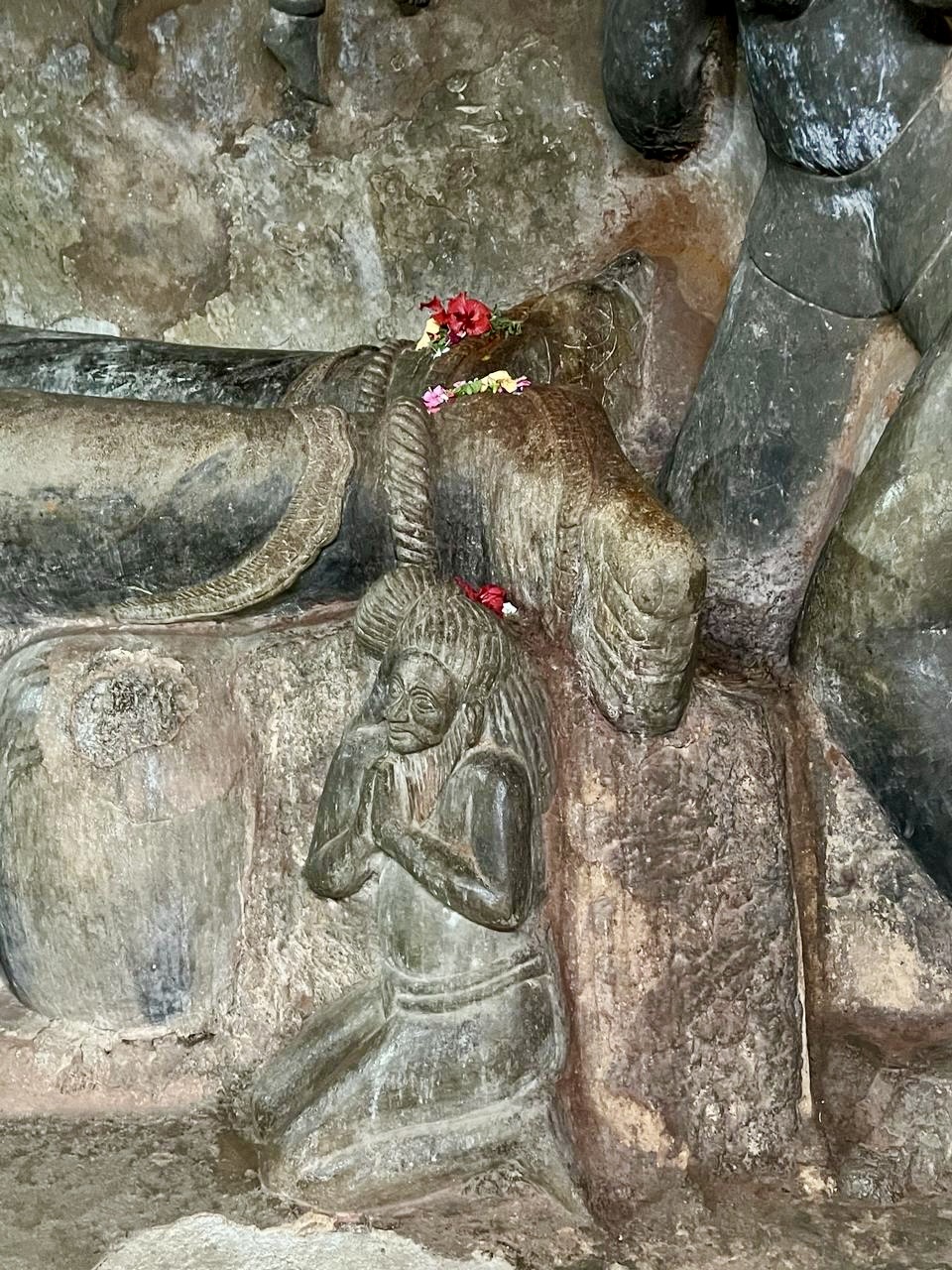 |
| Sitting near the feet of Padmanabha Swamy |
 |
| Upper floor is much better chiselled out with many sculptures on the walls. In the far end is Ganesha |
 |
| The hood, Yaksha and a Rishi |
 |
| Long airy cool corridor of the first floor |
 |
| Flowers on the pillars and in the back, engraved idols of Brahma, Vishnu and Shiva |
 |
| Many decorations on pillars |
 |
| Part of structure may have disappeared due to the effect of weather |
 |
| Meditation cells perhaps |
 |
| Rishis on the first floor |
 |
| View from top |
History :
Shri Bankey Bihari Mandir is a Hindu temple dedicated to Lord Krishna,
in the holy city of Vrindavan in the Mathura district of Uttar Pradesh.
It is situated near Shri RadhaVallabh Temple.This temple is among the 7
temples of Thakur of Vrindavan including Shri Radha Vallabh Ji, Shri
Govind Dev Ji, Shri Radha Raman Ji, Shri Radha Madhav Ji, Shri Madan
Mohan Ji and Shri Gopinath Ji. Bankey Bihari Ji was originally
worshipped at Nidhivana. Bankey means “bent in three places” and Bihari
means “supreme enjoyer.” The image of Lord Krishna stands in the
Tribhanga posture. Haridas Swami originally worshipped this devotional
image under the name of Kunj-Bihari (“Enjoyer of Lakes”).
Krishna upholding the Govardhan mountain in the Tribhunga stance
‘Bānke’ means ‘bent’, and ‘Bihāri’ or ‘Vihāri’ means ‘enjoyer’. This is
how Kṛṣṇa, who is bent in three places, got the name “Bānke Bihāri”.
According to Śrī Brahmjaiasaḿhitā (verse 5.31), Brahma says the
following about Kṛṣṇa:
“I worship Govinda, the primeval Lord,
round whose neck is swinging a garland of flowers beautified with the
moon-locket, whose two hands are adorned with the flute and jewelled
ornaments, who always revels in pastimes of love, whose graceful
threefold-bending form of Śyāmasundara is eternally manifest.”
Bankey Bihari Temple was established by Swami Haridas (Lalita Sakhi in
Dvapara Yuga), a guru of the famous singer Tansen. Once on the request
of his disciples Swami Haridas ji sang the following verse in Nidhivan
in Vrindavan “Mai ri sahaj jori pragat bhai ju rang ki gaur syam ghan
damini jaisen. Pratham hun ahuti ab hun aagen hun rahihai na tarihai
taisain.. Ang ang ki ujraii sugharaii chaturaii sunderta aisain.. Shri
Haridas ke swami syama kunjbihari sam vais vaisain..” On singing the
verse, the Celestial couple Shyama-Shyam (Radha Krishna) appeared in
front of him and his devotees. On the request of Shri Swami ji the
couple merged into one and the idol of Banke bihari appeared there (the
same idol seen in the temple). The idol was established in Nidhivan.
The image of Bihariji installed in Shri Bankey Bihari Mandir, is the one granted to Swami Haridas by the celestial couple Shyama-Shyam themselves. Submitting to the desire of devotees, The Lord appeared in person with his divine consort and left back a black charming image before disappearing.
Swami Haridas was born to Shri Ashudhir and his wife Srimati Gangadevi on the day of Radha Ashtami i.e. eighth day of second (bright) fortnight of Bhadrapad month of the year 1535 Vikrami (1478 A.D.). He was born in a small village, now known as Haridaspur, near Aligarh in Uttar Pradesh. The lineage of the family can be traced back to Shri Gargacharya. Shri Gargachrya was the Kulaguru (family guru) of Yadavas and visited Brij secretly for conducting the Namakarana Samskara (naming ceremony) of young Krishna and Balarama on request of Sri Vasudeva. A branch of the family migrated to Multan (now in Pakistan), but some of them returned after a long time. Sri Ashudhir was one such migrant who after returning from Multan settled at the outskirts of Brij, near Aligarh.
Swami Haridas was the reincarnation of Lalita ‘sakhi’ (female friend), of the inner consortium of Lord Krishna. This easily explains the fact that even in his childhood, he was more into meditation and scriptures, while other children of his age were busy playing. He was married at the suitable age according to the time to Harimati. Even after his marriage, young Haridas stayed away from worldly pleasures and concentrated on meditation. Harimatiji was such a saintly soul herself that on realizing the inclination of her husband, she prayed intensely and was bodily transported to the heavenly abode of Lord by entering the flame of a small lamp in the presence of Haridas. No physical remains were left behind.
Soon after that Haridas left his village for Vrindavan, which was a dense forest at that time and chose a secluded spot, which is now known as Nidhivan, to practice his music and to enjoy eternal bliss of meditation. He constantly and continuously meditated on Nitya Ras and Nitya Bihar of Lord at Nitya Vrindavan. His way of Sadhna was to compose and sing songs in the praise of Lord. While on earth, living in a mortal state, he facilitated his regular unobstructed entry in the Nitya Bihar and always enjoyed the pleasure of closeness of Lord. He chose a secluded and densely forested area, Kunj, in Nidhivan as his gateway to the nirvana and was mostly sitting there, singing, meditating and surfing in the ocean of eternal bliss.
His disciples were curious about this place and one day with permission of Swamiji, they all entered the kunj. But instead of seeing anything they were almost blinded by bright, intense light, which seemed to fill the whole place. On knowing of their plight Swamiji himself went there, and then after his requests, the lord appeared in person with his divine consort, pleasantly smiling and in a playful mood and casting a spell of charm on every living being present there. Those who witnessed this, were so spell bounded by the beauty of the Lord and his consort, that they couldn’t even blink their eyes; it seemed that all of them had turned into stone statues.
The legend as handed down to the generations of Goswamis, says that the beauty of the divine couple was such that no one wanted to lose the sight and proximity of divinity, but then what kind of divinity is it, which cannot make a mere mortal swoon and charmed enough to forget and give up the world and its luxuries? The beauty of the divine couple was so much that lesser mortals, like you and me, won’t be able to bear such a heavenly beauty. Sensing this Swami Haridasji requested both of them to take a single form, as the world won’t be able to bear their image. He requested them to take a single form like Ghan (cloud) and Damini (lightning), thus giving a perfect metaphor to the combined beauty of dark Lord and his fair consort, Radhaji.
Also he wanted his beloved lord to be in front of his eyes always. Granting him his both wishes, the couple turned itself into one single black charming idol, the same one that you see in the temple today. The charm and beauty of Shri Bankey Bihariji is the only reason why the ‘darshan’ in the temple is never continuous but is broken by thel curtain drawn on him regularly. It is also said that if one stares long enough into the eyes of Shri Bankey Bihariji, the person would lose his self-consciousness.
Thus came into existence the physical form of Lord Bankey Bihari, popularly known as Bihariji. The responsibility of Sewa of Bihariji was handed over to Goswami Jagannath by Swamiji himself. Goswami Jagannath was one of the principal disciple and younger brother of Swamiji. By tradition, the Sewa is performed by descendents of Jagannath Goswami till day.
Initially, the deity was installed in a temple close to the first appearance in Nidhivan. A new temple befitting the glory of Bihariji was constructed in 1862 AD. Goswamis themselves mobilized resources for the construction. The temple is an architectural beauty in itself and follows the contemporary Rajasthani style.
The sewa of the Bihariji is unique in its own way. It is performed in three parts every day i.e. Shringar, Rajbhog and Shayan. While shringar (which includes bath, dressing and adornment with jewellery like crown and necklaces) and Rajbhog(feast) is offered in the forenoon, Shayan Sewa (shayan means sleep) is offered in the evening. The temple doesn’t have a tradition of Mangala (early morning) sewa. Swami Haridas did not favour Mangla Sewa as he wanted his child like Lord to take complete rest and did not want to disturb him out of deep slumber so early in the morning.
So, the temple today stands with its
full glory, inside which the Lord himself resides. It is thronged by
thousands of visitors everyday.
Brahmapureeswarar Temple
History :
The Brahmapureeswarar Temple is a Hindu
Temple located in Thirupattur near Trichy, India. Worshippers believe
that a person can change his fate by seeking the blessings of Lord
Brahma at Sri Brahmapureeswarar Temple, Tirupattur.
Lord Brahma’s overwhelming pride as the Creator of the Universe. Lord
Brahma felt that He was more prevailing than Lord Shiva – since He had
the supremacy of creation.
This sense of pride provoked Lord Shiva, who destroyed Lord Brahma’s Fifth Head, and also cursed Him that He would lose His power of creation.
To relieve himself of this curse, Lord Brahma started out on a pilgrimage of Lord Shiva Temples.
During the course of His pilgrimage, Lord Brahma also visited this temple and installed 12 Shiva Lingams around Brahmapureeswarar and worshipped Lord Shiva here for a considerable time.
Being moved by Lord Brahma’s prayers, Lord Shiva, on Devi Parvathi’s appeal, gave him Darshan under the Magizha tree and liberated Him from His curse. Lord Shiva also restored the power and responsibility of creation to Lord Brahma.
Lord Shiva also blessed Lord Brahma that He would have a separate shrine at this temple. He also advised Lord Brahma that since Brahma himself had His destiny rewritten here; He should rewrite the destiny of His devotees visiting this temple.
Since the fate of Lord Brahma, the Creator, Himself was changed by Lord Shiva at Tirupattur, one can expect a turning point in life by praying at this temple.
The temple is under the administration of The Hindu Religious And Charitable Endowments Department, Government of Tamil Nadu.
Sri Agora Veerabhadra Swamy Temple
History :
Agora Veerabhadra Swamy Temple is located in Hanumanthapuram Village near Chengalpattu in Kanchipuram District of Tamilnadu.Hanumanthapuram is a very remote village near Chengalpattu. The village is located off the road going from Chengalpattu towards Thirupporur after Perunthandalam and Senneri villages. The road that leads to this village is not easily motorable and is amidst the reserved forest zone.
Hanumanthapuram has an ancient temple where the main deity is Sri Agora Veerabadhra Swamy and Goddess Sri Kaalikaambal. Dhakshan (son of Sri Brahma and father of Sri Parvathi) performed a Yagnya. He had invited all Devas and Gods for his Yagnya except Lord Shiva, as he always disliked him because Lord Shiva married his daughter Sri Parvathi without his knowledge.
But as per the rituals, he has to invite Lord Shiva, without which the Yagnya won’t be complete. But Dhakshan ignored Lord Shiva and also was not willing to give due offerings to Him in his Yagnya.


No comments:
Post a Comment