Hindu Deities: Imposed Imports By Kushana Warlords?
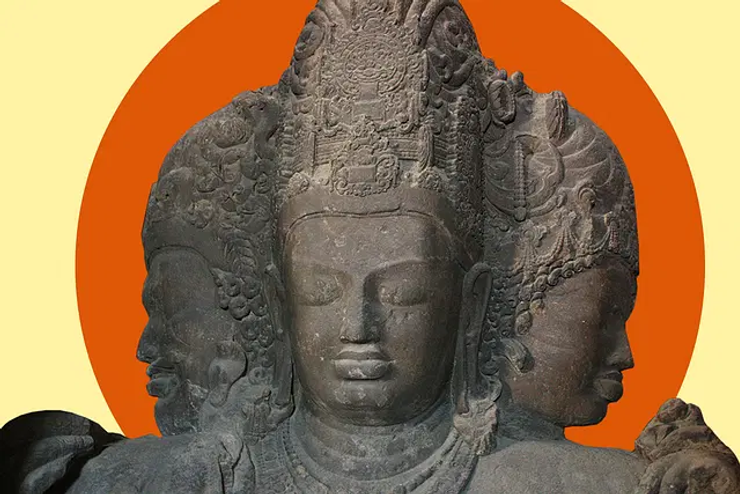
Some very crucial iconographic elements of Hindu Gods and Goddesses as we worship them today were actually not original to India but were imported and imposed by Central Asian ‘elites’ for political manipulation of religious sentiments.
Or so claims ‘public historian’ Anirudh Kanishetti in an article (‘Shiva, Skanda: How Hindu gods absorbed Iranian, Greek ideas’) published on 23 February 2023 in a news portal.
According to him the depictions of Hindu Gods and Goddesses we see today, 'were shaped by a place that confounds unitary nationalist imaginations: Greater Gandhara.'
Here, Iranic, Hellenic and Indic gods were combined in weird and wonderful ways by diverse elites, laying the foundations for deities who are still revered today.
So Indians, 'fond of boasting of “Indian” gods being worshipped in medieval Southeast Asia, owe much to the imaginations of Central Asian rulers who once shaped them.'
He substantiates this claim with a 2006 paper by art historian Franz Garnet which is titled, quite revealingly, as ‘Iranian Gods in Hindu Garb: The Zoroastrian Pantheon of the Bactrians and Sogdians, Second–Eighth Centuries’ (Bulletin of the Asia Institute, New Series, Vol. 20 (2006), pp. 87-99).
How much of this budding narrative stands against actual facts and historical processes though?
Should ‘Greater Gandhara’ confound the so-called ‘unitary nationalist imagination’ given such an imagination exists?
Even Abdus Samad, a Pakistani archaeologist who likes to attribute every Hindu symbol to non-Hindu source in his thesis, points out that ‘the earliest reference to Gandhāra in literature’ was from ‘the Ṛg-Veda (1.126.7)’ and hence ‘since old belonged to the coreland of Indian culture.’
Now getting into the specifics, let us examine the case of Shiva.
According to Kanishetty, Kushans had a politico-religious solution for their conquered regions. On their coins they simply took the Zoroastrian Gods and gave them images derived from Greeks. As they expanded their empire over India, they did the same to Hindu Gods and Goddesses:
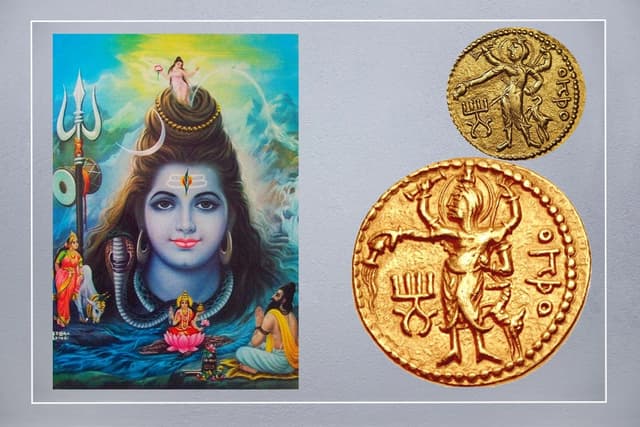
A fascinating case of this, described by Professor Grenet, is of the god Oesho-Shiva. In the late 1st–early 2nd century CE, he appeared on the coins of the Kushan king Vima Kadphises with the titles of “Great Lord” and “Lord of all the World”, titles also used by Vima. These depictions were inspired by the Greek demigod Herakles, with a muscular body and occasionally a lion pelt. But by the 2nd century CE, under the Kushan emperor Kanishka and his successor Huvishka, Grenet writes that “the iconographic ties with Heracles are severed and the god exhibits the three-headed and four-handed type of [Shiva] Mahadeva.”
The reader should note here the suggestions made.
The Deity appears with the titles ‘Great Lord’ and ‘Lord of all the World’. These depictions were inspired by ‘Greek demigod Herakles with a muscular body and occasionally a lion pelt.’ Implied suggestion is that these were all imported for Shiva.
Read More at https://swarajyamag.com/culture/hindu-deities-imposed-imports-by-kushana-warlords-part-1
https://www.induqin.com/post/hindu-deities-imposed-imports-by-kushana-warlords
https://swarajyamag.com/culture/hindu-deities-imposed-imports-by-kushan-warlords-part-2
Hindu Deities: Imposed Imports By Kushana Warlords? (Part 1)
Aravindan Neelakandan
Mar 01, 2023, 08:13 PM | Updated 08:13 PM IST
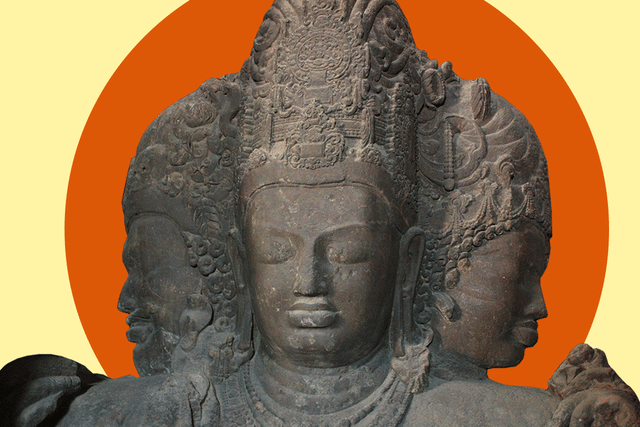
Some very crucial iconographic elements of Hindu Gods and Goddesses as we worship them today were actually not original to India but were imported and imposed by Central Asian ‘elites’ for political manipulation of religious sentiments.
Or so claims ‘public historian’ Anirudh Kanishetti in an article (‘Shiva, Skanda: How Hindu gods absorbed Iranian, Greek ideas’) published on 23 February 2023 in a news portal.
According to him the depictions of Hindu Gods and Goddesses we see today, 'were shaped by a place that confounds unitary nationalist imaginations: Greater Gandhara.'
Here, Iranic, Hellenic and Indic gods were combined in weird and wonderful ways by diverse elites, laying the foundations for deities who are still revered today.
So Indians, 'fond of boasting of “Indian” gods being worshipped in medieval Southeast Asia, owe much to the imaginations of Central Asian rulers who once shaped them.'
He substantiates this claim with a 2006 paper by art historian Franz Garnet which is titled, quite revealingly, as ‘Iranian Gods in Hindu Garb: The Zoroastrian Pantheon of the Bactrians and Sogdians, Second–Eighth Centuries’ (Bulletin of the Asia Institute, New Series, Vol. 20 (2006), pp. 87-99).
How much of this budding narrative stands against actual facts and historical processes though?
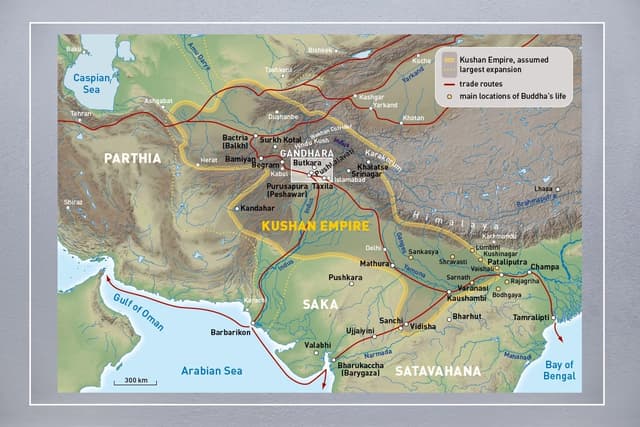
Should ‘Greater Gandhara’ confound the so-called ‘unitary nationalist imagination’ given such an imagination exists?
Even Abdus Samad, a Pakistani archaeologist who likes to attribute every Hindu symbol to non-Hindu source in his thesis, points out that ‘the earliest reference to Gandhāra in literature’ was from ‘the Ṛg-Veda (1.126.7)’ and hence ‘since old belonged to the coreland of Indian culture.’
Now getting into the specifics, let us examine the case of Shiva.
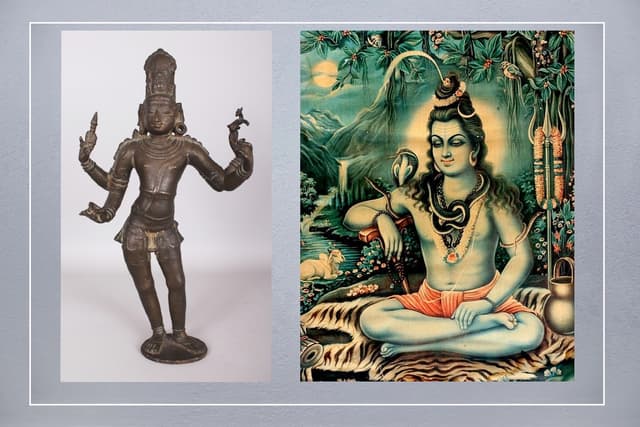
According to Kanishetty, Kushans had a politico-religious solution for their conquered regions.
On their coins they simply took the Zoroastrian Gods and gave them images derived from Greeks. As they expanded their empire over India, they did the same to Hindu Gods and Goddesses:
A fascinating case of this, described by Professor Grenet, is of the god Oesho-Shiva. In the late 1st–early 2nd century CE, he appeared on the coins of the Kushan king Vima Kadphises with the titles of “Great Lord” and “Lord of all the World”, titles also used by Vima. These depictions were inspired by the Greek demigod Herakles, with a muscular body and occasionally a lion pelt. But by the 2nd century CE, under the Kushan emperor Kanishka and his successor Huvishka, Grenet writes that “the iconographic ties with Heracles are severed and the god exhibits the three-headed and four-handed type of [Shiva] Mahadeva.”
The reader should note here the suggestions made.
The Deity appears with the titles ‘Great Lord’ and ‘Lord of all the World’. These depictions were inspired by ‘Greek demigod Herakles with a muscular body and occasionally a lion pelt.’ Implied suggestion is that these were all imported for Shiva.
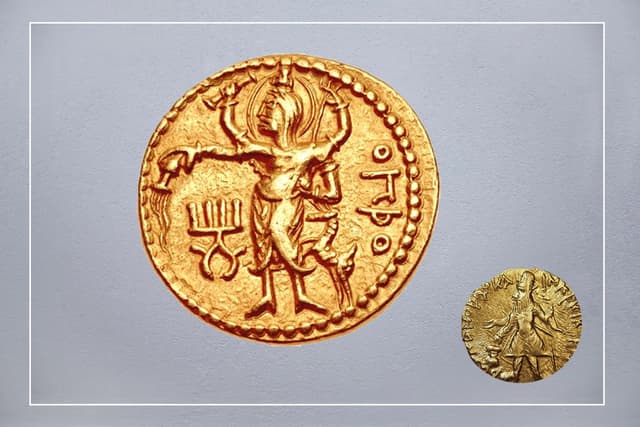
Now the facts.
The
first Kushan emperor did use the 'Greek religious designs, so that
Herakles, Zeus and Nike appear on the coins'; a practice which also
continued into the reign of his son Wima Takto, points out numismatist
Joe Cribb who specializes in the Kushan coins.
... but his grandson Wima Kadphises replaced the Greek imagery with a representation of the Kushan god Oesho using Indian imagery, water-pot, erection and bull, borrowed from the Hindu deity Shiva, but with some Greek features.Joe Cribb, Greekness after the end of the Bactrian and Indo-Greek kingdoms, in 'The Graeco-Bactrian and Indo-Greek World',(Ed.Rachel Mairs),Routledge 2021. p.672
The name used on this coins for the trident-wielding Deity with a bull is Oesho, written in Bactrian; it is pronounced as ‘Wēś’ an Iranian deity of wind.
Incidentally there is still no iconography of this God found independent of one given by Kanishka, which later enters the sculptural representation as well.
On the coins of Vima Kadphises, who was the father of Kanishka, the Deity is clearly declared as 'Sarvalokeswara' - the Lord of all worlds - in Gandhari and Karoshti.
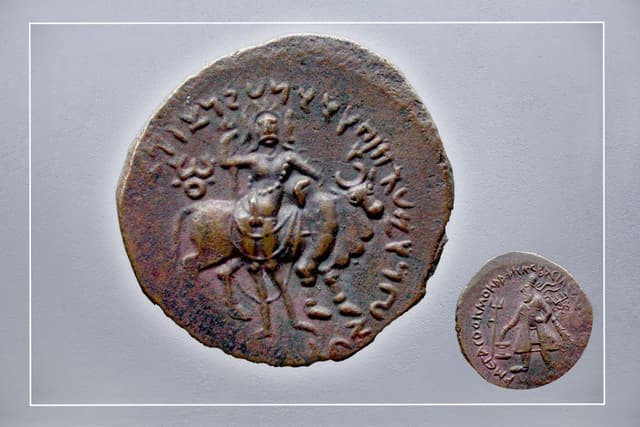
In other words one can say that it was not the iconographic attributes of Shiva getting borrowed from Iran and Greek but rather an Iranian deity was receiving the already well-defined, very Indian attributes of Shiva.
As we will see, even the 'some Greek features' that Cribb points have a strong Indian influence.
To be fair to our ‘public historian’, this is not just his view.
There is always a tendency among a section of scholars to reject indigenous elements of Indian culture.
For example, almost every feature of Shiva in the Wēś imagery is seen by archaeologist Abdus Samad as a non-Indian import:
The trident Wēś is holding was copied from Poseidon images ... Nakedness, diadem, club and animal skin: These characteristics of Wēś were borrowed from the Heracles on Indo-Greek and Scythian coins. ... The thunderbolt was an attribute of the Greek Zeus. ... The bull behind Wēś may have been copied from Scythian coinage. ... These are again attributes of Wēś which have to be considered as Indian features.Abdus Samad, Emergence of Hinduism in Gandhara An analysis of material culture, PhD Thesis, Freie University Berlin, 2010
The problem is that the Vedic Rudra has on him animal-skin. He is associated with Sula in the later Brahmana period. And Trisula is well associated with Him in the older Mahabharata texts.
Trident has also been attested in the seals of Harappa as a weapon.
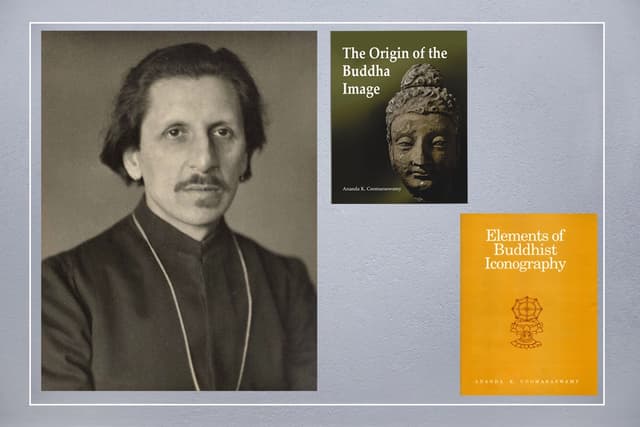
Ananda Coomaraswamy, in his detailed paper on the evolution of the image of Buddha had cautioned against the late borrowing theory.
Not only Vajra as the three-pointed weapon of Indra had been alluded to in Rig Veda, even ‘more importantly we have also early literary references to the form (Atharva Veda, XI, 10, 3) where the trisamdhi, the three-pointed bolt of Indra, is deified.’ ('The Origin of the Buddha Image', The Art Bulletin , Jun., 1927, Vol. 9, No. 4, pp. 287-329: pp:305-6)
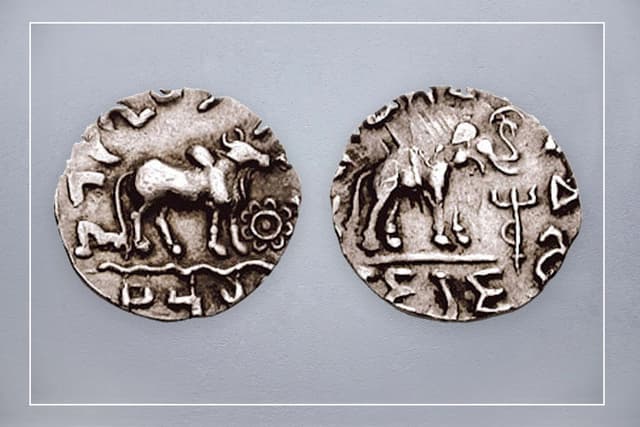
Tribes in the Himalayan region at least a century prior to Kushanas had issued coins with Trishul, Nandi bull and elephant. Nandi the bull and trident had clearly emerged as the sign of Shiva.
They had also used the very Saivaite salutation verse Bhagavata Mahadevasa Rajarana. In other words, all the features said to be imported features from Greek Herakles in the late 1st to early 2nd century BCE were already there right in further interior India, away from the early expansion space of Kushanas.
Even in the case of thunderbolt, said to have been ‘appropriated’ from Zeus, art historian Pratipaditya Pal points out:
Although not common, the thunderbolt is a prescribed emblem of Siva in some texts. Of particular interest is the shape of the implement. Curiously, the engravers seem to have used the type of thunderbolt held by the bodhisattva Vajrapani in Gandharan art rather than that held by Zeus or Athena in earlier coins.Pratapaditya Pal, Indian Sculpture - Vol-I : A catalogue of the Los Angeles County Museum of Art Collection, University of California Press, 1986, p.77
The curious fact is that earlier Prof. Pal had pointed out the way Zeus was depicted on the coins of Saka king Azes, who was around prior to the coming of Kushanas.
Zeus was getting very much Indianised with a dhoti and more importantly, his figure 'approximates much more slightly effeminate image of the male body preferred by Indian sculptors.' (p.75) This is truer for Shiva whose images throughout India (pre-late twentieth century) are shown not muscular but with a feminine charm.
Dr. Shailendra Bhandare, an expert in numismatic study of ancient India in a paper points out how the Trident symbol appears on the coins of the ‘two ‘tribal’ monarchies, namely the Audumbaras (Udumbaras) and the Vemakis, located ‘on the ‘Indian’ side of the so-called ‘Kingdom of Jammu’ region’ and points out that this symbol ‘has distinct Shaivite overtones’ and the figure of Shiva holding a trident first appears on the coins of Gondophares and how the ‘trident-battle axe’ symbol continues to appear on the coins of later Kushana rulers. He writes:
The employment of distinctly Shaivite motifs like these on either side of the chronological spectrum of the ‘last phase of the Indo-Greeks’ points to the circulation of such symbols in the common cultural pool surrounding the last Indo-Greeks and the ‘visuality’ associated with them.Shailendra Bhandare, The last phase of the Indo-Greeks: Methods, interpretations and new insights in reconstructing the past, in in 'The Graeco-Bactrian and Indo-Greek World',(Ed.Rachel Mairs),Routledge 2021, p.532
So it is from here the iconographic elements are taken, at least by the Kushanas, and then attributed to an Iranian Deity. Even here it is interesting to see a subtle continuity that is preserved in Vedic texts.
The name Oesho – identified with Zoroastrian Wēś, the wind Deity, has a Shiva connection. Shiva as Rudra is the father of Maruts, the storm gods who also declare Prisni, the celestial cow as their mother (Rig Veda 5.52.16).
Wife of Rudra, Rodasi, the mother of Maruts, accompanies them in their chariots to fight in the battles. Marut in singular is Vayu. In popular Hinduism, Hanuman also called Maruti because He is the son of Vayu is considered as having Rudra-Amsa.
Further the artisans who minted the coins often took the imagery from the Indian sculptural elements present around them. Sometimes when those engravers employed by the kings were foreign to the local traditions mistakes/misinterpretations happened.
But these very mistakes are today valuable for us to prove that the images on the coin were not imposed on the population by an elite but the rulers derived the imagery from the worship traditions around them.
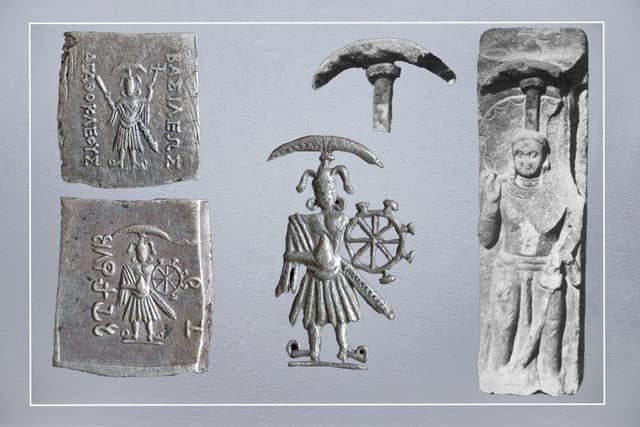
Historian and numismatist Osmund Bopearachchi points out how in the famous Balarama-Vasudeva coin of Agathocles who reigned between 180 to 190 BCE, the coin engravers misrepresented two elements - one the head-dress and another the conch shell, which they showed like a Greek deity holding a vase. We all know how subsequently only the correct holding of the conch—derived not from the coinage but from the surrounding sculptural evolution as well as textual depictions—decided the popular Hindu imagery.
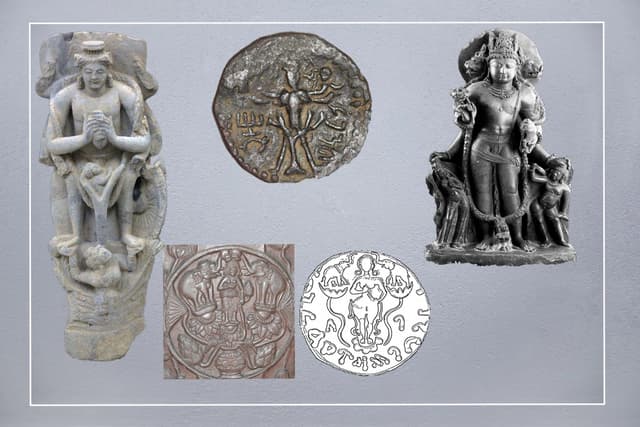
Similarly, he shows how the different coin images, despite some Greek embellishments, were derived from existing sculptural elements which in turn were derived from strong scriptural—Vedic to Puranic—narratives.
Particularly interesting is the coin of Huvishka showing a multi-armed Vishnu.
He points out that modern numismatist-historians like Nasim Khan and J.Cribb had seen the forking element in the coin only as a 'plant sprouting between the legs.' However combined with the sculptural elements, both from Kandhara temple depiction of Vishnu (now in private collection) and later Kashmiri depiction of Vishnu, Bopearachchi shows it to be the floral garland Vishnu wears - the famous vanamali. (Osmund Bopearachchi, Emergence of Vishnu and Siva images in India: Numismatic and Sculptural Evidence, May-14-2016, Asian Art Museum, San Francisco).
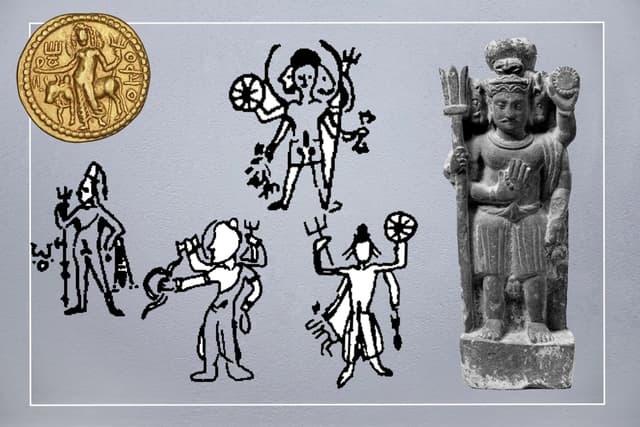
Very similar processes can be seen in the way basic Shaivaite elements evolved in their iconography in Kushana territory. And then the spirituo-cultural 'natural' selection further evolved.
Nobody can argue that Hindu religious icons evolved without any input from outside. Like all religious iconographies world over, there has been cross-fertilising here too. But to reduce that complicated process to the 'import of imagery' and 'elite imposition' is to caricature a complex process.
Further, Hindu spiritual traditions with their Vedic and evolving as well as highly diverse and decentralized Puranic local traditions provided a rich substratum from which various experiments could be performed in syncretism. In attempting that, the Kushanas became deeply Indianised and also vastly contributed to India.
Kushanas came from outside, true. But they imbibed the very Indian values of eclectic syncretism. They favoured an environment that introduced varied styles into the elements. Meanwhile there should have been churning of Indian traditions like Pasupata, Bhagavata etc. within and Iranian, Greek from outside.
To discount the process of Samanvaya in the evolution of these images is to leave a big empty space in the entire narrative while it could well be the heart of the whole process.
When Kanishka boldly took the features of Shiva into Oesho, he was making, perhaps even unknown to him, a civilisational leap.
What we have here is Kanishka creating a deliberate ambiguity of syncretism with the iconographic elements of Shiva as Oesho. At the basis of this syncretic 'experiment' is the deeper yet typical Hindu vision of seeing the One in various names and forms. Otherwise he could just be seen as taking the Hindu vision into the Iranian religion.
In the subsequent Kushana coins we further find the combination of the features of Shiva and Vishnu which in turn is attested by continuous sculptural depictions in the society.
Hindu Deities: Imposed Imports By Kushan Warlords? (Part 2)
Aravindan Neelakandan
Mar 09, 2023, 07:41 PM | Updated 07:41 PM IST
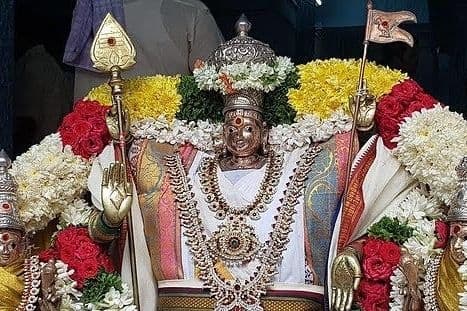
Anirudh Kanisetti extends the notion of the politically motivated, Kushana-imposed features of Hindu Deities to Skanda as well.
Skanda, a deity of unclear origins, appears in the Mahabharata texts as a fierce God associated with ‘the Matrs (“Mothers”) and Grahas (literally “Graspers”, ... figures were connected with childbirth and child-rearing, sometimes even killing or stealing infants’).
In Mahabharata, he also ‘gets linked to another spear-wielding young god called Visaka and this terrible god ‘when worshipped with Brahminical rituals, becomes a brilliant divine general.’
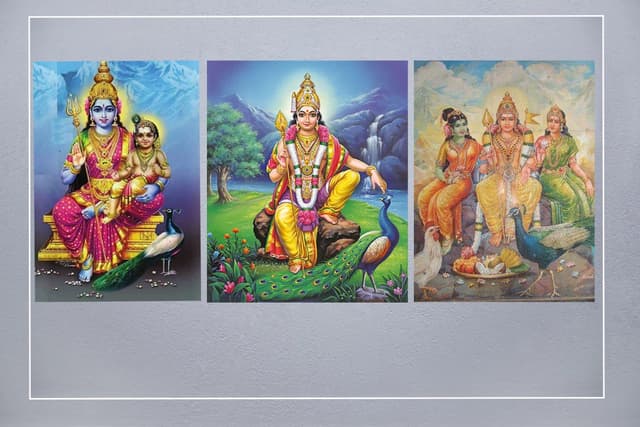
Yadeays of 2nd century CE presented Skanda on their coins ‘trying to appeal to the gods’ worshippers.’ Kushanas were more successful. They removed ‘the Matrs’ and highlighted ‘his martial aspect, known as Mahasena/Mahasenapati, the Great General’ and ‘Mahasena is also associated with the rooster, the bird of the Zoroastrian god Sraosha.’
Moral of the story of Skanda as Mahasena supposedly importing features from Sraosha is this:
The consequences of these ancient political calculations are still visible; many South Asian rulers would go on to claim his favour in later centuries, and it is as the general of the gods, the son of Shiva, that Skanda is best known to Hindus today.Aniruddh Kanisetti, 'Shiva, Skanda: How Hindu gods absorbed Iranian, Greek ideas'
Kanisetti relies mainly on the work of art historian Richard D Mann - 'Rise of Mahasena: The Transformation of Skanda-Karttikeya in North India from the Kusana to Gupta Empires', (Brill, 2012).
Even here, an elaborate thesis by Dr Mann that takes into account, at least partially, the multiple dimensions in the evolution of the Deity, has been flattened and reduced to a unidimensional rhetoric.
As in the case of Shiva, here too there is brushing aside of a lot of facts.
I. Martial and Gnostic Skanda-Kumara in Early Texts
The Rig Veda itself speaks of Agni as Kumara. Scholars of Murugan studies Dr. Ramaseshan and Va.Ra.Krishnan in their work point out that in one of the hymns of Rig Veda (10-1-35), Kumara is also an independent Deity.
The Atharva Veda calls Kumara Agnibhuh – son of Agni – a title that is quite venerated even today by His devotees and retained in later Amarakosa.
The association of Skanda with timeless wisdom is quite revealed in the name ‘Sanatkumara’ of the Upanishads. Chandogya Upanishad identifies Sanatkumara with Skanda.
So, the associated identity of Skanda and Kumara goes back to Vedic-Upanishadic time and He is clearly associated with mystic wisdom.
The article depicts Skanda as a deity associated with child-birth and child protection as well as health. The Mahabharata actually shows Skanda as the leader of armies as well—that too made of garrisons of women.
Historian Ram Sharan Sharma (1919-2011) points out:
Although several gods had their own Parishadas who were lent to Skanda in the fight against the Daityas, generally speaking the Parishada was led by Siva or Skanda! There is a whole chapter in the Salya Parva dealing with the Parishadas under the leadership of Skanda. It informs us that, accompanied by them and the members of the matriarchal ganas, he proceeded for the destruction of Daityas.Aspects of Political Ideas and Institutions in Ancient India, Motilal Banarsidas, 1968, p.126p.126
Prof. R.S.Sharma was a Marxist historian and subscribed strongly to the Aryan-non-Aryan binary. Yet, the above passage establishes clearly the martial nature of Skanda along with His child-protecting ability in Mahabharata.
These martial exploits of Skanda and Shiva narrated in the epic according to Sharma belonged to ‘undoubtedly ... the tradition of earliest times.’ (p.129)
II. Skanda in Yaudheya Numismatic
The narrative that the Yaudheyas presented Skanda with mothers and the Kushanas highlighted the martial aspects, is too simplistic—but fits a particular motivated narrative.
There is a numismatic taxonomy of Yaudheya coins made by John Allan which consists of six classes.
Of these, the third and sixth classes show Skanda.
According to John Mann, the class three 'are either pre-Kuṣāṇa issues, or they are issued in the immediate aftermath of the Kuṣāṇa invasion of north India.'
According
to Allan they belonged to later second century CE. The coins show six
headed Skanda on the coins and on the other side a Goddess.
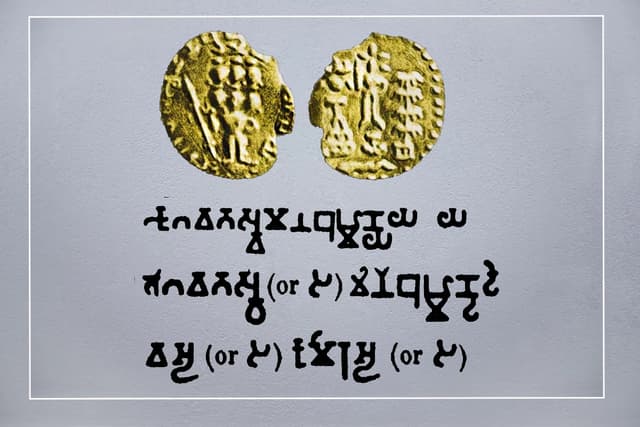
'Brahmanyadevasya' relates to the another name, Subrahmanya.
Nityananda Misra, a brilliant Sanskrit scholar of our times, has brought out the multi-dimensional meaning of this Vedic term.
He further points out that as per the commentary of Sayana on Rigveda-Samhita, the neuter word 'Subrahmanya' means 'magnificent brilliance of Brahman.' As a masculine word, therefore, 'Subrahmanya' can also mean 'he with the magnificent brilliance of Brahman (askesis or truth).'
Leaving aside the political turmoil and hardships the Yaudheya clan faced, the continuity and integration of Vedic Skanda with deeper spiritual meanings in the general culture should have led to the legend and the six heads of the Deity.
While Mann makes much of the six heads becoming one in the later coins (class 6), the fact is such one-face Kartikeya coins were already present. And more importantly in the later iconography of Skanda, the six faces do make a strong presence and there is no break.
III Skanda-Murugan in Tamil Tradition: Martial Warrior and Lover
A major lacunae in the book of Mann as he himself agrees, is that it ‘limits itself to the northern Sanskrit tradition and does not engage the extensive Tamil tradition of Murukaṉ’ (p.3).
That in itself is not a flaw in that specific study but if one tries to build the narrative of the evolution of present iconography of Skanda only from this study, then that is problematic.
Thirumurukattrupadai of southern India (2nd to 3rd century CE) describes each of the six faces of Murugan-Skanda and then describes the beneficial function each renders, which also includes the acceptance of Yajna, properly conducted by learned Brahmins with perfect utterances of Mantra and giving the fruits of the Yajna.
In other words the assimilation that happened even long before the Kushanas, happened in the setting made possible by both the material culture as well as the already ancient sacred literature. And then this imagery was explicitly used by the Yaudheyas.
Sangam literature (third century BCE to third-fourth century CE) contains a lot of information on Murugan. As usual it has been fashionable to say that Skanda and Murugan come from two separate, even conflicting cultures, the former Aryan and the latter non-Aryan and got merged (and in some narratives as part of an Aryan conspiracy).
Purananuru speaks of ‘Skanda of strong lance’ (380:12). While the article claims that comparison of the martial qualities of kings with that of Skanda as a post-Kushana phenomenon, in deep south just prior to and contemporaneous with the Kushana period, the Tamil kings and chieftains got compared with Skanda-Murugan for those very martial aspects.
At the same time, Murugan also shows Mahabharata Skanda’s relation with ailment – here not of children but more of virgin women. If Murugan is called Velan – one who wields the lance (‘Vel’) – His shamanic priests were called Velans.
They used to be called by parents of the virgins. Lest Murugan had taken possession of the girl, the shaman Velan would perform a fierce dance in an altered state with the sacrifice of rooster or goat and offer rice mixed in blood of the animal sacrifice and Murugan satisfied with the offerings would leave the girl. Usually the girl would be suffering more from love sickness. Murugan becomes the divine presence in the pain for the lover.
Thirumurukattrupadai also shows how the same Deity is worshipped in different ways by different groups - the Brahmins, the ascetics, the lay devotees, musicians playing instruments, youthful maidens and shamans including women.
The grains are mixed with blood of rooster or goat and offered. This diversity of worship to the same Deity is a characteristic Indian feature.
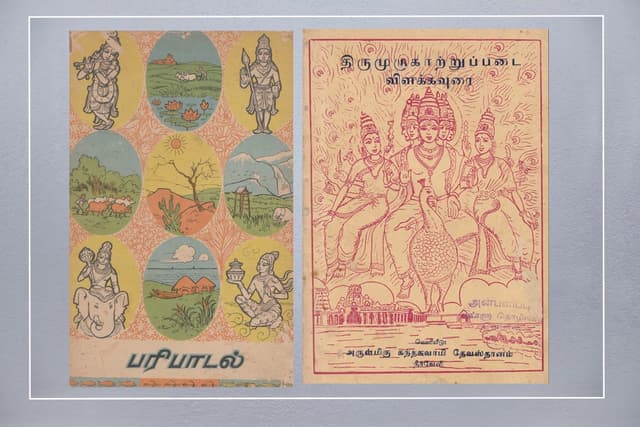
The larger point though is that Murugan manifested in ancient Tamil literature both the attributes of Skanda shown in Mahabharata. Even in pre-Kushana period, the martial valour of kings had been associated with Skanda-Murugan.
IV Rooster of Sroshad?
So in all these what we see is that when the attributes of Murugan-Skanda had been syncretised by the Kushanas with the Bactrian deity Sroshard, who also holds a rooster, it is doubtful if the rooster was really transferred from one Deity to another.
The possibility is that both the Deities could have evolved the shared feature independently. But the feature did help in synchronizing them both. But there is a crucial difference here.
In the norther depictions, Mahasena-Sroshard carries the rooster in his hands. In southern India, invariably, the rooster is inscribed in the banner – which in itself is the sign of kinghood.
Regarding the depiction of rooster, Sushma Jansari,
Tabor Foundation Curator: South Asia at the British Museum, points out
that the first appearance of cockerel in the region comes on Sophytes
coins (circa 300 BCE), which are Greek-style coins with an Indian name
inscribed in Greek
characters. The coins come in two types : one with
Athena and another with a helmeted male face. In both the coins on the
reverse side a cockerel is shown.
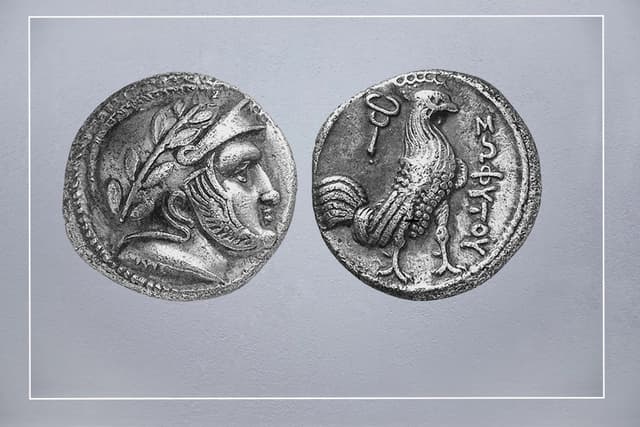
In her view 'the helmeted figure may represent one of the deities which incorporated Indian and Iranian traditions and which were later assimilated into the cult of Skanda.'
While pointing out that Mann had suggested a strong Parthian influence on the iconography, she reasons that 'Skanda’s mythology, which includes the cockerel, is considerably older than the Yaudheya coins and Gandhara sculpture and can be found in texts such as the Mahābhārata (e.g., 3.214.22–4).'
And she concludes:
A well-known phenomenon, widely accepted by art historians, is that images change in meaning before their manifestation in material culture. There is, therefore, a long-standing connection between the cockerel and Skanda in both early mythology and artistic representations in the material culture of South Asia. On the basis of this link, I suggest that the combination of the martial male figure and cockerel found on the Sophytes coins may represent one of the deities who was later assimilated into Skanda’s cult.Two Sides of the Coin: From Sophyes to Skanda-Kartikeya, in 'The Graeco-Bactrian and Indo-Greek World' (Ed. Rachel Mairs),Routledge 2021, p.492
The above conjecture may or may not be 100 per cent correct. But it should be noted that the transfer of cockerel either way was not that simple a linear process and could have had followed its own stochastic pathways. But in literature and worship, the rooster was associated with Skanda-Muruga, centuries before Kushanas set foot in India.
V. Depiction and Continuation of the Mother Images with Skanda
Kanisetti claims that in Kushana centres of power, Gandhara and Madhura, 'Mahasena was increasingly depicted alone, without any accompanying Matrs' and that in 'the coins of the Kushana emperor Huvishka, he is shown with a bird banner, a Zoroastrian emblem of kingship'.
This is demonstrably wrong.
There is for example the famous Cleveland Museum piece of Kushana Gandhara sculpture (second to third century CE) - well after Kanishka. It shows Sashti with Skanda as His mother/sister. The six heads can be seen. Then inside the 'portable shrine' one can see again Skanda - the scaly armour is gone but He holds a rooster.
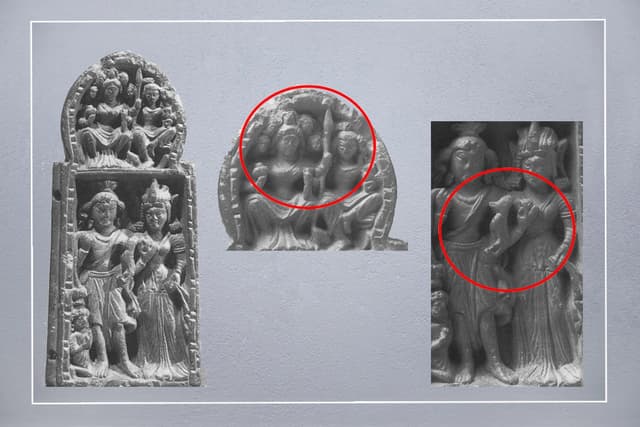
Though Indologist R.C.Agrawal in his paper thinks that the two different sides seating of the female deities may be because of Greek and Indian styles getting mixed, the truth may be different.
Hindu tradition clearly delineates the left side of a man to his wife and the right side to mother or daughter. So except when a God is shown simultaneously with two consorts the female figure seated in the right is either mother or daughter.
The reversal of female deity in the right above and left below shows that the former was not a wife and later a wife. So the claim that under Kushanas the association of Matru Devatas with Skanda declined is wrong.
Now let us come to question of unifying the multiple Deities into one with prominence of Martial persona of Mahasena by Kushanas for political reason.
Even in the Kushana coins we see Skanda and Vishaka shown in two separate forms. Whereas when Skanda is shown as one with six heads in Yaudheya coins, the unifying of multiple characteristics of the Deity into one singular form had received a framework.
So contrary to what Dr. Mann claims the unification is a more archaic and a holistic process that belongs to the Hindu psyche. Kushanas too, when they got Hinduized absorbed this quality and reflected it in their inscriptions. They might have or have not had political reasons for that. That they had was only a remote possibility.
Consistently in Hindu tradition the six faces of the Deity represent six aspects of Skanda: One is playful, another imparts wisdom to Shiva, another removes the obstacles of the devotees, another destroys the mountain of illusions, another destroys the Asuras, another in love with his consort.
As a clinching evidence for dissociating political ambitions of the ruler and the development of Divine iconography let us take another Gandhara style depiction of the Holy family of Shiva obtained from Dargai in the Malakand region in Pakistan.
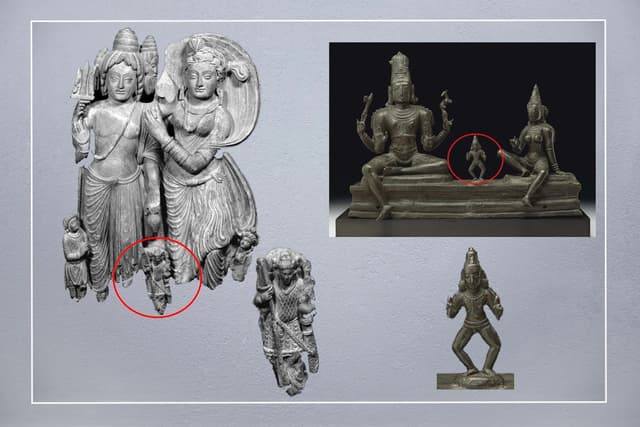
In the Gandhara style between Shiva and Uma one can see Skanda - made small but still in warrior style with scaly armour and lance. The image develops well in Hindu iconography.
This can be seen as a kind of early prototype for the celebrated Soma Skanda where Shiva and Parvati are seated and Skanda is in the middle. Under imperial Cholas this image became famous. Chola emperors had sponsored temples where Somaskanda is an important part.
If Kanisetti's speculation is true then with the martial prowess of Cholas the Skanda in between Uma and Siva should have become more martial and militant. But the Skanda we see has become a charming infant from being an armoured and armed Deity.
This should show the fundamental fallacy in considering political motives behind the evolution and acceptance of a form of Deity during a particular time in history.
VI. Preservation of Multi-Faceted Kartikeya in Hindu Culture
Our ‘public historian’ implies that this Mahasena imagery of Skanda alone had become prominent in subsequent Hindu image of Skanda. Actually the very name Karthik by which Muruga is famous in northern India, is associated with the astral maidens of Pleiades.
The Matrika connection is well preserved in Puranic as well as popular culture of Skanda.
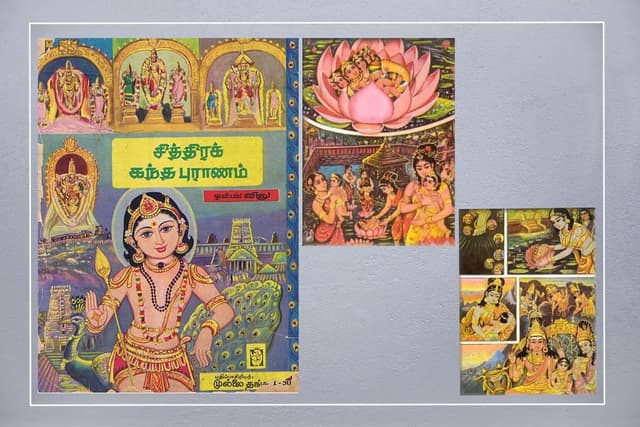
In fact one feature of Yaudheya coins seems to have an amazing connection in the now prevalent southern Indian Murugan Puranas and iconography.
One group of Yaudheya coins depict Skanda with six heads on the one hand and a deer on the reverse. In one of the coins the word 'Dharma' could be seen. What is the association of deer with Skanda?
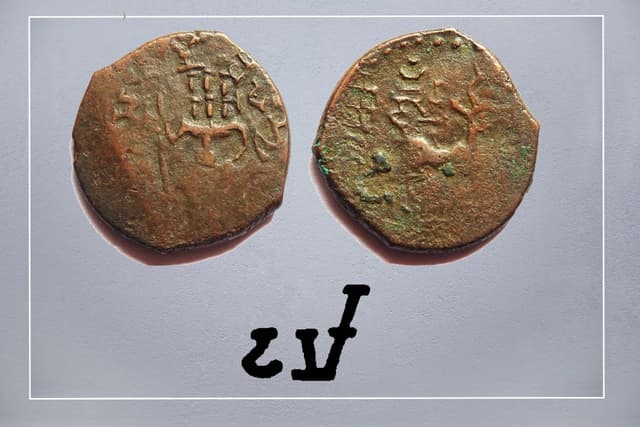
This connection comes out perhaps in the southern Indian tradition.
Valli, the tribal consort of Skanda-Muruga was born from a deer. Bhakti literature, classical iconography, calendar art, folk theatre and even non-devotional love ballads hail the romance between Valli and Murugan-Skanda. That Valli was the Goddess born of a deer clearly shows a connection to the association of deer to Kartikeya in Yaudheya coin.
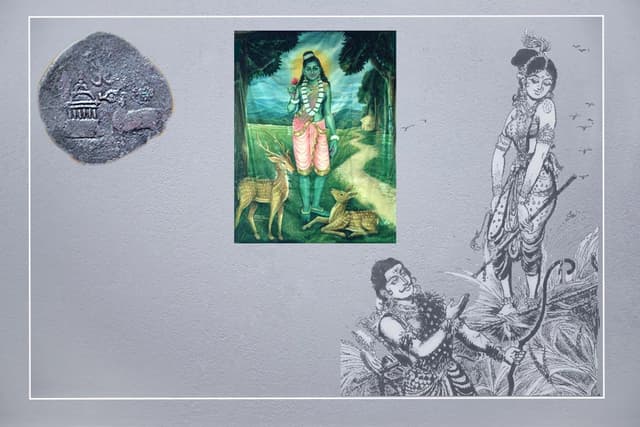
One should note here this: Skanda as Mahasena or the General of the Deva Ganas is a feature well nourished in Tamil traditions of the south just as reflected in both Yaudeheya, Kushana and Gupta coins. Other features of Him as Subrahmanya as shown in Yaudeheya coins and the continuity of His relation to deer depicted in the coins have also continued and found their full expression in southern India.
These dimensions are not mutually exclusive. Nor do they emerge only for or primarily because of political reasons.
The original position of Skanda from the Vedas and Upanishads as the embodiment of eternal wisdom had been consistently nurtured and today Murugan-Skanda is more a General of the forces of light and hence wisdom. His spear is for a Hindu a symbol of that divine wisdom that destroys the darkness.
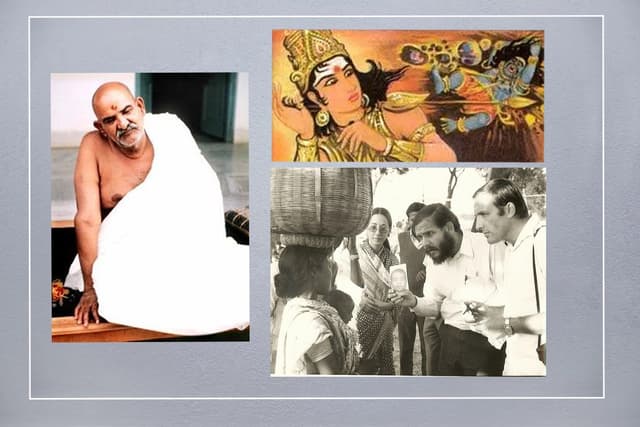
In the 1960s and '70s Neem Karoli Baba resurrected the healing nature of Skanda-Muruga also a warrior general -Mahasena- in an amazing way.
He blessed Larry Brilliant and gave him as his spiritual name Subrahmanya another popular name for Skanda-Muruga. Then he commanded him to fight small pox.
Larry Brilliant, a Jewish doctor from the United States, became an important force to accomplish small pox vaccination - a healing warrior against small pox.
When the last case of small pox was eradicated Brilliant made a pilgrimage to the temples of Subramanya in Tamil Nadu. Perhaps Neem Karoli Baba in an archetypal way renewed the deeper complementarity of Skanda-Muruga being the archetypal commander of war as well as healing saviour of children.
Perhaps in the wisdom and vision of Neem Karoli Baba there is a gentle hint of an immense lesson for the scholars of history as to how to understand the iconography and its timeless dynamism. Hindu iconography evolves and was not and never has been imposed.
The interconnected spiritual and social evolution has always been a co-evolution with external impulses assimilated and harmonised in the basic form envisioned by Hindu tradition.
Hindu Deities - Imported by Kushan Warlords? (Part 3)
Aravindan Neelakandan
Mar 12, 2023, 01:44 PM | Updated Mar 17, 2023, 11:56 AM IST
Read part 1 here and part 2 here.
This is the last of a three-part series that examines the conjecture put forth as a historical fact by historian Aniruddh Kanisetti: that the present-day important features of Hindu Deities were imported by Central Asian warlords for their political interests.
In part-I, the evolution of the iconography of Shiva was examined and in part-II, that of Skanda.
Now in this concluding part the important Indic contribution of Kushanas to the world around them, shall be seen.
Deity or Devotee? Rabatak Inscription Question
Greek invaders starting from Alexander, issued coins that identified the rulers as Gods. Kanisetti and a school of historians extend the same values to Kushana kings.
Kanisetti, on the authority of the famous Rabatak inscription, states:
The Rabatak inscription of the emperor Kanishka makes this quite clear. Sraosha is mentioned as one of the gods leading the worship of deified Kushan kings, and the inscription says that “in [the] Indian [language] he is called Mahasena and he is called Visakha”.
The twenty-three lines Rabatak inscription in Bactrian language and Greek script, made by Kanishka-I, was discovered in 1993.
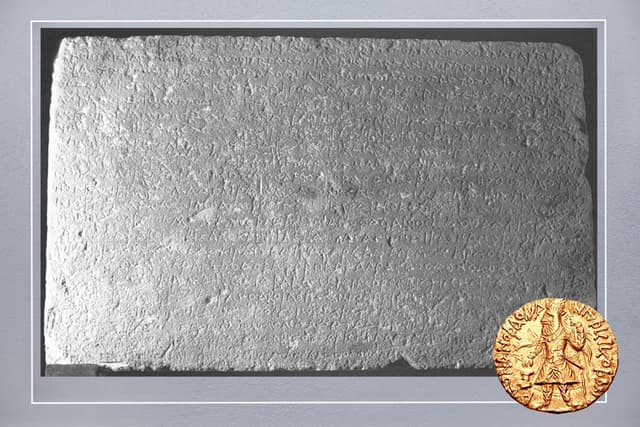
Going through the translation of this inscription, first by Prof. Nicolas Sims-Williams of Cambridge University and translated again by Prof.B.N.Mukherjee of University of Calcutta in 1995, what we find is quite contrary to what Kanisetti suggests.
Here is the relevant part:
The king Kanishka commanded Shapara (Shaphar), the master of the city to make the Nana Sanctuary, which is called (i.e. known for having the availability of) external water (or water on the exterior or surface of the ground), in the plain of Kaeypa, for these deities of whom are Ziri(Sri), Pharo (Farrah) and Omma.' To lead are the Lady Nana and the Lady Omma, Ahura Mazda, Mazdooana, Srosharda...Narasa, (and) Mihr.Hamid Naweed, Art Through The Ages in Afghanistan,2013, p.136
From the above it is very clear that Kanishka might have projected himself as at best a demi-god but it was not his or his ancestors' worship that was being referred to here. Rather it is the worship of the Deities.
Worship of ancestral kings is mentioned separately. In a detailed study of Kushana Devakulas or dynastic temples in Mathura and Surkh Kotal (modern Afghanistan) (made before the discovery of Rabatak inscription)
... we now understand what a dynastic shrine is: it is a shrine where the king and his family and high officials worshipped the deity who protects the king and his family, not the temple of the godlike king.Gerard Fussman, The Mat devakula: a new approach to its understanding,in Mathura : The Cultural Heritage, (Ed.Doris Meth Srinivasan), American Institute of Indian Studies,1989,p.199
The truth of this can also be attested from numismatic evidence.
For example, in the case of Kanishka’s coin, he is shown with elephant goad which was an important feature of Shiva (and definitely not got from any Greek or Iranian divine) but without the trident and on the reverse side Shiva is shown with trident.
The king is no more a god but a devotee of the Lord.
But there is even a more important change.
Yajna and the Kushanas
On Kushan coins one finds an interesting change in the relation between the ruler and the Deity. For the first time the ruler is shown making an offering at the fire altar.
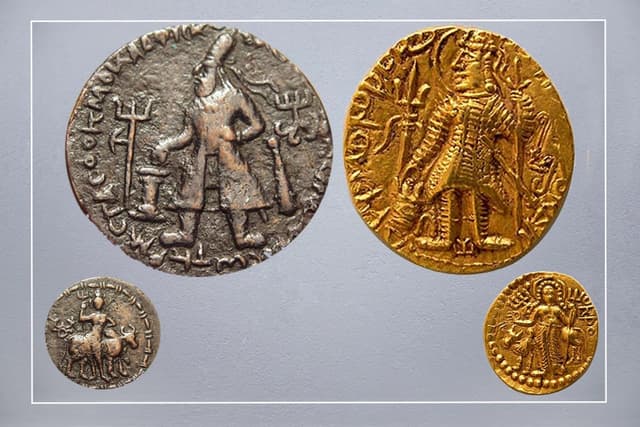
Was this Vedic or Iranian fire altar? The shape resembles the Iranian. At the same time even a historian like Nayanjot Lahiri points out an important fact about this ‘oldest representation of fire altar in Asiatic coins’:
Fire-Altars have not been found in the coins of the Parthian dynasty of Persia, and their earliest appearance is on the coins of the Kushan Emperors of India.Nayanjot Lahiri, Finding Forgotten Cities - How the Indus Civilization was Discovered,2015, pp. 362-363. Kindle Edition.
The Indian nature of fire altar is further strengthened by the fact that in the Rabatak inscription, Kanishka calls hjs 'grandfather Saddashkana the Soma sacrificer.'
Archaeologist Satya Shrava in his detailed study ‘The Kushana Numismatics’ (1985) also considered the fire altar, even though the imagery is Parthian, as ‘emerged from Indian customs’ (p.88).
The form is Iranian but the flame is Indian. This change is significant. Yet it is not much discussed.
In India the concept of Yajna has always been nurtured through the typical Hindu process of internalising. It has emerged as an archetype of national consciousness of India.
Conducting Yajna bestowed upon the ruler prestige and ritual power, no doubt, but more importantly it symbolised the ruler’s concern for the welfare of all his subjects.
Aitereya Brahmana proclaims the objective of a sacrifice: Yajna is done for the welfare of the people. So what is this fire pit offering by a king symbolising in the Indian context?
A strong possibility is that statecraft itself got symbolised as the Yajna.
This extension of Yajna as a functional archetype into various domains was strongly done by the Bhagavad Gita, which should have been then a text that influenced the so-called 'elite'.
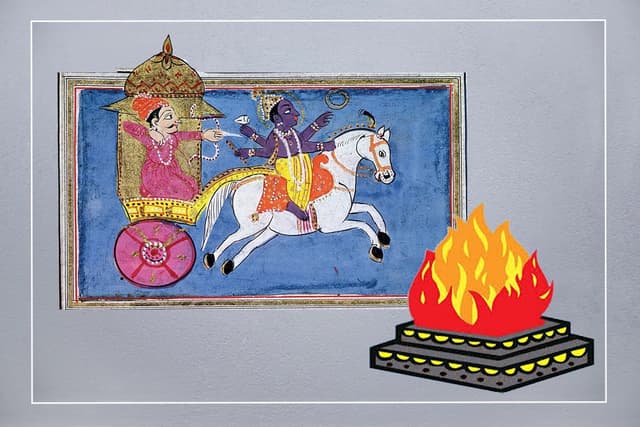
Almost two thousand years later none other than Mahatma Gandhi pointed this out in his writings.
Being a votary of Ahimsa he could not condone Vedic sacrifice with animal offerings. But he pointed out how Gita has transformed Yajna into a fundamental archetype that could be extended to all domains of life:
Yajna means an act directed to the welfare of others, done without desiring any return for it, whether of a temporal or spiritual nature. 'Act' here must be taken in its widest sense, and includes thought and word, as well as deed. 'Others" embraces not only humanity, but all life... The world cannot subsist for a single moment without yajna in this sense, and therefore, the Gita, after having dealt with true wisdom in the second chapter, takes up in the third the means of attaining it, and declares in so many words that yajna came with the Creation itself. This body, therefore, has been given us only in order that we may serve all Creation with it. And therefore, says the Gita, he who eats without offering yajna eats stolen food. Every single act of one who would lead a life of purity should be in the nature of yajna.M.K.Gandhi, From Yeravda Mandir: Ashram Observance: (trans. V. G.Desai),Navajivan Publishing House, 1932:1992, pp.31-2
It is a possibility. The Yajna offering by the kings on Kushans coins shows a value shift in the kings in their relation to their rule. It is an act of Yajna.
Though from the coins of Huvishka the fire altars do not make an appearance on the coins, definitely the concept of Yajna has influenced Kushana polity.
Return of the Divine Feminine
One can see in the Rabatak inscription an important feature—that the chief receivers of worship were 'Lady Nana and Lady Omma'.
Omma is clearly Goddess Uma. Nana was also the Goddess in whose name the temple was named.
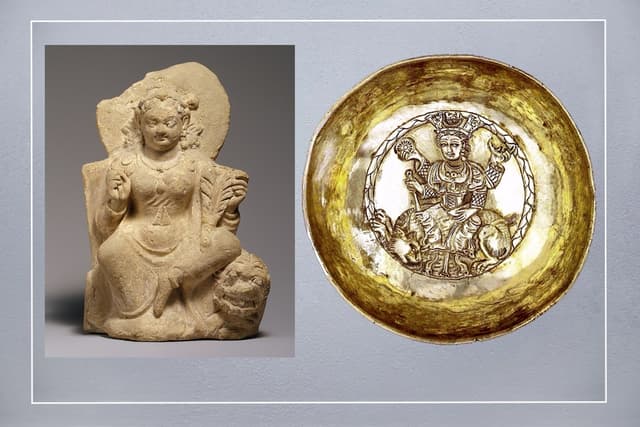
Goddess Nana has a rich, mysterious and complicated history.
Many historians used to assert that she was Inana, a Mesopotamian Goddess. But recent scholarship suggests that that 'Inanna/Istar must be strictly distinguished from Nana' and that she is more frequently 'the Iranian divinity Anāhitā and/or the Greek goddess Artemis.' (Manya Saadi-nejad, Anahita: A History and Reception of the Iranian Water Goddess, I.B.Tauris, 2021, p.13)
In the Indo-Iranian context then, Nana would be Anahita. Originally, she was a powerful all-encompassing, river Goddess - a counterpart of Saraswati.
Even in Zoroastrian monotheism that took over, which had prolonged conflicts with the older religion of the Devas, Anahita had to be accommodated. Her full name was 'Arəduuī Sūrā Anāhitā'.
In a later Zoroastrian liturgical text, Yašt (1000-600 BCE), the full problem of accommodating an older all powerful Goddess into the monotheistic hierarchy becomes obvious.
In some of the liturgical verses, She is the Goddess to whom Ahura Mazda gives sacrifice and pleads (p.57).
In most other verses, She is created by Ahura Mazda and is secondary to him. Even when Zoroastrian royalty made peace with Anahita, she was mentioned in the inscriptions only after Ahura Mazda.
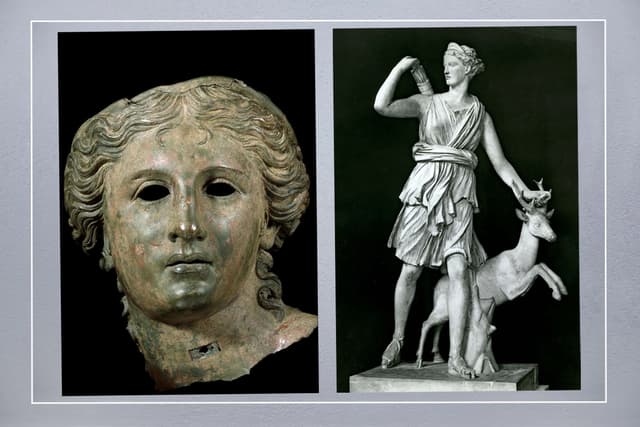
Was Nana a Goddess imported by Kushanas?
Indologist Asko Parpola presents evidence for a continuity of Goddess worship right from Harappan times.
Leaving aside his obsession with identifying different waves of 'Aryans', he provides material evidence for this Goddess worship in the Bactria–Margiana Archaeological Complex (BMAC) seals from Afghanistan which depict 'a winged goddess escorted by lions very probably depict Nana, nearly two millennia before the Kuṣāṇas' and that it was in Afghanistan that 'the Kuṣāṇas adopted, among other local divinities, the goddess called Nana and Nanaya, who is depicted as riding the lion and wearing the mural crown.' (The Roots of Hinduism: The Early Aryans and the Indus Civilization, Oxford University Press, 2015, p.256).
Further Nana In Rig Veda is used to denote mother (RV 9.112.3).
Kushanas evidently brought back the importance and prominence of Nana, along with Uma and perhaps took it further into Iran.
The Rabatak inscription itself shows the predominance of the Goddesses. It is a 'Nana Sanctuary' with 'water on the surface' for the deities 'Ziri (Sri), Pharo (Farrah) and Omma (Uma).
Incidentally the descent of Ganga with Shiva breaking her fall is clearly stated in Mahabharata (3.108.9–14 and 5.109.6). While it was Ikshvaku of Surya vamsa who toiled for her descent, in Mahabharata she has a very intimate role with Chandra Vamsa kings.
In a striking comparison, Anahita is also prayed for her descent and it was by Ahura Mazda himself.
While many scholars have compared her to Saraswati, she as milky way Goddess descending to earth makes her comparison with Ganga also possible. As Nana she is also the Goddess who anoints the kings.
Kanishka in the Rabatak inscription states that he received his kingship from Nana. Then in his portrayal of Oesho with Shiva iconography we find water coming forth from one hand of Shiva through a jar.
Is that symbolic of Nana identified with the already-developed Ganga with a remarkable syncretism of Nana-Anahita?
While Ganga becoming a consort of Shiva is not fully described in Mahabharata, Uma is very much His consort. She is also Himavat's daughter right from the early Upanishadic age.
We find in the legend of one of the coinsof Huvishka, the legend of Nan-Oesho. This is very similar to much commoner Oesho-Omma.
Clearly this reflects the evolution of the imagery of Uma and Ganga as consorts of Shiva being taken and used to create a syncretic parallel with Iranian deities.
Over all one can say that the Kushanas with their Indic influence brought back to eminence a Goddess who lost her primal place during monotheistic Zoroastrianism. But again with the monopolistic take over, it is only in India that the river veneration of Ganga (and other rivers) still happen.
Samanvaya
Almost all the scholars who have studied Kushan period art, architecture and numismatics have been struck by what they call its 'eclectic' and/or tolerant nature. Many Gods, Goddesses of diverse cultures and civilisations have been accepted, including the pantheons.
Almost all studies of Kushan rulers point out this aspect.
Satya Shrava in his study (cited earlier) points out how the Kushan coins proclaimed the 'religious syncretism of the rulers' and that 'the heterogenous religious elements in Kushana coinage betray also an eclectic attitude of the Kushanas towards religion.' (p.9)
Even Richard D Mann, who argues for a political motivation in what he alleges to be the elevation of Mahasena worship under Kushanas suggests:
... particularly given the religious eclecticism of the Kuṣāṇas, that both Mahāsena and Sroaša may be intended by the statues It may be a case of deliberate ambiguity, or hybridity, designed to allow a single figure to appeal to a wide range of people within the Kuṣāṇa Empire.p.128
In one study on Kushanas, a historian claims that the religious broadmindedness led to their assimilation into Hinduism.
The Kushana monarches were themselves conscious of the unity of all religions as is evident from their depicting divinities of different pantheons. Toleration and broadmindedness did not stand in the way of their personal religious leanings culminating in their final assimilation in Hinduism.B.N.Puri, India Under the Kushanas, Bharatiya Vidya Bhavan, 1965,p.156
Despite the use of the typical cliché of 'growing reaction against the high pretensions of the Brahmins' and 'the inequity engendered by the Hindu caste system', Dr. Kanchan Chakraberti is closer to truth when he quotes the following words of artist and art-philosopher K.G.Subramanian (1924-2016) to explain the reason why Kushanas were exceptionally and creatively eclectic even for their other pagan counterparts:
This is probably of a succinct pantheistic vision the Indian has of his environment whatever his religious persuation; all things from the most humble to the most sophisticated, have in them the 'animus' and so are different forms of the same. ... One can trace the Indian concepts of metamorphosis, rebirth and trans-substantiation to such a vision. (Subramanyan, K. G., 'Religion and Art in India', Moving Focus, p. 99.)Society, Religion and Art of the Kushana India: A Historic Symbiosis, Bagchi & Company, 1981, p.23
Here an alternative is suggested. It is that Kushanas became 'conscious of the unity of all religions' because of their Hinduised nature.
In the Rabatak inscription, after the name Srosharda and before the name Narasa (between lines 9 and 10) an interlinear line is inserted which reads :
'who is called ... and Komaro (Kumara) and called Maaseno (Mahasena) and called Bizago (Visakha)'B.N.Mukherjee Translation
In a 2004 translation, Nicholas Sims-Williams reads the line as 'Sroshard—who in Indian is called Mahäsena and is called Visäkha' (The Bactrian Inscription of Rabatak: A New Reading, Bulletin of the Asia Institute, Vol.18, 2004). But this is a typical Hindu-Vedic technique to speak of one Deity being called by different names. Or different names considered as multiple aspects of the same divine.
There is a well known Rig Vedic dictum. This celebrates and proclaims theo-diversity as a condition for spiritual life of India:
Indram mitram varunam agni mdhuradho divyah Sa suparno garutman Ekam sat vipra bahudha vadanti. They call it Indra, Mitra, Varuna, Agni, Yama, Matariswan and Garutman of divine plumage. That which exists is One and the seers of wisdom call it by many names.Rig Veda 1.164.46
Then in the celebrated Prithvi Sukta of Atharva Veda - three essential diversities are mentioned and they are made the basis of creating prosperity for the individual and the nation.
From diversity nourished by mother earth the seeker wishes to harness prosperity like a cow yielding milk:
Janam bibhrati bahudha vivachasam nanadharmanam Prithivi yathaukasam Sahasram dhara dravinasya me duham dhruveva dhenuranapasphuranti Earth, who bears people of varied groups (yathauhasam hahudhd janam), speaking different languages (vivachasam), with multiplicity of their spiritual/religious traditions(nanadharmanam), developed suited to their dwelling places, be a never failing milch cow, yielding unto me a thousand streams of prosperity.Atharva Veda 12.I.45
In India there existed already a spiritual basis to understand and accept diversity.
Kushanas had a multi-ethnic, multi-religious empire. They had an option. They could have with modifications imposed their Deities on all the people they conquered. Or they could have just got converted to the religion of the people whom they conquered.
Instead they imbibed unto themselves the civilisational principles of India. They became Hinduised. Because they became Hinduized, they could see in multiple Deities the same Divinity.
It is not because they were tolerant that they got assimilated into Hinduism. It is because they got Hinduised they became eclectic and religiously broadminded.
The Tyranny of Shallow Historiography
Now the question is: why do a section of historians obsess with the notion of foreign imports into Indian religion and culture and use it as a means to deflate a notion of historical purity which Hindus do not have anyway?
The Hindu mind has never worried about the historical roots of their symbols. They know better as to what the symbolism of the iconography of their Gods and Goddesses means. To them it is more about the inner experience than a historical immutability.
More important is the question: why the same school of historians cannot see any intrinsic value in the emergence of the iconography and worship of Hindu Deities and its evolution? Why do they always see Hindu spiritual movements, Bhakti or temple-building or creation of Murtis, as elite imposition or propaganda alone?
Dr. Meenakshi Jain in her masterly scholarly book ‘The Hindus of Hindustan’ points out that the oldest Saraswati sculpture found in India was actually donated not by any royalty but by a metal worker.
Most of the Hindu spiritual movements emerged from within and were not imposed from above. In fact, Hindu spirituality stands out in pointing that the temple within of a simple devotee is superior to the temples built by kings. Yet these aspects of Hindu religious history would not even be discussed in the historical narrative set by the colonised historians.
Both Protestant colonial historians and colonized Marxist historians see no value in Hindu religious symbols except as tools for the subjugation of people.
These two schools feed into each other and they have a stranglehold on historiography. It is time Hindu historians with a holistic view of religion and society, importance of spiritual experience in emancipating the society and liberating the individual, take up the challenge of writing a holistic history of Hindu civilisation.
That is more a reason why this long three-part essay has been written, and not answering a 'public historian'.
The Kushan Empire, which existed from the 1st century BCE to the 3rd century CE, was a culturally diverse empire that spanned modern-day Afghanistan, Pakistan, and parts of India. The Kushanas issued a variety of coins, which featured a wide range of deities and symbols.
Some of the deities that were commonly depicted on Kushan coins include:
- Shiva: One of the most frequently depicted deities on Kushan coins was Shiva, the Hindu god of destruction and transformation. Shiva was often shown in a meditative pose, with his legs crossed and his eyes closed.
- Buddha: The Kushanas were known for their patronage of Buddhism, and many of their coins featured images of the Buddha. These depictions often showed the Buddha with a halo and a serene expression.
- Mithras: Mithras was a Persian god who was associated with the sun and with oaths and contracts. He was often depicted on Kushan coins wearing a Phrygian cap and carrying a knife.
- Herakles: Herakles, the Greek hero, was also a popular figure on Kushan coins. He was often depicted wearing a lion skin and holding a club.
- Nana: Nana was a goddess of the moon who was worshipped in Central Asia. She was often depicted on Kushan coins wearing a headdress and holding a crescent moon.
These are just a few examples of the deities that were depicted on Kushan coins. The variety of deities and symbols on these coins reflects the diverse cultural and religious influences of the Kushan Empire.
KUSHAN DYNASTY(30,032 words)
the line of rulers in Bactria, Central Asia and northern India from the first century CE.
KUSHAN DYNASTY (Kušān), the line of rulers in Bactria, Central Asia and northern India from the first century CE.
The Kushan kings were succeeded in the third century, in part of the region they had ruled, by the Sasanian princes who governed with the title of “Kushanshah” (q.v.).
KUSHAN DYNASTY i. Dynastic History
KUSHAN DYNASTY (Mid. Pers. Kušān, Bactrian Košano) of the 1st-3rd centuries CE.
During the first to mid-third centuries CE, the empire of the Kushans (Mid. Pers. Kušān-šahr) represented a major world power in Central Asia and northern India. They were able to contend on equal terms with Parthia, and at times even gained the upper hand over these western neighbors. Their history has, however, until recently received minimal attention from Classical historians. This is because apparently their existence has been explicitly noted only once in Classical literature, by Bardaiṣan (see BARDESANES) of Edessa in his Book of the Laws of Countries, where he speaks of the “Laws of the Bactrians who are called Kushans” and remarks (allegations not yet confirmed elsewhere) on the luxurious lifestyle and promiscuous morals of their women. It is probable, too, that the celebrated allusions in Prologue 41 and 42 of Pompeius Trogus to the “Asiani (who became) kings of the Tochari” (Reges Thocarorum Asiani), is a reference to the Kushans. Other mentions in Classical literature from the Imperial period of “the Bactrians” (Bactriani) may also sometimes cover notices of the Kushans.
It was only with the advance of modern research during the 19th century in India and Afghanistan, and later in Central Asia, that the true importance of the Kushans began to be recognized. The increasing interest of numismatists in the enormously rich legacy of coinage coming to light in India soon began to reveal that a large part were issues of rulers using the epithet Košano “The Kushan.” This coinage included a spectacular sequence of gold pieces, clear evidence of a kingdom enjoying huge prosperity (see COINAGE). Soon afterwards, as progress was made in the recovery and interpretation of lapidary inscriptions in India, it was found that many of these made mention of the same rulers named on the coins. Some of these inscriptions, from the northwest, mostly in what is today Pakistan, were written in the Kharoṣhṭī alphabet and the Gandhari dialect of Prakrit; others, centering especially around the area of Mathura, were in the Brāhmī script, and in a dialect increasingly merging with Sanskrit. Many of these inscriptions mentioned the Kushan rulers who were also attested on the coins, notably Kanishka, Huvishka, and Vasudeva. Although several of these inscriptions were dated, uncertainty concerning the origin points of their eras, of which there were certainly more than one, gave rise to much controversy among historians on the absolute chronologies to which they related.
The foundation of the Kushan empire in Bactria and India was the result of a long series of ethnic migrations. Since the 7th century BCE, Chinese annals had recorded the presence of the Yuezhi (Yüeh Chih), close to the Chinese frontiers in Kansu (Gansu) (Haloun, 1937; Pulleyblank, p. 19). During the 1990s, sensational reports of the discovery of mummies in graves of the 2nd-1st millennia BCE along the northern side of the Tarim basin, noted that these bodies exhibited Indo-European rather than Chinese features: Tall stature, hirsute features, blond hair, and flowing moustaches all contrasted strikingly with the East Asian physical type. Scientific tests, such as blood grouping and DNA have been undertaken so far on a limited scale, but such results as are available tend to connect these individuals with the populations of Europe (Mallory and Mair, 2000).
It is plausible to link these findings with linguistic evidence relating to the Tarim region. Among the manuscripts recovered by Central Asian expeditions of the early 20th century were several in previously unknown languages. One group of these, written in a form of the Indian Brāhmi alphabet, presented unique features. These were Indo-European dialects of the centum type, similar to Greek or Celtic, and markedly distinct from languages such as Slavic, Iranian, and Sanskrit, which are of the satem variety. There is considerable evidence for two dialects of this type, sometimes known as Agnean and Kuchean, or more generally, for reasons which will become clear, as Tocharian A and B. All these sites lie along the northern and eastern sides of the Tarim basin. These languages are today extinct, and the records that attest them are thought to belong to the seventh to ninth centuries CE. Such dates reflect the closing stages of their culture, but it may be assumed that the ancestral languages, and the people who spoke them, had existed in this region since remote times (Narain, p. 14).
The time gap between these two periods of evidence is bridged by historical indications from Chinese and Greek sources for the second century BCE, relating to the Yuezhi, or, as they are later called by the Greeks, the Tochari, a powerful horde who had long dominated the Kansu area, and who are plausibly identified as the ancestral speakers of the “Tocharian” dialects. They had been a numerous and powerful tribe, well able to maintain themselves against the encroachments of neighbors. However, the rising power of their northern borderers, the Xiong-nu/Hsiung-nu (probably ancestors of the later Huns), was beginning to make itself felt, and in 176 BCE the Yuezhi were heavily defeated by Maodun (d. 174 BCE), the rising chief (shanyu) of the Xiong-nu. A few years later, they were again decisively defeated by his son and successor Jizhu (entitled the Laoshang), and their chieftain was killed. This was the notorious occasion when the skull of the defeated Yuezhi chief was made into a drinking-cup for the use of the conqueror (Konow, 1929, p. liii, citing the Chinese annals, the Shi-Ki; for this and parallel authorities, see Hulsewé and Loewe, p. 120).
This crushing reversal convinced the Yuezhi, though still a very numerous tribe, that they could no longer maintain their hold over their grazing-grounds in Kansu province in the face of the encroaching Xiong-nu. They began a long migration to the west, and eventually, around 140 BCE, emerged on the plains of present-day Kazakhstan. This area was at the time dominated by two confederacies of nomadic Iranian tribes. In the east, probably centered around the north shore of Lake Issyk Kul, were the group who, in Achaemenid times, had been known as the Sakā Haumavargā (Haoma-consuming Scythians; inscription DSe 24-25). Further west, around the lower course of the Syr Darya (Jaxartes) River, and the shore of the Aral Sea, was a similar confederacy known as the Sakā Tigraxaudā (Pointed-hat Scythians; DNa 25-26). The blow from the Yuezhi probably fell first on the former, whose ruling elite, not long before 100 BCE, migrated southwards by arduous mountain routes to cross the Karakorum range into present-day Pakistan under the leadership of their chieftain Maues, whose name appears in the Indo-Greek (see INDO-GREEKS) coinage at Taxila after the demise of Archebius (ca. 100 BCE). On these coins, Maues already claims the title “Great King of Kings,” implying a prominent status (see, e.g., Whitehead, I, p. 98, no.1; pl. X, 1; Jenkins, p. 14 and Pl. III, 1). It may be of interest to note that the commander of the Sakā contingent against Alexander at the Battle of Gaugamela was identically named Mauakes (Arrian, Anabasis 3.8.3) and was most likely a predecessor of Maues as a member of the same longstanding lineage.
The Yuezhi/Tochari continued to establish their domination north of the Oxus (Āmu Daryā) River, and the second Sakā confederacy were driven southwards, towards the frontier of the Greco-Bactrian kingdom. Forced to break through or perish, the Sakā contingent overwhelmed the defenses and drove westwards through Herat. They provided mercenaries to support the Parthian armies in their war against the Seleucid Antiochus Sidetes (129 BCE); denied remuneration since they had arrived late, they turned against the Parthians, with whom they fought a major battle the following year, which resulted in the defeat of the Parthians and the death of their king, Phraates II (128 BCE; Bivar, 1983a, p. 38; Debevoise, pp. 35-36). They then turned southwards, and past Herat to occupy Drangiana, which henceforth assumed the name of Sakastān, subsequently Sistān.
Meanwhile the Yuezhi/Tochari, hard on the heels of the Sakāi, in turn, so Justin records (42.2), collided with the Parthian frontier. The succeeding king, Artabanus II, led an expedition against them, but died (124/3 BCE) from a wound in the arm, perhaps from an arrow (Bivar, 1983a, pp. 38-39; Debevoise, pp. 37-38). Thereafter, the Tochari seem to have withdrawn to the east where their presence, so it seems, is attested by the excavations at , north of Oxus River. Here remarkable sculptures depict the Tochari princes, with bobbed hair, and slanting eyes of East Asian type, possible evidence of dynastic intermarriage with Chinese princesses sent to their rulers to seal alliances of their nations against the Xiong-nu. Friezes illustrate battle scenes in which the Tochari are depicted as horse-archers, defeating Sakā cavalry armed with lances and scale-armor. Images of similar type appear on an ivory panel from the excavations at Taḵt-e Sangin (Litvinsky and Pichikiyan, Pl. VII), where the hunters are horse-archers with bobbed hair and long moustaches. That the figures from Khalchayan are not only Tochari, but specifically Kushans is suggested by the strong similarity between their portraits and those on coin series bearing the legend Turanountos Hēraiou sanaβ koÞanou. Here, the third character of the last word, resembling two consecutive Greek letter ro s, is understood as representing the character san, which in later Kushan inscriptions renders the sound of š. Therefore one could conclude that Heraus/Heraeus was a member of the Kushan tribe. An exhaustive discussion of these coins is provided by Cribb (1993), but his conclusion that the name of the ruler in question is not Heraus but Kushan, and that he is identical with Kujula Kadphises, seems rather paradoxical. (This revives the suggestion of Jayaswal, 1920, esp. pp. 17-19.)
According to the Chinese chronicle, the Hou han-shu, the territory gained by the Yuezhi in Bactria was divided between five tribal or regional chiefs (hi-hou), those of Hiu-mi, Shuang-mi, Kuei-shang, Hi-tun, and Tu-mi. It is clear that the Kuei-shang represent the Kushans, but the others are difficult to identify. That Heraus was therefore the tribal chief of the Kuei-shang (Kushan) section of the Tochari, ruling towards the end of the first century BCE, or during the first century CE, seems probable enough. A coin discovered during 1992, allegedly from Badaḵšān but afterwards said to have been from Mir Zakah in Paktiā province, showing a helmeted ruler on the obverse, and a “king on prancing horse” on the reverse, and bearing an Iranian name, Naštēn, son of Xšatran, may also be an issue of one of these regional chiefs, evidently not a Kushan (Bopearachchi and Grenet, p. 306: “This does not rule out the theory that Naštēn may have ruled north of the Hindu Kush under a Yue-chi domination that was still not consolidated”). On epigraphic grounds, the editors date him after 50 BCE.
The Hou han-shu reports “More than a hundred years after this [i.e., the Yuezhi migration], the hi-hou of Kuei-shang, called K’iu-tsiu-k’io, attacked the four other hi-hou; he styled himself king; the name of his kingdom was Kuei-shang. He invaded An-si [Parthia] and seized the territory of Kao-fu [Kabul]; moreover he triumphed over Pu-ta and Ki-pin [Kashmir?] and entirely possessed those kingdoms. K’iu-tsiu-k’io died more than eighty years old” (Konow, 1929, p. lxii). K’iu-tsiu-k’io is generally identified with the Kushan king Kujula Kadphises, named on late imitations of the Indo-Greek Hermaeus coin series in the Kabul valley region, and subsequently as the “Prince Kapa” on the celebrated Takht-i Bahi (remains of a Buddhist monastery in Pakistan) inscription (Konow, 1929, p. 62). There he appears as subordinate to the Indo-Parthian ruler Gondophares. The inscription is dated to the latter’s twenty-sixth year, and the year 103 of an era that is evidently the Azes/Vikrama Era of 58 BCE. Thus the Azes date of the inscription is 103 – 58 = 45 CE, and the first year of Gondophares (presumably at Taxila) is 45 - 26 = 19 CE.
A plausible reconstruction of events at the start of the Christian Era would be along the following lines: The last member of the Indo-Scythian dynasty was Azes II, whom we believe to have still been ruling Arachosia and the Punjab in 6 CE. In the phrase of Trogus (Prologue 42.2.2) Reges Tocharorum Asiani interitusque Saraucarum “The Asiani (becoming) kings of the Tochari, and the destruction of the Saraucae,” the second clause relates to the collapse of the Indo-Scythian (Sakā) empire, with the demise of Azes II, which may have occurred towards 9 CE. “Asiani,” as the name appears in the text, refers to the Kushans (there may be here a scribal error in the Latin) and describes the assertion by Kujula of his rule over the whole Tochari confederacy. This is likely to have taken place not long after, though the event was not necessarily connected with the Indo-Scythian defeat. Possibly that was the achievement of the Indo-Parthian prince Gondophares. A hoard of rare silver coins of Kujula found at Taxila (Marshall, I, p. 68; II, p. 841; III, Pl. 243, nos. 258-60) suggests that he may, after advancing down the Kabul River valley, have briefly occupied that city. By 19 CE, however, Gondophares, progressing through Drangiana and Arachosia, had asserted his control at Taxila and obliged Kujula to acknowledge his suzerainty, if only nominally. Finds of Gondophares’ coins in the Kabul area also suggest that his forces may have made a temporary incursion there also, penetrating from Arachosia via the Kandahar-Kabul main road. Kujula would have retained control of the Indus west bank, with headquarters on the Kabul River at Nagarahāra (Jalālābād), besides his original territories north of the Hindu Kush and beyond the Oxus/Āmu Daryā River.
There was issued in the name of Kujula an extremely varied coinage, in several districts and almost entirely in copper (COINAGE). As noted above, the Hou han-shu attests that he lived for more than eighty years. Unfortunately, we do not know the date of his accession, or his age at that time. He probably became king of the Tochari around the commencement of the Christian Era, already in his thirties, and could have lived until nearly 50 CE.
Our understanding of the succession after his death is fragmentary. A Kharoṣṭhī inscription (Bailey, 1980, p. 23; cf. Salomon, 1986 and von Hinüber, 2003) mentions one Ṣadaskaṇo, a son of the “Great King, King of Kings, Kuyula Kataphˆa,” and who enjoys the title devaputra “Son of the god(s).” In some ways reminiscent of the Roman Imperial title divi filius, it is not clear that, like its Latin equivalent, it necessarily implies that the parent is deceased. The Kushan emperor, however, is not prominently placed in the inscription, and the only dating is in the 14th regnal year of the local raja of Oḍi, Seṇavarma, son of Ayidaseṇa. One could therefore conclude, though without claiming absolute certainty, that at this time Kujula had recently passed away. One might infer that at this moment the succession was not clear, since Saḍaskaṇo, at any rate under that name, did not in fact succeed to the imperial dignity.
The most prominent coin series following on the demise of Kujula is that which has been called that of the Nameless King, since it bears merely the Greek titles Basileùs Basiléōn Sōtēr Mégas “King of Kings, Great Savior.” Also, several Kharoṣṭhī inscriptions datable after the middle of the first century CE appear not to name the reigning Kushan emperor, referring only to “The King of Kings, son of the God(s), the Kushan.” They are the Panjtar Stone Inscription of 122 Vikrama/64 CE, the Kalawan Copper Plate of 124 Vikrama/76 CE, and the Taxila Silver Scroll of 136 Vikrama/78 CE. These, again, could be epigraphs of the “Nameless King” (Konow, 1929, p. 67; 1932, p. 949; 1929, p. 70).
The discovery of the Rabatak Bactrian inscription provides a complete genealogy of Kanishka the Great (Sims-Williams and Cribb, p. 80), showing Kujula Kadphises as his great-grandfather and his grandfather as Vima Taktu, also designated as king. It is possible to infer from this that Vima Taktu was the Nameless King—a conclusion strengthened by the existence of a unique copper coin with the tamgha of Sōtēr Megas and an obverse Greek inscription OOHMO TAKT[.] ooēmo takt[.] (Cribb, 1995-96, pp. 98, 118, 142, fig. 15.f., type 8)—or else that Vima Taktu was the throne name of Saḍaskaṇo. Yet these conclusions are by no means inevitable. The scarcity of coins explicitly naming Vima Taktu does not suggest a long or prosperous reign. Yet at the same time the extensive coin issues for the “Nameless King,” Sōtēr Megas, suggest Kushan expansion in several directions, and the capture of Mathura by the Kushans was apparently an event of the Sōtēr Megas period (Cribb, 1995-96, pp. 100, 123). One might then suspect a period of dynastic disputes, with mints reluctant to declare openly for any individual candidate, a situation familiar from other coin series. At the same time, Joe Cribb contends that Kujula was identical with Heraus, whose silver coinages are well known north of the Hindu Kush (Cribb, 1993, p. 131). This conclusion is based on the fact that certain rare copper coins which appear to bear the types of Heraus carry a Kharoṣṭhī inscription naming Kujula (maharayasa rayatirayasa /devaputra kuyula kata [sic] kapasa). In this earlier paper Cribb regards the immediate successor to these issues as being the bull-and-camel issues of Vima Kadphises, but in the later article (Cribb, 1995-96, p. 97) these issues are re-attributed to the newly established ruler Vima Taktu. Cribb (1993, pp. 119, 123) is inclined to ascribe the bull-and-camel series as local issues of Kashmir, a relatively isolated context, where uncertainties concerning a disputed succession might have been current. Several writers have, however, queried the identification of Vima Taktu (Fussman, 1998, pp. 620-21; MacDowall, p. 163), on the ground that the relevant readings rely on conjectural restorations of damaged inscriptions and coins.
Despite the problems associated with the succession to Kujula and the still uncertain status of Vima Taktu, with the opening of the next reign, namely that of Vima Kadphises, a unified coinage attests an undivided kingdom and rising prosperity. Besides a standardized and well-executed copper currency, an important gold coinage makes its appearance, clear evidence of spectacular commercial activity. This no doubt resulted from expanding trade on the Silk Road, on the one hand with China exporting that staple commodity together with lacquer and, no doubt, other typical manufactures; and on the other hand with Rome’s imports of those and other eastern luxuries being largely financed, as in South India, by volumes of silver, and also of gold, coins. Other western exports certainly included fine glassware, art objects, and “nice-looking girls for concubinage” (Periplus of the Erythraean Sea, Chap. 49: ... húelos argēˊ… dēnárion chrusoûn kai arguroûn… parthénoi eueideîs pròs pallakeían). At the same time, local products from India, most typically ivory, would have traveled in both directions.
The growing affluence of the middlemen in these transactions began to manifest itself in the construction of new Buddhist monuments, of which the foundation dates are to some extent fixed by deposits of coins in their interiors. The gold casket of Bimārān, from the neighborhood of Jalālābād, Afghanistan, was perhaps the earliest example of Gandhara iconography. It should be dated to the reign of Kujula, because of the inclusion in the deposit of several copper coins which, though carrying the types of Azes II, are shown, by the presence of a “Catherine-wheel” symbol in the field, to be posthumous imitations actually put out by Kujula, who uses a similar symbol on an explicit issue of his coins. These items could be dated before around 50 CE, together, no doubt, with the stupa of which they formed a central feature. Again, the substantial stupa complexes at Manikiyala near Rawalpindi, and at Guldarra [Goldarra] near Kabul, both have primary deposits dated by gold pieces of Vima Kadphises. Although that ruler’s accession is not precisely fixed, it is likely to have fallen around 100 CE. The proliferation of Gandhara-style sculpture, characterized by the human Buddha figure with classical draperies, is likely to have been in full swing by this time, and to have originated at Nagarahāra near Jalālābād already in the time of Kujula (Bivar, 1991).
The sponsors of this flowering of architecture and sculpture would have been principally the Indian merchant communities, who were benefiting hugely from this expansion of trade. Many of the artists who executed their commissions would have been persons of Greek descent and training, several Greek names having been found in association with work of this period. The Kushans appear to have continued the use of the Greek alphabet for writing the local Bactrian language, a practice in all probability pioneered by the Greco-Bactrians, and even for many years to have used the language itself for their coin inscriptions. They may well have found the surviving Greeks useful as clerks and administrators, and also countenanced their employment as sculptors and architects.
In addition to the Gandhara School of sculpture and art, vehicle of the Prakrit-speaking Buddhist element of the population and probably financed by the profits of traders, the Kushan empire seems to have supported another, dynastically oriented, school of sculpture, coinage, and glyptic that one may call the Royal Kushan school. This was chiefly devoted to renderings of royal figures, sculptured in the round, or engraved in high relief, and portraying court scenes and finery, equestrian figures, and elephant- or camel-riders.
In general, the Kushan rulers seem to have acquired a reputation for humane and tolerant rule, an attitude that the religious eclecticism of their later coinage seems to substantiate. On the coinage of Vima Kadphises, however, only one deity is represented. This was the figure of the Hindu god Sˊiva, often accompanied by his vehicle, the bull Nandi. He was rendered with two or four arms, ithyphallic, and later frequently triple-faced, with some or all of his customary attributes: the trident (triśula) often with attached axe-blade, the water-pot, and the animal-skin. The Śiva image appears in every succeeding Kushan reign, and we know that his name in Bactrian, for the Kushans, was OHÞO Vēš, corresponding to the Iranian wind-god Vayu. Since Śiva “the Destroyer” had clearly some aspects of an underworld god, one may understand this aspect of the identification. On the Kushano-Sasanian coins with Pahlavi inscriptions, the corresponding deity seems to be Mithra, whose cult—at least when introduced into the Roman world—has likewise an esoteric character. (For evidence of esoteric elements in early Mithraism, see Bivar, 2005, esp. p. 349.).
The next Kushan ruler of the lineage was the celebrated Kanishka I, the Great, whose accession date has long been a contentious problem for scholarship. Though a wide range of options have been mooted, the question now appears to be nearing solution. An important series of scholars, including Vincent A. Smith (1903, p. 31) and Sir John Marshall (I, p. 71), favored an approximation falling around 125 CE, for Kanishka’s installation. It was known that the dates of inscriptions ascribable to the era founded by Kanishka extended over a period of nearly 100 years. At the same time the inscription of the Sasanian Šāpur I at Kaʿba-ye Zardošt near Persepolis claims that Kušān-šahr “The Kushan Empire” was largely in Sasanian hands during his reign (241-72 CE; Maricq, p. 306). Indeed, a passage of Ṭabari mentions an invasion of Kushan territory already in the time of Ardašir I (r. 226-41 CE), in which the easterners suffered a sanguinary defeat, and many of their western provinces submitted to the Persians (Ṭabari, I, pp. 819-20; tr. V, pp. 14-15; Smith, 1920). Nicholas Sims-Williams (1999), following a lead of Helmut Humbach, has deduced from the later Bactrian documents that the era they attest should begin in 233 CE and could record the consolidation of Sasanian rule over Kushan territory. However, a recent study by de Blois shows that this era was more probably that of the establishment of the Sasanian dynasty in 223 C.E. (see Sims-Williams and de Blois). There also exist Brāhmī inscriptions of the Kushan ruler Vasudeva dated in the era of Kanishka up to the year 98. Later inscriptions then appear seemingly with omitted hundreds, or perhaps with a re-started era commencing close to or at the year 100.
A recent article by Harry Falk (p. 126) reinterprets a passage of the early Sanskrit astronomical text Yavanajātaka, by Sphujiddhvaja, to signify that a Kushan Era commences 149 years after the start of the Śaka Era. Since the Śaka Era began in 78 CE, this Kushan Era would begin in 227 CE (78 + 149 = 227). It is now generally agreed, as we have seen, that at or about the year 100 of the era of Kanishka, a new count was begun by the succeeding Kushan rulers. Thus the era indicated by the Yavanajātaka should be this second Kushan Era, and the original era founded by Kanishka would be 100 years earlier. Thus the era of Kanishka would begin in 127/8 CE.
This solution coincides closely with the one that was argued many years ago by W. E. van Wijk (admittedly on enigmatic grounds) and maintained by many British scholars such as Vincent Smith and Sir John Marshall, which places the start of the Kanishka Era in 125 or 128-29 C.E. (see above). One may conclude that Falk’s solution is in fact the definitive one and should henceforth provide the basis for converting epigraphic dates. Then inscriptions attributable to the first Kanishka would run from the year 2 (i.e., 128-29 CE) to year 23 (149-50 CE), those of Huvishka (see HUVIŠKA) from year 28 (i.e., 154-55 CE) to year 60 (186-87 CE), and those of Vasudeva from year 64 or 67 (i.e., 189-90 or 193-94 CE) to 98 (224-25 CE).
There is now some agreement that there follows a second Kushan century running from 227-28 and accommodating such Kushan rulers as Kanishka II, Vasishka (at least years 24-28), Kanishka III, son of Vasishka (year 41), and perhaps even a Vasudeva II. These rulers are known chiefly from the coin series, but the dates for the second and third are substantiated by inscriptions (see below).
The city especially associated with Kanishka I is Peshawar, where he is credited with the foundation of the great stupa and vihara complex to the southeast of the city, known in the past as Shāh-jī kī Ḍherī. This stupa was one of the largest to have been recorded in the subcontinent (Dobbins, 1971 p. 22). The most important find of the excavations conducted by David Spooner in 1908 (see Spooner, 1908-09) was the object termed the Kanishka Reliquary, a cylindrical casket in gilded bronze with relief decoration in the Gandhara style. The body of the casket has a figural frieze, showing a garland supported by putti, and, at what is evidently the front, the frontal figure of a Kushan prince in the characteristic costume of kaftan and trousers. On the opposite side, above the garland, is the seated figure of a Buddha with monastic robe and halo, and worshippers at either side. Above this, the vertical rim of lid carries a further frieze of flying geese. These birds would be associated with the legend that the geese (haṁsa) migrating through Gandhara represent the souls of the deceased, permitted to visit their lifetime home for one day in the season. This theme would be appropriate for a cremation casket. The knob on the center of the lid has the form of a seated Buddha, with a standing companion at either side. He is facing directly above the figure of the Kushan prince, which accordingly should represent the front aspect of the casket (illus. in Spooner, 1908-09, pls. 12-13; Mukherjee, pls. xiv-xv; Errington, pp. 116, 119, 120).
The later interpretation of the Kharoṣṭhī inscription on the casket by B. N. Mukherjee (1964) differs somewhat from the original edition by Sten Konow (1929, pp. 135-37). Both authors agree that the text records a dedication by Kanishka and in the Vihara Kanishka, also in the monastery of Mahasena (who is presumably the abbot). Mukherjee does not, however, find the date of year 1, and further reads the name of the city as Kanishkapura. The phrase dasa Agisala navakarmia in the penultimate line could well signify “the slave Agesila was the architect,” and the possibility that the words designate a Greek architect named Agesilaus should not be ruled out. This suggestion has been vigorously denied by Indologists, but the discovery of other Greek names associated with works of the Gandhara period, especially that of Palamedes (Curiel, 1954, pp. 194-97) at Surkh Kotal [Sorḵ Kōtal] shows that such participation was possible. (On the inscription, see further, Fussman, 1987, p. 79; Falk, 2002.)
The patronage of Buddhism by the Kushan rulers is attested by the appearance of Buddha among the divinities portrayed upon the coinage of Kanishka. This image may celebrate the Third Buddhist Conference, which, according to Buddhist tradition, was convened during this reign. One should not, however, suppose that the Kushans themselves professed Buddhism, and the predominance of coin types reflecting a variety of Iranian religion suggests that they practiced an eclectic form of Zoroastrianism. Specific to that faith were renderings of three of the six Amahraspands (see AMƎŠA SPƎNTA), Šaoreoro (Šahrewar), Ashaeixsho, and Manaobago, if the last two are correctly identified with Ardwahišt and Wahman. At the same time, representations of “pagan Iranian” or possibly Mithraic deities, such as Mithra, Nana, Vərəƒraγna (Orlagno, Wahrām “Mars”), and Tīr “Mercury” (not Tistriya “Sirius,” as later conceived) are prominent. The figuring of Vēš “Vayu” in the form of the Brahmanical Śiva was already mentioned. Several classical deities appear, including Serapis (Göbl, p. 69; photo no. 185) and Heracles. Again, there are several enigmatic figures such as Mozdooano (probably not identical with Ahura Mazdā) with his two-headed horse. Ahura Mazdā, the supreme deity of Zoroastrianism, is in fact a rare type, if reported specimens are genuine at all (Göbl, p. 65).
The coinage of Huvishka is especially varied, including a large number of gold, and many copper, issues. It is indeed iconographically one of the richest coinages of any historic period. The fullest repertoire is provided by the album of Robert Göbl (pp. 64-76, with some reservations; pls. 10-27), illustrating many of the types already discussed. A feature of the coinage is that there are two main obverse portraits, one with rounded helmet with crescent ornament, the second with conical, jeweled crown, each shown in a variety of postures. Since the first of these appears chronologically earlier yet has the more elderly appearance, and the reign covers the long span of thirty-two years, a suspicion has been entertained that there were two successive kings named Huvishka, but this has not been confirmed. In a long-lived dynasty, a reign of this length is nothing improbable. Many inscriptions naming Huvishka have been recorded in and around Mathura. The bronze vase inscription of the year 51 from Wardak in Afghanistan (Konow, 1929, p. 170) also mentions Huvishka, evidently reigning there also. The Surkh Kotal temple (“Kanishka’s Victory Temple”) was restored in the year 31, presumably under Huvishka, but here the inscription does not name the ruler. Kanishka and Huvishka are also mentioned in the Kashmir chronicle, the Rajātaraṅgiṇī, and credited with the foundation of the cities Kaniṣkapura, Juṣkapura, and Huṣkapura (Stein, tr., 1900, I, p. 30).
Though the copious gold coinage suggests an epoch of spectacular prosperity, it is probable that the reign of Huvishka also covered one of history’s greatest humanitarian disasters. Notoriously, the pandemic of smallpox usually known as the Plague of Marcus Aurelius struck the Roman empire in 166 CE, having been acquired in the previous year by soldiers taking part in the expedition to Ctesiphon. That the reservoir of the infection lay in South Asia, as it has remained until quite recent times, is evident enough. The proliferation in the art of Gandhara of images of Hāritī, Goddess of Smallpox, clearly indicates local preoccupation with this danger at the time. The appearance of images of the Buddha on the coinage of Kanishka shows that the art of Gandhara was then in full production. If the present writer’s previous attribution (Bivar, 1970, p. 18) of the Skārah D˘herī Hāritī image to 136 CE is correct, this date will fall into the reign of Kanishka, representing an early preoccupation with the epidemic. Production of the large number of stylistically more developed Hāritī figures in Gandhara sculpture should reflect rising anxiety at the spread of the infection. Evidence is found for subsequent plague deaths in Southern Arabia, and even in China, as the virus spread along the flourishing trade routes (Smith, 1924, pp. 288-89; Bivar, 1970).
The reign of the subsequent emperor, Vasudeva lasted twenty-six years. One may guess that the empire had been weakened by the epidemic, no less than was that of Rome. When, with the rise of the Sasanian Empire in Persia, an external threat appeared, the Kushan state was no longer able to mount effective resistance. Whether Vasudeva’s death was the signal for the Persian invasion or its result is at present uncertain. On our chronology the list of inscriptions for Vasudeva at Mathura ceases in 225 CE, and in the following year Ardašir’s control of Persia was decisively established. Before long the Persians were embarked on their conquest of the Kushan Empire, a task which must have taken several years, and which established their control up to the River Indus. Peshawar seems to have remained in Kushan hands, at least intermittently (see the Kaʿba-ye Zardošt inscription of Šāpūr I: “bis vor Pešāwar,” Huyse, I, p. 24).
After the loss of their western territories, succeeding Kushan rulers withdrew towards the east, where the main focus of their activities was at Mathura. Some doubts remain as to the succession of following rulers and the attribution of their coins and inscriptions. That Vasudeva I was succeeded by a second Kanishka seems sufficiently clear. His name on the coins is written in the nominative case, KANHÞKO, rather than in the oblique case KANHÞKI, as on coins of the first Kanishka, who followed Greek practice in naming the issuer of a coin in the genitive. The dominant, perhaps the exclusive, reverse type of Kanishka II is a seated Ardoxšo. He seems to have achieved some temporary successes against the Persian invaders and to have inaugurated a second Kushan Era one hundred years after the commencement of that of Kanishka I. His successor in the eastern territories appears to have been a king called Vasishka, who is named in four inscriptions. One of these in Brāhmi from Isapur, now at Mathura (Lüders, pp. 125-26), is dated to the year 24 of the new era (227 + 24 – 1 = 250 CE). Another fragmentary text (Lüders, p. 63) has the year 28 of the same king. Yet Vasishka’s rule evidently extended to the Indus, as he is named in a Kharoṣṭhi inscription from Kamra near Attock (Mukherjee, 1973, p. 111). He appears again as the father of a third Kanishka in the Ara inscription of the year 41 of the new Kushan era (227 + 41 – 1 = 267 CE) (Konow, 1929, p. 162). The find-spot of this inscription is once more close to the Indus, and it is curious that this third Kanishka is believed to have used the Roman title kaisara in his protocol.
The coinage of Vasishka remained unrecognized for a long time, but Robert Göbl (p. 77) claimed to have identified it from a well-preserved specimen at Peshawar. By this date, in the third century, the coinage becomes difficult to read, since the flans are increasingly smaller than the dies, and parts of the marginal legend disappear off the flan. The Bactrian inscriptions are, moreover, frequently blundered. The obverse legend starting at 5 or 11 o’clock is said to be disposed BA – ZHÞKO (ba – zēško). However, few legible specimens can be adduced, and identification may largely depend on the specific Brāhmi akṣaras in the reverse fields. There are also believed to be issues attributable to a second Vasudeva, but the gold coinage, though copious, becomes increasingly obscure and fragmented in structure, with names of apparently local rulers appearing in Brāhmi script on the flans. With the inauguration of the Gupta dynasty in Bihar from 320 CE, the epoch of the Kushan successors was at an end.
Bibliography
Harold Walter Bailey, “A Kharoṣṭhi Inscription of Senavarma, King of Oḍi,” JRAS, 1980, pp. 21-29.
Bardesanes of Edessa, Ketava de-namusa de-atravat, ed. and tr. H. J. W. Drijvers as The Book of the Laws of Countries: Dialogue on Fate of Bardaiṣan of Edessa, Assen, 1965.
Craig Benjamin, “The Origin of the Yüeh-chih,” in Craig Benjamin and S. N. Lieu, eds., Walls and Frontiers, Silk Road Studies 6, Turnhout, 2003, pp. 131-51.
A. D. H. Bivar, “Hāritī and the Chronology of the Kusanas,” BSOAS 33/1, 1970, pp. 10–21.
Idem, “Political History of Iran under the Arsacids,” in Camb.Hist. Iran III/1, 1983a, pp. 21-99.
Idem, “The History of Eastern Iran,” in Camb. Hist. Iran III/1, 1983b, pp. 181-231, esp. pp. 191-209.
Idem, “The Historical Origins of the Art of Gandhara,” Pakistan Archaeology 26, 1991, pp. 61-72.
Idem, “A Current Position on Some Central and South Asian Chronologies,” Bulletin of the Asia Institute, N.S. 14, 2000, pp. 69-75.
Idem, “Mithraism: a Religion for the Ancient Medes,” Iranica Antiqua 40, 2005, pp. 341-58.
Osmund Bopearachchi, “Naštēn, A Hitherto Unknown Iranian Ruler in India,” in Joe Cribb, Helen Wang, and Katsumi Tanabe, eds., Studies in Silk Road Coins and Culture: Papers in Honour of Prof. Ikuo Hirayama on His 65th Birthday, Silk Road Art and Archaeology 6, Kamakura, 1997, pp. 67-73.
Osmund Bopearachchi and Franz Grenet, “Našten, un souverain iranien inconnu entre Grecs et Kouchans,” Studia Iranica 22, 1993, pp. 299-307.
Jamsheed Choksy, “The Enigmatic Origins of the Tokharians,” in Carlo C. Cereti and F. Vajifdar, eds., Ātaš-e Dorun: The Fire Within: Jamshid Soroush Soroushian Commemorative Volume, San Diego, 2003, pp. 107-19.
Joe Cribb, “The ‘Heraus’ Coins: Their Attribution to the Kushan King Kujula Kadphises,” in Martin Price, Andrew Burnett, and Roger Bland eds., Essays in Honour of Robert Carson and Kenneth Jenkins, London, 1993, pp. 107-34.
Idem, “A New Bactrian Inscription of Kanishka the Great,” pt. 2: “The Rabatak Inscription, Its Historical Implication and Numismatic Context,” Silk Road Art and Archaeology 4, 1995-96, pp. 98-142.
R. Curiel, “Inscriptions de Surkh Kotal,” JA 242/2, 1954, pp. 189-205.
Neilson C. Debevoise, A Political History of Parthia, Chicago, 1938; repr., New York, 1968.
K. Walton Dobbins, The Stūpa and Vihāra of Kanishka I, Asiatic Society Monograph Series 5/18, Calcutta, 1971.
Idem, “The Kamra Kharoṣṭhī Inscription of Vāsiṣka,” East and West 25/1-2, 1975, pp. 105-09.
Elizabeth Errington, “Numismatic Evidence for Dating the Kanishka Reliquary,” Silk Road Art and Archaeology 8, 2002, pp. 101–20.
Harry Falk, “The Yuga of Sphujiddvaja and the Era of the Kuṣanas,” Silk Road Art and Archaeology 7, 2001, pp. 121-36.
Idem, “Appendix,” to Errington, 2002, pp. 11-13.
Erich Frauwallner, “Die buddhistischen Konzile,” ZDMG 102, 1952, pp. 240-61.
Gérard Fussman, “Chronique des études kouchanes (1975-1977),” JA 266, 1978, pp. 419-36.
“Documents épigraphiques kouchans (III): L’inscription de Senavarma, roi d’Od˘i: une nouvelle lecture,” Bulletin de l’École Française d’Extrême-Orient 71, 1982, pp. 1-46.
Idem, “Chronique des études kouchanes (1978-1987),” JA 275/3-4, 1987, pp. 333-400.
Idem, “Numismatic and Epigraphic Evidence for the Chronology of Early Gandharan Art,” in Marianne Yaldiz and Wibke Lobo, eds., Investigating Indian Art: Proceedings of a Symposium on the Development of Early Buddhist and Hindu Iconography Held at the Museum of Indian Art, Berlin, in May 1986, Berlin, 1987, pp. 67-88.
Idem, “L’inscription de Rabatak et l’origine de l’ère saka,” JA 288/2, 1998, pp. 571-651.
Gérard Fussman and Jean Claude Gardin, Surkh Kotal en Bactriane II: monnaies, ceramiques, petits objets. Paris, 1988.
Gérard Fussman and Olivier Guillaume, Surkh Kotal en Bactriane II: les monnaies, les petit objets, MDAFA 32, Paris, 1900.
Robert Göbl, System und Chronologie der Münzprägung des Kušanreiches, Vienna, 1984.
Anthony F. P. Hulsewé and Michael Loewe, China in Central Asia. The Early Stage: 125 BC – AD 23, Sinica Leidensia XIV, Leiden, 1979.
Gustav Haloun, “Zur Üe-Ts˘i-Frage,” ZDMG 91, 1937, pp. 243-318.
Walter Bruno Henning, “Argi and the ‘Tokharians’,” BSO(A)S 9/3, 1938, pp. 545-71.
Idem, “The Name of the ‘Tocharian’ Language,” Asia Major, N.S. 1/2, 1949, pp. 158–62.
Idem, “Surkh-Kotal und Kaniṣka,” ZDMG 115/1, 1965, pp. 75–87.
Oskar von Hinüber, Beiträge zur Erklärung der Senavarma-Inschrift, Abhandlungen der Geistes- und Sozialwissenschaftlichen Klasse, Akademie der Wissenschaften und der Literatur, Stuttgart 1, 2003.
Helmut Humbach, “Vayu, “iva und der Spiritus Vivans im ostiranischen Synkretismus,” in Monumentum H. S. Nyberg I, Acta Iranica 4, 1975, pp. 397-408.
P. Huyse, Die dreisprachige Inschrift Šābuhrs I. an der Kaʿba-i Zardušt (ŠKZ), Corp. Inscr. Iran. Part III, Vol. I, Texts I, 2 vols., London, 1999.
K. R. Jayaswal, “The Statue of Wema Kadphises and Kushan Chronology,” Journal of the Bihar and Orissa Research Society 6, 1920, pp. 12-22, esp. p. 17.
G. K. Jenkins, “Indo-Scythic Mints,” Journal of the Numismatic Society of India 17/2, 1955, pp. 1–26.
Marcus Junianus Justin, M. Iuniani Iustini Epitoma Historiarum Philippicarum Pompeii Trogi: accedunt prologi in Pompeium Trogum, ed. Otto Seel, Stuttgart: Teubner, 1972.
Sten Konow, Kharoshṭhī Inscriptions, Corpus Inscriptionum Indicarum II/1, Calcutta, 1929.
Idem, Sten Konow, “Kalawan Copper-Plate Inscription of the Year 134,” JRAS, 1932, pp. 949-65.
Boris A. Litvinsky [Livinskiĭ] and I. R. Pichikiyan [Pichikyan], “The Temple of Oxus,” JRAS, 1981, 2, pp. 133-67.
Idem, The Hellenistic Temple of the Oxus in Bactria (South Tajikistan) I. Excavations, Architecture, Religious Life, Moscow, 2000 (in Russian, English summary).
Heinrich Lüders, Mathurā Inscriptions, Göttingen, 1961.
Bertille Lyonnet, “Les nomades et la chute du royaume gréco-bactrien: quelques nouveaux indices en provenance de l’Asie centrale orientale. Vers l’identification des Tokhares - Yueh-Chi?” in Paul Bernard and Frantz Grenet, eds., Histoire et cultes de l’Asie Centrale préislamique: sources écrites et documents archéologiques, Paris, 1991, pp. 153-61.
David William MacDowall, “The Rabatak Inscription and the Nameless Kushan King,” in Warwick Ball and Leonard Harrow, eds., Cairo to Kabul: Afghan and Islamic Studies Presented to Ralph Pinder-Wilson, London, 2002, pp. 163-69.
J. P. Mallory and Victor H. Mair, The Tarim Mummies: Ancient China and the Mystery of the Earliest Peoples, London and New York, 2000.
André Maricq, “Classica et Orientalia: Res Gestae divi Saporis,” Syria 35, 1958, pp. 297-360.
John Hubert Marshall, Taxila: An Illustrated Account of Archaeological Excavations Carried out at Taxila… between the Years 1913 and 1934 , 3 vols., Cambridge, 1951.
Gritli von Mitterwallner, Münzen der Späten Kuṣāṇās, des Hunnen Kirada/Kidara und der fruhen Guptas, Munich, 1983. Bratindra Nath Mukherjee, “Shāh-jī-kī-ḍheri Casket Inscription,” British Museum Quarterly 28/1-2, 1964, pp. 39-46.
Idem, “Kamra Inscription of Vajheshka (Vāsishka),” Indian Museum Bulletin 7/2, 1973, pp. 111-17.
A. K. Narain, The Tokharians : a History without Nation-State Boundaries, Shillong, 2000. Periplus of the Erythraean Sea : Karl Müller, ed., Geographi Graeci Minores I, Paris, 1855, repr., Hildesheim, 1990, pp. 257-305; tr. Wilfred H. Schoff, The Periplus of the Erythraean Sea: Travel and Trade in the Indian Ocean by a Merchant of the First Century, New York, 1912.
Walter Posch, Baktrien zwischen Griechen und Kuschan. Untersuchungen zu kulturellen und historischen Problemen einer Übergangsphase, mit einem textkritischen Exkurs zum Shiji 123, Wiesbaden, 1995.
Edwin G. Pulleyblank, “Chinese and Indo-Europeans,” JRAS, 1966, pp. 9-39.
Idem, “Why Tocharians?” Journal of Indo-European Studies 23/3-4, 1995, pp. 415-30.
Richard Salomon, “The Inscription of Senavarma, King of Odi,” Indo-Iranian Journal 29, 1986, pp. 261-93. Daniel Schlumberger, Marc Le Berre, and Gérard Fussman, Surkh Kotal en Bactriane I: les temples architecture sculpture inscriptions, MDAFA 25, Paris, 1983.
Nicholas Sims-Williams, “A New Bactrian Inscription of Kanishka the Great,” pt. 1: “The Rabatak Inscription, Text and Commentary,” Silk Road Art and Archaeology 4, 1995-96, pp. 77-97.
Idem, “From the Kushan-Shahs to the Arabs. New Bactrian Documents Dated in the Era of the Tochi Insciptions,” in M. Alram and D. Klimburg-Salter, eds., Coins, Art and Chronology. Essays on the pre-Islamic History of the Indo-Iranian Borderlands, Vienna, 1999, pp. 245-58.
N. Sims-Williams and Fr. de Blois, “The Bactrian Calendar: New Material and New Suggestions,” in Languages of Iran: Past and Present. Iranian Studies in memoriam David Neil MacKenzie, ed. D. Weber, Wiesbaden, 2005, pp. 185-96.
Vincent A. Smith “The Kushan, or Indo-Scythian Period of Indian History, B.C. 165 to A.D. 320,” JRAS, 1903, pp. 1-64.
Idem, “Invasion of Panjāb by Ardashīr Bābakān (Bābagān), The First Sasanian King of Persia, A.D. 226-41,” JRAS, 1920, pp. 221-27.
Idem, Early History of India, 4th ed., Oxford, 1924. David Brainerd Spooner, “Shāh-jī-kī-Ḍherī,” in Archaeological Survey of India, Annual Report, Simla, 1908-09, pp. 38-59.
Boris J. Staviskij, La Bactriane sous les Kushans: Problèmes d’histoire et de culture, tr. Paul Bernard, M. Burda, and Franz Grenet. Paris, 1986. M. A. Stein, tr., Kalhana’s Rajatarangini: A Chronicle of the Kings of Kashmir, Translated, With an Introduction, Commentary, and Appendices, 2 vols., Westminster, 1900; repr. Delhi, 1979.
R. B. Whitehead, Catalogue of Coins in the Panjab Museum, Lahore I. Indo-Greek Coins, Oxford, 1914; repr., Chicago, 1969. Walter Emile van Wijk, “On Dates in the Kanishka Era,” Acta Orientalia 5, 1926, pp. 168-70.
KUSHAN DYNASTY ii. Inscriptions of the Kushans
The inscriptions issued by the Kushan rulers or in areas under their rule include texts in Bactrian, written in Greek script, and in Prakrit written in Brāhmī or Kharoṣṭhī script. Naturally enough, the Bactrian inscriptions are mostly found in Bactria and the Indian inscriptions in the Kushan territories to the south and east of the Hindu Kush. The use of the Greek language in Kushan inscriptions is rare and probably ceased at about the same time that Greek was superseded by Bactrian on the coinage, early in the reign of Kanishka I (see iv. COINAGE OF THE KUSHANS). A few Kushan inscriptions are written in an undeciphered script; one can only speculate about the language which this conceals.
Bactrian inscriptions. The most important Bactrian inscription of the Kushan period is that of Rabātak (Sims-Williams, 1995-96; 1998; 2004), a record of the foundation of a temple housing the statues of Kanishka I and his ancestors as well as numerous gods and goddesses. The significance of the list of deities, its relationship to the pantheon attested on the Kushan coinage, and the nature of the sanctuary have been much discussed (e.g., Cribb, pp. 107-10; Huyse; Carter; Gnoli; see also viii. RELIGION OF THE KUSHANS). The Rabātak inscription is also extremely rich in historical data, describing events of the first years of Kanishka and the extension of his power over northern India. It states plainly that Kanishka “inaugurated the year one,” evidently referring to the inception of the “Kushan era” or “era of Kanishka,” which H. Falk (2001; 2004a) has convincingly placed in 127/8 CE (see also iii. chronology OF THE KushanS). Much of the inscription is concerned with events of “year one,” which is referred to in terms reminiscent of those used by Darius I in his Bisotun inscription (Sims-Williams, 1995-96, p. 83), but the third and the sixth years also seem to be mentioned, in which case the inscription itself cannot have been inscribed earlier than 132 CE. One phrase, the exact translation of which is not quite clear, may allude to a policy of replacing Greek by Bactrian (referred to here as “Aryan”), a switch attested on the Kushan coinage very soon after the beginning of the reign of Kanishka (Cribb, pp. 110-11).
Another precious piece of information provided by the Rabātak inscription is the genealogy of Kanishka I, whose lineage is traced back via his father Vima (II) Kadphises and his grandfather Vima (I) Taktu to his great-grandfather Kujula Kadphises. Vima Taktu (ooēmo taktoo) is also mentioned, probably as the ruling monarch, in a Bactrian inscription at Dašt-e Nāwur, where his titulature is given in almost the same words as that of Kanishka at Rabātak. This is one of a group of five poorly preserved inscriptions in Bactrian, Kharoṣṭhī, and the undeciphered script, all of which are inscribed on a single boulder near the peak of Mt. Qarabāy (Ghazni Province, Afghanistan). Both the Bactrian inscription DN 1 (Fussman, 1974, pp. 2-50 and Pl. I-XXVII; Davary and Humbach, 1976; Sims-Williams, 1995-96, pp. 95-96 and fig. 9) and the Kharoṣṭhī inscription DN 4 are dated in the year 279 of an unnamed era; another Bactrian text, the so-called “unfinished inscription” of Surḵ Kotal (SK 2), of which nothing can be read apart from its date, seems to be dated in the same year (Bivar, 1963; 1976). This date is probably to be attributed to a yavana era or “era of the Greeks,” which is attested in a Buddhist reliquary inscription with a synchronism indicating that it began 128 years earlier than the era of Azes (Salomon). In view of strong evidence that the era of Azes began in 47/6 BCE (rather than in 58 BCE, as often assumed), the beginning of the “era of the Greeks” can now be placed in 175/4 BCE (Falk and Bennett, 2009), in which case its year 279 will be 104/5 CE. Since Vima Taktu is now known to have been the grandfather of Kanishka I, this solution is easily compatible with the hypothesis that Kanishka came to the throne in, or possibly just before, 127/8 C.E.
The first line of DN 1, containing the date “(Year) 279, (day) 15 of (the Macedonian month) Gorpiaios,” is written in Greek, though the rest of the inscription is in Bactrian. Another inscription combining these two languages is the fragmentary “Palamedes inscription” (SK 3) from Surḵ Kotal (Curiel, pp. 194-97; Henning, 1956; Benveniste, pp. 150-51; Humbach, 1966, p. 102), the Bactrian part of which refers to the construction of a temple by an official whose name is not preserved. The inscription ends with two words in Greek: “(Written[?]) by Palamedes.” The inscription is not dated but is unlikely to be earlier than the period of Kanishka I, who (according to SK 4, described below) was the founder of the temple at Surḵ Kotal, while the fact that it is “signed” in Greek tends to suggest a date in the early years of his reign. Yet another Bactrian inscription which probably belongs to the time of Kanishka is the so-called “Inscription pariétale” (SK 1), an inscription in a single long line which formerly adorned the façade of the Surḵ Kotal temple platform. The final phrase of this inscription (Benveniste, pp. 146-50)—the only part which survives intact—seems to indicate that it was “written” (i.e., composed or carved?) by a certain Yōlesagōg (see now Sims-Williams, 2010, p. 72).
The best-preserved Bactrian inscription is the great inscription of Surḵ Kotal (SK 4), which is known in three versions (M, A, and B) with minor variants. Version M was first published by A. Maricq, and versions A and B by É. Benveniste (pp. 114-40). The most convenient synoptic edition is that of G. Davary (pp. 53-64, without translation); the most reliable editions with translation are those of I. Gershevitch (pp. 64-65) and G. Lazard (in Lazard, Grenet, and de Lamberterie, pp. 226-30). As was first recognized by W. B. Henning (1960), the inscription records restoration and building works initiated by an official named Nokonzoko in the year 31 (no doubt of the era of Kanishka, i.e., in 158/9 CE, early in the reign of Huvishka); it was presumably erected in that year or soon afterwards. The inscription contains an interesting series of royal titles and epithets as well as information regarding the temple cult at Surḵ Kotal.
Although this inscription is easily legible, the fact that it is written in a language which was virtually unknown at the time of its discovery meant that it was not immediately comprehensible, allowing H. Humbach (1966) to develop a fantastic interpretation of the text as a Mithraic hymn (disowned in Humbach, 2003). Rather different problems have arisen with more recently discovered Bactrian inscriptions, most of which are much less legible than SK 4, so that there is a risk that an editor may over-interpret ambiguous traces of letters. In particular, the translation of the Dašt-e Nāwur inscription by Davary and Humbach is subject to caution, since it depends on readings which are ingenious but often highly adventurous. Much the same applies to J. Harmatta’s interpretation of the inscription of Ayrtam, a text of six lines carved on the pedestal of a statue. On the basis of photographs of this poorly preserved text, Harmatta reads the name of Huvishka and the date “year 30,” but it must be stressed that neither the name of the king nor the date is visible on the stone itself. B. N. Mukherjee’s edition of the Rabātak inscription is equally worthless from the epigraphic point of view, since his new readings, e.g., of the city-name Ujjain and the royal name Saddashkana, are incompatible with what can be seen on the stone and are evidently based on preconceptions rather than epigraphic considerations. In this connection it is only fair to note that G. Fussman (1998) regards N. Sims-Williams’ readings of the Rabātak and Dašt-e Nāwur inscriptions as unduly speculative. It can be argued that Fussman’s attitude is excessively sceptical (thus Sims-Williams, 2004, pp. 58-59), but there is clearly room for some difference of opinion.
One other Bactrian inscription of the Kushan period is worth a brief mention. Several fragments of a monumental inscription from Dil’berdzhin have been published by Livshits and Kruglikova. The largest fragment includes parts of 14 lines, several of which appear to be almost complete and in which a number of words and phrases are comprehensible; nevertheless, the text as a whole remains enigmatic.
Indian inscriptions. A good collection of Kushan inscriptions in Brāhmī script is found in H. Lüders, 1961, while all older ones written in Kharoṣṭhī are in , 1929. Restricted to Kushan texts dated in the Kushan era is Satya Shrava, 1993, but this work should be used with utmost care, as it is full of misprints and misreadings. A volume in the series of the Corpus Inscriptionum Indicarum is still a desideratum and would require intensive research in the museums and collections concerned. The texts written in Kharoṣṭhī can now easily be accessed online (see “Catalogue of Kharoṣṭhī Inscriptions” [CKI]). References to its entries are given below through their “CKI” numbers, where full references can be found.
The name of the Kushans can come in various forms. In Brāhmī it occurs as kuṣāṇa in the term kuṣāṇaputra on the Māṭ figure (Lüders, 1961, p. 135) and in the compounded name vaskuṣāṇa (van Lohuizen-de Leeuw, 1949, p. 313; Satya Shrava, 1993, p. 51, no. 58). The Yavanajātaka (Falk, 2001) uses koṣāṇa instead. Only the Māṭ figure calls a Kushan king “kuṣāṇa” in a text written in Brāhmī; this term is never used in the usual date formulae. In the Kharoṣṭhī documents from the North-West, things are different. The king is often called “kushan,” the spellings found being guṣaṇa (Panjtar: Konow, 1929, pp. 67-70, CKI 59; Manikiala: Konow, 1929, pp. 145-50, CKI 149; Kamra: Falk, 2009a, pp. 27-28, CKI 230), khuṣaṇa (Taxila silver scroll: Konow, 1929, pp. 70-77, CKI 60) and kuṣaṇa (Spinwam: Falk, 2009a, p. 29, CKI 244).
The foundation of the Kuṣāṇa empire was not an ad hoc affair. As the coinage shows, the first Kushan Kujula Kadphises slowly changed names and titles until he finally issued coins in his own name, where formerly those of Hermaios (see INDO-GREEK DYNASTY) had prevailed in the Kabul area, and those of the Kharahostes family in the Jammu area. No text from the Brāhmī-writing region mentions Kujula Kadphises, and no text from his own office has been found so far. He occurs as the reigning king on the Senavarma gold plate reliquary inscription, receiving salutations together with his son Sadaṣkaṇa (von Hinüber, 2003, p. 29, CKI 249), of whom no other testimony exists. A nameless maharaya guṣaṇa occurs in the Panjtar inscription (Konow, 1929, pp. 67-70; CKI 59) dated [Azes] 122, i.e., ca. 75 CE, a nameless yabgu mahārāja (yaua maharaya) on a stone cist (Fussman, 1985, pp. 47-51; for the latest reading, cf. Sadakata, 2000) dated [Azes] 126, i.e., ca. 79 CE. On the Taxila silver scroll (Konow, 1929, pp. 70-77, CKI 60) we find the maharaja rajatiraja devaputra khuṣaṇa in the year Azes 136, i.e., ca. 89 CE, connected with the wish for his health (arogadakṣiṇae), possibly indicative of a precarious health situation.
There are a number of texts which mention a “Kushan” king, without specifying his personal name. There are two phases for this habit. The first one is at the beginning of the dynasty, when naming the new dynastic affiliation was sufficient to distinguish the new ruler from the toppled one. The second phase is found at the end, when some governors or warlords may not even have known which of the family was ruling.
The second king was Vima Taktu, son of Kujula Kadphises. The Dašt-e Nāwur trilingual inscription has been referred to above. Its Kharoṣṭhī part has the same year number 279 as the Bactrian part (Fussman, 1974, p. 20). While in Bactrian the kingʼs name is spelled out as ooēmo taktoo, the Kharoṣṭhī version has only vh(e)ma kuśa. There is an inscription in Brāhmī from Giridharpur Ṭīlā at Mathura (Lüders, 1961, pp. 162 f., no. 123) which uses the same yavana era and speaks of a the ruling king simply as a mahārāja, not mentioning his name. It dates from year 270, which is ca. 95 CE. If we consider that the Chinese general and chronicler Pan Chʼao (see CH’IEN HAN SHU) knew of just two Kushan kings while in office in the “Western region” from 91 to 101 CE (Fussman, 1998, p. 635), then this date of 95 CE should belong to Kujulaʼs son, rather than to Kujula himself. This gives us life dates of at least 270-279 yavana, ca. 95-104 CE for Vima Taktu. The next attested date of 287/112 already belongs to his son.
Of utmost importance is the beheaded statue of Vima Taktu from the family sanctuary at Māṭ, beyond the Yamuna at Mathura. In the triangle between the felt shoes of the sitting statue, an inscription records the installation of a park with sanctuary. It stands to reason that the royal portrait is that of Vima Taktu, here called Vema Takṣu(ma) (Falk, 2009b). The park was installed by a supervisor for the gods (bakanapati) by order of the king referred to as kuṣāṇaputra. There seems to be a seal made for external use in the name of Vima Taktu (Falk, 2009b, p. 110). We also have Vimaʼs name on his coins, but otherwise he occurs so rarely that until the work of J. Cribb (1995/6) his name did not even play a role in discussions on Kushan history.
A relatively long reign is in conflict with the few coins found issued in the name of Vima Taktu. However, Vima Taktu has been linked by Cribb (1995/6) to the unified copper currency which is found in masses from Bactria to northern India, where the king refers to the god and to himself in Greek as sōtēr megas, the “great savior.” Fussman (1998, p. 621) lists four possible ways of explaining this currency, either as issued by Kujula in a late phase of his rule, or by Vima Kadphises in an early phase, or by Vima Taktu, or by an otherwise unknown usurper. O. Bopearachchi (2008, p. 45, n. 131) upholds the usurper theory, citing (n. 131) Fussman as a supporter of this attribution, but Fussman himself describes the attribution to Vima Taktu as a “simpler solution.”
The next king, Vima Kadphises, spells his name v́ima kalpiśa in Kharoṣṭhī on his coinage, which can be found misread as hima or kathphiśa in the literature. There is only one epigraph mentioning him by name, a rock at a junction in the mountains beyond those of Kashmir at Khalatse (Konow, 1929, pp. 79 ff., CKI 62), which now survives only in photographs, as the rock seems to have been blasted away for the construction of a road. It shows the king in his usual attitude with left fist akimbo and a text reading deva[pu?]da / maharajasauvemo kav[?]usasa / sa 2-100-20-20-20-20-4-1-1-1, probably amounting to “the devaputramahārāja Vema Kav[?]usa, in the year 287.” Spelling and writing are unique, not displaying a thorough knowledge of the language. Thus the only clear information found in Kharoṣṭhī epigraphs is that Vima Kadphises was venerated in the year 287 of the yavana era, i.e., in ca. 112 CE.
There is another inscription in Brāhmī which uses this era. As in the case of Vima Taktu at Giridharpur Ṭīlā (see above), the king is referred to simply as mahārājarājātirāja, his name being left unmentioned. It is found on the pedestal of a Jina from Kaṅkalī Ṭīlā at Mathura (Lüders, 1940; Satya Shrava, 1993, p. 132, no. 167) and contains a year number 290 (in fact 200-90, then he in Kharoṣṭhī, and 2hemantamāse 2 in Brāhmī; the unexpected Kharoṣṭhī he has led to a series of misreadings, so that the year number can occur in the literature as 292 or 299). The yavana-era was re-introduced by Vima Taktu and continued by Vima Kadphises.
Vima Kadphises always sports a club on his coinage, hinting at the “Herculean” tasks he was to accomplish. There is a famous statue at the Mathura Museum, beheaded, with an inscription saying mahārājā rājātirājā devāputro kaniṣko, which has been assumed to unmistakably name the person depicted. However, rājātirājā has been written on top of an earlier “kaniṣka,” showing that the inscription went through several stages. In fact, it seems strange to have just one figure labeled, to have it inscribed twice, and the letters placed in a very low position. The sanctuary was destroyed in or shortly before the time of Huvishka (see below), and it seems that when it was rebuilt, a decapitated statue of Vima Kadphises with his typical club was given a new head (in plaster?) and inscribed to affirm the new attribution.
Kanishka I follows his father Vima Kadphises. He changes from the yavana era to one of his own. It can be questioned whether year 1 of this era marks the beginning of his rule, as there is good reason to assume that Kaniṣkaʼs era is a deliberate shift to the Arsacid era, which also started a new (third) century that very year (Falk and Bennett, 2009). There is no text in Brāhmī or Kharoṣṭhī from the office of this king. (His name on a beheaded statue at Māṭ has been discussed above.) With him and the era introduced by him we find ca. 15 dated inscriptions mentioning him with the simple formula mahārājasya kaniṣkasya saṃvatsare “in the year x of the Mahārāja Kanishka.” This form seems to have been made compulsory by the royal offices for civilians as well. On his coinage he first uses Greek basileus basileōn kanēškou “of the king of kings Kanishka,” only to change to the Bactrian equivalent šaonano šao kanēški after a very short time, to judge from the rarity of the pieces of the first series.
A monastery at or near Peshawar was founded by Kanishka and carried his name, as known from a perfume casket (Errington, 2002; Falk, 2002) and a painting on a rock at Kala Tassa near Mansehra (Nasim Khan, 2000, p. 34, fig. 28).
Huvishka follows his father Kanishka, and he seems to have faced great difficulties with uprisings in his realm as well as attacks from outside. The Giridharpur inscription (Konow, 1929; Satya Shrava, 1993, p. 57, no. 64) transfers all merits from a pious donation to the king and “to those who like the king” (yeṣāṃ ca devaputro priyaḥ); the Wardak vase reliquary (Konow, 1929, pp. 165 ff.; Falk, 2008, p. 70; CKI 159) likewise has this king profit from the foundation of a stūpa. The headless statue of a Kushan ruler or prince bears an inscription (Lüders, 1961, pp. 138-45, no. 99; Satya Shrava, 1993, pp. 59 ff., no. 66) which speaks of a family sanctuary (devakula) set up by Huvishkaʼs grandfather, that is, Vima Kadphises, which in his time was “broken, fallen down, and in a ruinous state” (bhagnapatitaviśīrṇa). The repair work was also aimed at the “increase of the life and strength of mahārāja-rājātirājadevaputra Huvishka.”
There is a series of copper coins with unique and highly artistic reverse sides, all of them reading yodhavade. Most of these pieces can be traced back to the mountain sanctuary called Kashmir Smast, in the foothills of the Himalayas just above Mardan. If related to Skt. yodhapati, the coinage would go back to a “warlord,” or better “warrior-lord.”
On the said devakula statue from Māṭ, a king is given titles, and it is most likely Huvishka, and not his grandfather, who is called “steadfast in the true law” (satyadharmasthita). The next term was often misread to make Huvishka an adherent of Śarva, a form of Śiva, but the correct reading is nanay(o)tsave ścandavīrātisṛṣṭarājya and makes Huvishka a king “to whom was handed over royalty by the resplendent heroine at the festival of Nanaya.” This event refers to the same procedure by which his father Kanishka was installed by Nana/Nanaya.
Around the year 30 of the Kushan era, Huvishka must have told people to enlarge a reference to him from mahārājahuviṣka to mahārāja devaputra huviṣka. The titles rājātirāja and ṣāhi are very rare in his time and are only used on non-Buddhist pieces. A pillar base was donated to a monastery carrying the name of Huvishka, probably as its founder, in (Vāsudevaʼs) year 77 (Lüders, 1961, p. 68, no. 31).
We have no independent evidence that the next ruler, Vāsudeva, is the son of Huvishka, but also no reason to doubt it. No document from his office has survived. There are many Buddhist and Jaina statues where the current date is linked to his name. The titles rājātirāja and ṣāhi are becoming more frequent, but apart from that very little can be gleaned from inscriptions of his time.
Again, no evidence as to paternity is preserved, but in any case another ruler called Kanishka follows Vāsudeva, as is clear from the sequence of the coinage. The dedicatory texts of the time of Kanishka II, in contrast to those of Kanishka I, refer to him as a ṣāhi. The so far singular titles muroḍa and marzaka occur on the Zeda well inscription, dated year 11 (Konow, 1929, pp. 142 ff.; Falk, 2009a, p. 26; CKI 148). There is the possibility that this text was written in the third Kushan century, referring not to a Kushan ruler at all but to one of their successors (Falk, 2010, pp. 79, 80). No personal information is available on Kanishka II, apart from ruling dates ranging from 4 to 17, i.e., 104 to 117 in the second Kushan century. One seal (Satya Shrava, 1993, p. 4, no. 3) referring to the present ruler as mahārāja-rājātirāja-devaputrakaniṣka and used by his officials, is probably his.
The next king appears as Vāsishka and as Vaskuṣāṇa (Rosenfield, 1967, pl. 34) with dates ranging from 22 to 30. The Kamra well inscription (Falk 2009a, p. 27; CKI 230) is our best witness so far, listing in Kharoṣṭhī script a series of titles, some of them enigmatic or rare (detriata,svayabala,śpalasakarita), others standard (maharaja,rajatiraja,mahata,tratara,dhramathida,devaputra,guṣaṇa), one known but not common to Kuṣāṇas (jayata), possibly also referring to a deified human (debamanuśa) Kanishka (I) or to his own son Kanishka (III).
The inflationary use of titles continues in the only text from the time of Vāsishkaʼs son Kanishka III, the Ārā well inscription in Kharoṣṭhī (Konow, 1929, pp. 162-5; Falk, 2009a, p. 28; CKI 158). The king is called maharaja, rajatiraja,devaputra,kaïsara and vazeṣkaputra; the year is 41. At Mathura, no date after Vāsishka comes with the name of a king; Kanishka III remains unmentioned there.
There are some late inscriptions from the western border where the name of the ruler is not given, issued by a local governor or warlord. They could date from the phase when the last three kings had lost their power, i.e., after Kanishka III, but they could as well date from the phase of the last three kings, i.e., from Kanishka II to Kanishka III, when leaders of mercenaries acted on their own, possibly not even knowing who the present “Kushan” ruler was. One is the Spinwam well inscription (Falk, 2009a, p. 29; CKI 244), written in Kharoṣṭhī in a year 39, referring to a Kṣatrapa Anacapahaka, who was general (daḍaṇayaga) to an unnamed Bhaṭṭāraka Svāmi (?) Kuṣāṇa. Another one is a large cooking vessel, deg, inscribed in Brāhmī (Falk, 2004b, p. 143), given to a Buddhist monastery by Devadāsa, general (daṇḍanāyaka) of an unnamed mahārāja-devaputra.
Bibliography
Émile Benveniste, “Inscriptions de Bactriane,” JA 249/2, 1961, pp. 113-52.
A. D. H. Bivar, “The Kaniṣka Dating from Surkh Kotal,” BSOAS 26, 1963, pp. 498-502.
Idem, “The Kuṣāṇa Trilingual,” BSOAS 39, 1976, pp. 333-40.
Osmund Bopearachchi, “Les premier souverains Kouchans: chronologie et iconographie monétaire,” Journal des Savants, 2008/1, pp. 3-56.
Martha L. Carter, “Kaniṣka’s Bactrian Pantheon in the Rabatak Inscription: The Numismatic Evidence,” in Proceedings of the 5th Conference of the Societas Iranologica Europæa held in Ravenna, 6-11 October 2003, Vol. I: Ancient and Middle Iranian Studies, ed. A. Panaino and A. Piras, Milan, 2006 [2007], pp. 351-58.
[CKI] “Catalogue of Kharoṣṭhī Inscriptions” at http://gandhari.org/a_inscriptions.php.
Joe Cribb, “A New Bactrian Inscription of Kanishka the Great,” pt. 2: “The Rabatak Inscription, Its Historical Implication and Numismatic Context,” Silk Road Art and Archaeology 4, 1995-96, pp. 98-142.
Raoul Curiel, “Inscriptions de Surkh Kotal,” JA 242, 1954, pp. 189-205.
G. Djelani Davary, Baktrisch: ein Wörterbuch, Heidelberg, 1982.
G. Djelani Davary and Helmut Humbach, Die baktrische Inschrift IDN 1 von Dasht-e Nāwūr (Afghanistan), Abhandlungen der Geistes- und Sozialwissenschaftlichen Klasse, 1976, no. 1, Akademie der Wissenschaften und der Literatur, Mainz, Wiesbaden, 1976.
Elizabeth Errington, “Numismatic Evidence for Dating the ‘Kanishka’ Reliquary,” Silk Road Art and Archaeology 8, 2002, pp. 101-20.
Harry Falk, “The yuga of Sphujiddhvaja and the Era of the Kuṣâṇas,” Silk Road Art and Archaeology 7, 2001, pp. 121-36.
Idem, “Appendix: The Inscription on the So-called Kaniṣka Casket,” in Errington, 2002, pp. 111-13.
Idem, “The Kaniṣka Era in Gupta Records,” Silk Road Art and Archaeology 10, 2004a, pp. 167-76.
Idem, “Six Early Brāhmī Inscriptions from Gandhāra,” Annali 64, 2004b [2007], pp. 139-155.
Idem, “Another Reliquary Vase from Wardak and Consecrating Fire Rites in Gandhāra,” in Claudine Bautze-Picron, ed., Religion and Art: New Issues in Indian Iconography and Iconology, Proceedings of the 18th Conference of the European Association of South Asian Archaeologists, London 2005, vol. I, London, 2008, pp. 63-80.
Idem, “The Pious Donation of Wells in Gandhara,” in Gerd Mevissen and Arundhati Banerji, eds., Prajñādhara: Essays on Asian, History, Epigraphy and Culture in Honour of Gouriswar Bhattacharya, New Delhi, 2009a, pp. 23-36.
Idem, “The Name of Vema Takhtu,” in Exegisti monumenta. Festschrift in honour of Nicholas Sims-Williams, ed. W. Sundermann et al., Wiesbaden, 2009b, pp. 105-16.
Idem, “Names and Titles from Kuṣāṇa Times to the Hūṇas - The Indian Material,” in Michael Alram, Deborah Klimburg-Salter, Minoru Inaba, and Matthias Pfisterer, eds., Coins, Art and Chronology II, Denkschriften der Österreichischen Akademie der Wissenschaften, Phil.-Hist. Klasse, 412 = Veröffentlichungen der Numismatischen Kommission, 50, Vienna, 2010, pp. 73-89.
Harry Falk and Chris Bennett, “Macedonian Intercalary Months and the Era of Azes,” Acta Orientalia 70, 2009, pp. 197-216.
Gérard Fussman, “Documents épigraphiques kouchans,” Bulletin de l'École Française d'Extrême-Orient 61, 1974, pp. 1-75.
Idem, “Nouvelles inscriptions Śaka (IV),” Bulletin de l'École Française d'Extrême-Orient 74, 1985, pp. 47-51.
Idem, “L’inscription de Rabatak et l’origine de l’ère Śaka,” Journal Asiatique 286/2, 1998, pp. 571-651.
Ilya Gershevitch, “Nokonzok’s Well,” Afghan Studies 2, 1979 [1980], pp. 55-73.
Gherardo Gnoli, “Some Notes upon the Religious Significance of the Rabatak Inscription,” Exegisti monumenta. Festschrift in honour of Nicholas Sims-Williams, ed. W. Sundermann et al., Wiesbaden, 2009, pp. 141-59.
János Harmatta, “The Bactrian Inscription of Ayrtam,” in Studia Grammatica Iranica. Festschrift für Helmut Humbach, ed. R. Schmitt and P. O. Skjærvø, Munich, 1986, pp. 131-46.
W. B. Henning, “‘Surkh Kotal’,” BSOAS 18/2, 1956, pp. 366-67.
Idem, “The Bactrian Inscription,” BSOAS 23/1, 1960, pp. 47-55.
Oskar von Hinüber, Beiträge zur Erklärung der Senavarma‐Inschrift, Akademie der Wissenschaften und der Literatur, Abhandlungen der geistes‐ und sozialwissenschaftlichen Klasse, Jahrgang 2003, Nr. 1, Stuttgart, 2003.
Helmut Humbach, Baktrische Sprachdenkmäler I, Wiesbaden, 1966.
Idem, “The Great Surkh Kotal Inscription,” in Religious Themes and Texts of pre-Islamic Iran and Central Asia. Studies in honour of Professor Gherardo Gnoli on the occasion of his 65th birthday on 6th December 2002, ed. C. G. Cereti, M. Maggi, and E. Provasi, Wiesbaden, 2003, pp. 157-66.
Philip Huyse, “Überlegungen zum βɑγοƛɑγγο des Kaniška I.,” in Religious Themes and Texts of pre-Islamic Iran and Central Asia. Studies in honour of Professor Gherardo Gnoli on the occasion of his 65th birthday on 6th December 2002, ed. C. G. Cereti, M. Maggi, and E. Provasi, Wiesbaden, 2003, pp. 175-89.
Sten Konow, “Mathura Brahmi Inscription of the Year 28,” Epigraphia Indica 21, 1931-32, pp. 55-61.
Gilbert Lazard, Frantz Grenet, and Charles de Lamberterie, “Notes bactriennes,” Studia Iranica 13/2, 1984, pp. 199-232.
V. A. Livshits and I. T. Kruglikova, “Fragmenty baktriǐskoǐ monumental’noǐ nadpisi iz Dil’berdzhina,” Drevnyaya Baktriya II, Moscow, 1979, pp. 98-112.
J. E. van Lohuizen-de Leeuw, The “Scythian” Period, Leiden, 1949.
H. Lüders, “The Era of the Mahārāja and the Mahārāja Rājātirāja,” in Bimala Churn Law, ed., D.R. Bhandarkar Volume, Calcutta, 1940, pp. 283-89.
Idem, Mathurā Inscriptions.Unpublished Papers, ed. Klaus Janert, Göttingen, 1961.
André Maricq, “La grande inscription de Kaniṣka et l’étéo-tokharien, l’ancienne langue de la Bactriane,” Journal Asiatique 246/4, 1958, pp. 345-440.
B. N. Mukherjee, “The Great Kushāṇa Testament,” in Indian Museum Bulletin 30, 1995 [1998].
M. Nasim Khan, Buddhist Paintings in Gandhara, Peshawar, 2000.
Sten Konow, Kharoṣṭhī Inscriptions with the Exception of those of Aśoka, Oxford, 1929.
John M. Rosenfield, The Dynastic Arts of the Kushans, Berkeley and Los Angeles, 1967.
Akira Sadakata, “Puriaasha kokubun,” Tōkai daigaku kiyō bungakubu 73, 2000, pp. 1-16.
Richard Salomon, “The Indo-Greek Era of 186/5 B.C. in a Buddhist Reliquary Inscription,” in Afghanistan, ancien carrefour entre l’est et l’ouest, ed. O. Bopearachchi and M.-F. Boussac, Turnhout, 2005, pp. 359-401.
Satya Shrava, The Dated Kushāṇa Inscriptions, New Delhi, 1993.
Nicholas Sims-Williams, “A New Bactrian Inscription of Kanishka the Great,” pt. 1: “The Rabatak Inscription, Text and Commentary,” Silk Road Art and Archaeology 4, 1995-96, pp. 77-97.
Idem, “Further Notes on the Bactrian Inscription of Rabatak,” in Proceedings of the Third European Conference of Iranian Studies, Part 1: Old and Middle Iranian Studies, ed. N. Sims-Williams, Wiesbaden, 1998, pp. 79-92.
Idem, “The Bactrian Inscription of Rabatak: a New Reading,” Bulletin of the Asia Institute 18, 2004 [2008], pp. 53-68.
Idem, Bactrian Personal Names, Iranisches Personennamenbuch, II/7, Vienna, 2010.
KUSHAN DYNASTY iii. Chronology of the Kushans
Dates in South Asia usually lack precision. Only in post-Kushan times do we meet with dates which are verifiably precise up to the day. The reason is that years can start in spring, the Indian way, or in the autumn, the Macedonian way. Years start with a certain month, but months can start with the full moon or with the new moon. Even where all these points are clear, we must be aware that year numbers can refer to a “current” or to an “expired” year.
The most frequent way to define time is the regnal year. Each king starts his reign with year 1, and, once the succession of kings is known, at least an approximate chronology can be established. In some cases the year count starting with one king continues after his demise, leading to a dynastic reckoning. One example in the area concerned is the so-called Azes era, which starts with low numbers in the lifetime of Azes and which is used for a long time after his demise, sometimes with reference to the “era of Azes (of by-gone times),” sometimes without. Another example is the era starting with some western foreigners, summarily called “Greeks,” or more literally “Ionians,” i.e., yavana in Sanskrit, yona in Gāndhārī and other vernaculars.
In general, such dynastic schemes have had to be linked to absolute year numbers on a trial basis using circumstantial evidence. Until only a few decades ago, the era of Azes was customarily equated with the Vikrama saṃvat era, starting 58/57 BCE, and the starting-point of the yavana era was placed somewhere in the middle of the second century BCE. However, this identity was questioned occasionally, particularly, since Vikrama saṃvat is not attested until the middle of the first millennium CE, when the Azes era had since long gone out of use.
Texts referring to two or more eras allow a co-ordination, but such texts were very rare until recently. The yavana and the Azes era were linked through a dedicatory text (CKI 405) inside the lid of a Buddhist reliquary, published by R. Salomon, where a regnal year of King Vijayamitra is combined with a yavana year 201 and a year 73 “in the era they call the era of Azes.” From this it arises that the two eras are 128 years apart. If the Azes era was identical with the Vikrama saṃvat era, then the yavana era started in 185 BCE. However, H. Falk and C. Bennett have shown that this is incompatible with the mention of a Macedonian intercalary month Gorpiaios in another reliquary text (CKI 328), which requires rather that the Azes era should begin in 48/7 (starting in autumn) or 47/6 (starting in spring) BCE. Counting 128 years back produces a start of the yavana era in ca. 175/4 BCE.
So far, this model has only been contested by H. Loeschner, who based himself on the so-called “unfinished inscription” of Surkh Kotal in the reading of J. Harmatta, who misread the year number 279 as 299 and found a reference to a king Vima “Takpiso,” of which no trace exists on the stone.
Although it is tempting to have the Azes era start with the first year of Azes’ rule, there are hints which point to another explanation. One is the vagueness of the reference to an “era which they call the one of Azes,” which may be due to the fact that a year 1 in 47/6 BCE would be year 201 of the Arsacid era, with its start in the spring of 247 BCE. Thus the “Azes era” may be merely the third century of the Arsacid era, which happened to fall within the reign of Azes. If so, others could use and name the era as they liked, and in fact we have another reliquary text where a Mahākṣatrapa uses this era with his own name (Falk, 2007, p. 140). In addition it seems that the Maues era, known only from one reliquary text (CKI 46), is just the same as the Azes era (Falk, 2007, p. 137).
If, on the basis of these considerations, we place the beginning of the Azes era in 47/6 BCE, the yavana era must have begun in 175/4 BCE. This raises the question: what event fell in that year that was important enough to start an era? Different answers are possible; Rapin has linked it to the Indo-Greek king Antimachus I (see INDO-GREEK DYNASTY), who, after forming an alliance with Apollodotus I, overthrew Agathokles in Bactria, thus combining the areas north and south of the Hindu Kush. The date would thus commemorate the installation of a rule for the first time encompassing two formerly separate areas.
After these necessary preliminaries we can have a look at how dates were used in the time of the Kushans.
The above-mentioned reliquary text which gives a date according to three reckonings does not mention a Kushan king, but the manufacture of the reliquary should fall into the period when Kujula Kadphises was expanding his influence. In addition to its dating to Azes 73, it is the first text to mention the yavana era in its year 201. It is remarkable that we have no dates from the first two centuries of this reckoning, apart from, maybe, a few numerical letters on the coinage of Platon and Heliocles I (Widemann).
The Azes reckoning continues: the Panjtar Śiva sanctuary inscription (Konow, 1929, pp. 67-70; CKI 59) speaks of the guṣāṇa king, Azes year 122, ca. 75 CE; a stone box inscription (Fussman, 1985; CKI 331) of the Azes year 126, ca. 79 CE, mentions an unnamed maharaja and yavuga(yabgu); the Taxila silver scroll inscription (Konow, 1929, pp. 70-77; CKI 60) of the year Azes 136, ca. 89 CE, speaks of an unnamed maharaja rajatiraja devaputra khuṣaṇa. All these unnamed references seem to follow a certain model: the kingʼs name is left unmentioned; he is called guṣaṇa or khuṣaṇa, as if the term “Kushan” was not yet spread in a uniform pronunciation; he is called yavuga, as Kujula, alone of the Kushans, is also referred to on his coinage, and in the end he is given glorious titles like rajatijara and devaputra. If all these texts refer to Kujula Kadphises and if he had any influence on the way he was referred to, then in Gandhāra he was following nothing but the Azes era and preferred to be unnamed. As a ruler, he appears on texts datable from 75 to 89 CE.
The next year numbers in Gandhāra follow the yavana scheme: the Dašt-e Nāwur inscription of the year 279 was inscribed by order of Vima Taktu, introduced as vh(e)ma kuśa with the titles rajatiraja,mahata, and dhramika. If 175/4 BCE is taken as the starting point of the yavana era, year 279 equals our 104 CE. As mentioned above, the same date in Greek numerical letters, with no further legible text, is also found in the “unfinished inscription” of Surkh Kotal. There are texts from this period dated in Azes years, but they do not refer to a Kushan king. So we can state that the yavana era with a date of 201 was known in the time of Kujula, but not used by people mentioning him. Vima Taktu, however, personally mentions his name and dates in the yavana era in its year 279.
The next king, Vima Kadphises is mentioned with a date at Khalatse (CKI 62). The year number can be clearly read as 1-1-100-20-20-20-20-4-1-1-1, i.e., 287, equivalent to 112 CE. This reading was first recognized by J. Cribb (pp. 213-14) but still meets stern resistance by some who do not want to see the second 1-stroke at the beginning, although it is as clear as one could wish. The old reading by S. Konow—184 or 187—can only be made to give sense if the first Kushan year of Kanishka was identical with the first year of the Śaka era, 78 CE, an idea which lost its basis after the discovery of the conversion formula of Sphujiddhvaja, which allows us to convert Śaka into Koṣāṇa (Kushan) dates (see below).
There are more epigraphs in yavana years, from the years 303, 318, 349 and 384, that is, 128, 143, 174 and 209 CE, none of them mentioning a Kushan ruler.
Turning to the Brāhmī-writing area, in particular Mathura, we find only one text which seems to make use of the Azes era. This is a flat base with a convex front from Maghera near Mathura, dated in the year 116 “in the reign of the Yavana” (Fussman, 1993, p. 113). It was certainly tempting to equate this Yavana with the yavana era. However, year 116 yavana is ca. 59 BCE, while the writing can safely be dated to the late first century CE on paleographic grounds. So, the era could be Azes, and 116 Azes is 69 CE, when all the paleographic features which we recognize in this inscription were current. Who is “the Yavana”? 69 CE probably falls within the reign of Kujula, but Mathura most likely was not yet under Kushan control. Instead, the Kṣatrapas of the Rajuvula line, recent intruders from the Jammu area, held the town and minted coins, so it may well be one of them who is mentioned here. That other rulers from the north used the Azes era is known from an inscription of Gondophares from Takht-i Bāhī (Konow, 1929, pp. 57-62, CKI 53), where the author connects Gondopharesʼ 26th regnal year with year 103 of an unnamed era, generally taken to be that of Azes.
The same type of Brāhmī as at Maghera is also found on a slab from Giridharpur (Lüders, 1961, pp. 162 f.), where a mahārāja is connected with a year 270. This should be the yavana era, equivalent to 95 CE. This is between the highest date of Kujula and the only one we have of Vima Taktu, so that either of the two can be meant. We are in a similar situation with one more text on the pedestal of a Jina figure. Here, the number 290 (Lüders, 1940; for the number, cf. Falk, 2012, p. 15, fn. 1) is connected with another nameless mahārājarājātirāja. The date is equivalent to 115 CE, which is in between the only dates we have of Vima Taktu and Vima Kadphises, so that again either of these two can be meant.
Summing up, we can say that in Gandhāra both Azes and yavana eras are known at least in Azes 73 = yavana 201 = 26 CE. Azes dates prevail under Kujula, until Vima Taktu switches to the yavana era, while in Mathura, at a time before we can reckon with Vima Taktu, there is first one Azes date ascribed to a ruling “western foreigner,” perhaps a kṣatrapa of the Rajuvula line. This single Azes date is soon followed by two clear yavana dates, so that the change from the Azes to yavana era can also be found in Mathura taking place at the same time as in Gandhara.
Why did Vima Taktu shift to yavana dates? He was most influential in unifying the vast tracts governed by him, from Bactria down to Mathura and Benares. He introduced a uniform copper coinage under the sobriquet Soter megas, remaining himself nameless, as his father and later his son did on some epigraphs. Possibly, he wanted to profit from the prestige of those who had inaugurated the yavana era. If Rapin is right, the yavana era commemorates the unified rule of lands north and south of the Hindu Kush. The Kushans had again achieved just this; their rule extended from Bactria to Benares. Their taking up the yavana era showed that they saw themselves as legitimate successors of those Indo-Greeks of 175 BCE.
Although yavana dates continue up to 209 CE, they are never again connected with the mention of Kushan rulers. Instead, Kanishka introduced an era which started with 1 again. The absolute date of this year 1 was disputed for a century. An astronomical text called the Yavanajātaka, written by Sphujiddhvaja in the fourth century, contains a formula indicating that a Kushana year number plus 149 gives the number of years in the well-known Śaka era, which starts in 78 CE (Falk, 2001). The year 227 CE would thus be Śaka expired 149 and Kushan current 1. In 1949, J. E. van Lohuizen-de Leeuw had given strength to the old impression that dates in the Kushan era instituted by Kanishka restarted with 1 after the first century, without mentioning the hundreds when numbering the years of the second century. This impression is called “dropped hundreds” and was called a “theory.” At Mathura we find some dates after the downfall of the Kushans which come in pairs: one date is a Gupta date, never using dropped hundreds, while the other, which is called “continued reckoning” (kālānuvartamāna), does show dropped hundreds and started anew in the 27th year of two successive CE centuries (Falk, 2004). This fits well with the computation of Sphujiddhvaja, which indicates that 227 CE was the start of the Kushan century current in his time and from which we may calculate that the year 1 of the previous Kushan century was equivalent to 127 CE. On this basis, 127 CE could be proposed as the date for Kanishkaʼs introduction of the Kushan era.
Why did Kanishka need a new era at all, when his forefathers had reverted to the yavana era? As Bennett (in Falk and Bennett) could show, the year 1 of Kanishka coincided with year 301 of the yavana era; in other words, Kanishka simply took the new yavana century and restarted with year 1. If 301 is year 1, why should not 401, 501, etc. also be 1? The reduction of the ongoing yavana centuries to independent saecula explains why the Kushan era uses dropped hundreds; it owes its very existence to dropped hundreds.
There is one new feature in Kanishkaʼs construction; it combines regnal and dynastic expressions: “in the year 18 of Kanishka” sounds merely regnal, “in the year 33 of Huvishka” (Bloch), however, combines the ongoing year number with the name of the ruler. The fact that the second century again started with a king called Kanishka (II) led to numerous complications, because “in the year 18 of Kanishka” could mean year 18 of Kanishka I, or year 118 of Kanishka II. Art historical analysis, numismatic sequences, and paleography unite to clearly separate the two Kushan centuries, so that the sequence Kanishka (I), Huvishka, Vāsudeva, Kanishka (II), Vāsishka, Kanishka (III) is today more or less undisputed. With regard to the absolute dates of these kings, we have no fixed years. No Kushan year occurs with reference to more than one king, so that we could use it as a borderline, ending one rule and starting the next. There are always a number of unmentioned years between the last year of one king and the first of his successor. Because of these unmentioned years, the dates of all reigns are known only in part. Even 127 CE, year 1 of Kanishka I, need not be the first year of his reign, though it must be one of his first years.
Bibliography
T. Bloch, “Two inscriptions on Buddhist images, B. Mathura image inscription of the year 33 of Huvishka,” Epigraphia Indica 8, 1905-06, pp. 181-182.
[CKI] “Catalogue of Kharoṣṭhī Inscriptions” at http://gandhari.org/a_inscriptions.php.
Joe Cribb, “The Greek Kingdom of Bactria, its Coinage and its Collapse,” in Afghanistan: ancien carrefour entre l'est et l'ouest: Actes du colloque international organisé au Musee archeologique Henri-Pradès-Lattes, ed. O. Bopearachchi and M. F. Boussac, Turnhout, 2005, pp. 207-25.
Harry Falk, “The yuga of Sphujiddhvaja and the Era of the Kuṣâṇas,” Silk Road Art and Archaeology 7, 2001, pp. 121-36.
Idem, “The Kaniṣka Era in Gupta Records,” Silk Road Art and Archaeology 10, 2004, pp. 167-76.
Idem, “Ancient Indian Eras - an Overview,” Bulletin of the Asia Institute 21, 2007 [2012], pp. 131-45.
Idem, “A New Kuṣaṇa Bodhisattva from the Time of Huviṣka,” Annual Report of the International Research Institute for Advanced Buddhology at Soka University 15, 2012, pp. 13-17.
Harry Falk and Chris Bennett, “Macedonian Intercalary Months and the Era of Azes.” Acta Orientalia 70, 2009, pp. 197-216.
G. Fussman, “Nouvelles inscriptions Śaka (IV),” BEFEO 74, 1985, pp. 47-51.
Idem, “Lʼindo-grec Ménandre ou Paul Demiéville revisité,” Journal Asiatique 281, 1993, pp. 61-138.
Sten Konow, Kharoṣṭhī Inscriptions with the Exception of those of Aśoka, Oxford, 1929.
Hans Loeschner, “The Stūpa of the Kushan Emperor Kanishka the Great, with comments on the Azes Era and Kushan Chronology,” Sino-Platonic Papers 227, 2012, pp. 1-24.
J. E. van Lohuizen-de Leeuw, The “Scythian” Period, Leiden, 1949.
H. Lüders, “The Era of the Mahārāja and the Mahārāja Rājātirāja,” in Bimala Churn Law, ed., D.R. Bhandarkar Volume, Calcutta, 1940, pp. 283-89.
Idem, Mathurā Inscriptions. Unpublished Papers, ed. Klaus Janert, Göttingen, 1961.
Claude Rapin. “L’ère Yavana d’après les parchemins Gréco-Bactriens d’Asangorna et d’Amphipolis,” in Traditsii Vostoka i Zapada v antiсhnoǐ kul’ture Sredneǐ Azii, ed. K. Abdyllaev, Tashkent, 2010, pp. 234-52.
Richard Salomon, “The Indo-Greek Era of 186/5 B.C. in a Buddhist Reliquary Inscription,” in Afghanistan, ancien carrefour entre l’est et l’ouest, ed. O. Bopearachchi and M.-F. Boussac, Turnhout, 2005, pp. 359-401.
François Widemann, “Une confirmation numismatique de lʼère yavana de 186/185. Une hypothèse sur les causes et les consequences de lʼassassinat dʼEucratide,” Numismatika Chronika 23, 2004, pp. 37-45.
KUSHAN DYNASTY iv. Coinage of the Kushans
The notion of a Kushan Dynasty or of a Kushan Period is entirely that of modern historians. Although the term Kushan is known in ancient sources, it is often used to refer to a dynasty other than the one designated by modern historians. Chinese chronicles employed the term Yuezhi, and at least one Indian source (Pargiter, 1913, p. 72) likely designated the dynasty we are discussing as muruṇḍa. Even the term Kushan as it appears on coins—koshano in Bactrian—is absent on the coins of two kings of the dynasty, while it is employed liberally among their contemporaries, the Kushano-Sasanian, or Kushanshah, kings and the . In addition, many 3rd-century and later sources use the term to describe the region of Bactria.
That the thirteen kings of the dynasty—Kujula Kadphises, Wima Takto, Wima Kadphises, Kanishka I, Huvishka, Vasudeva I, Kanishka II, Vasishka, Kanishka III, Vasudeva II, Shaka, and Kipunadha—are viewed as a discrete entity distinct from the Kushanshahs in Bactria, the Kidarites, and the usurper Maśra, is largely a function of the relationship between numismatic and epigraphic studies.
The cohesion of the group rests on establishing either that the coins were issued successively, in most cases from the same mints, or that the kings named are related to each other by epigraphic evidence. Today, modern constructs include thirteen kings who ruled from the mid-1st century until the late fourth, although exact details can vary (cf. KUSHAN DYNASTY i, ii, and iii). In the late 19th century when Alexander Cunningham wrote the first account of Kushan coinage (1892), he included only five kings: Kujula Kadphises, Wima Kadphises, Kanishka, Huvishka, and Vasudeva. Some coins of Kujula and those of his son Wima Takto were classified instead as Saka (Cunningham, 1891, pl. XII/IX). All of Vasudeva’s successors were excluded, even though Cunningham was able to correctly classify the coins as part of the same series the year before (Cunningham, 1890).
As the first detailed account of Kushan coinage (see Cribb, 2007, for earlier historiography), Cunningham’s list of names was influential. Coinage issued under Wima Taktu, known as the ‘Soter Megas’ types, was only integrated in the coin sequence in the 1960s (MacDowall, 1968) and only widely acknowledged as the issues of a member of the dynasty, rather than a subordinate or vassal, with the publication of the Rabatak inscription (Cribb, 1996). The seventh to ninth kings— Kanishka II, Vasishka, Kanishka III—whose coins were correctly identified by Cunningham, were usually excluded from accounts of the dynasty until the ordering of late Kushan inscriptions was substantially revised following studies by Lohuizen van Leeuw and John Rosenfield (see KUSHAN DYNASTY ii. INSCRIPTIONS). The final kings are still absent in many accounts, because the attribution of their coinage and the identification of Shaka in a Gupta-period inscription were made only recently (Cribb, 1999, p.187).
The coins issued under these kings are presented below in chronological order. The gradual visual evolution of the designs should make the numismatic connection apparent, and epigraphic relations will be referred to where significant.
The understanding of Kushan coinage changed dramatically in 1984 with the publication of Robert Göbl’s System und Chronologie der Münzpgrägung des Kušanreiches (henceforth MK). Where possible, type numbers for this publication will be included in the description of coins. Göbl’s catalogue compiled for the first time a comprehensive corpus of known examples of Kushan coins from the reign of Wima Kadphises onwards. However, the volume is not complete: firstly, it focused primarily on the gold coinage; secondly, a small number of attributions have since been challenged; and thirdly, the chronology is now widely rejected. As it omits the first two kings (under whom no gold was issued), MK is partly supplemented and corrected by Göbl’s publication (1993) of the collection in Bern, Switzerland.
The works of Michael Mitchiner (1976, 1978) are also often used as general references, particularly for the coinage before Wima Kadphises (1976). Some major studies on particular coinages, such as the Bactrian issues of Kujula known as the Heraios Sanab type (Cribb, 1993), the coinage of Wima Takto (Cribb, 1996), or the copper coinage of the Kushans after Vasudeva (Khan, 2010), also supplement MK. The recent publication of the American Numismatic Society [ANS] (Jongeward et al., 2015) is the most up to date and accessible account of types and attributions, although it is, of course, limited only to those examples which appear in the ANS collection.
The first Kushan king, Kujula Kadphises, ruled in the mid- to late 1st century. The coinage issued under him is diverse and issued from a number of different regions. The denominations and types usually follow the denominations and types already in use in each region (Figures 1-3, 6-7). For example, the types issued in different parts of Bactria (Figures 1-2) use only Greek script, and in size and weight come close to the 16 g tetradrachms of the late Bactrian Greek kings, while the types issued in Kashmir (Figure 7) feature an animal on each side (bull and camel) and a bilingual inscription like the Scythian satrapal coinage (which used a lion and bull) that preceded them. Most of these coinages, but not those in Bactria, also use some variation on the name of the king, and some include the term Kushan, possibly here a name or title for Kujula.
This variety in designs probably reflects the process by which the different regions were incorporated into Kujula’s empire. Chinese chronicles indicate that Kujula was initially only one of the Yuezhi chiefs who ruled in Bactria and that it was through a series of campaigns that he conquered the other Yuezhi kingdoms and then to the south, Begram, Gandhāra, Kashmir, and Sind. As each new territory was incorporated, Mathura in India being conquered by his son Wima, the local mints simply issued coins based on the existing types in that region.
There is evidence that this regional arrangement was unsatisfactory. The mint at Taxila issued several new types in what seems to have been an unsuccessful attempt to stabilize a coinage that continually reduced in weight (Figures 3-5). The cause of this problem is unclear, but the pre-Kushan rulers had debased the silver coinage once issued in the area, and the events may be related. One solution to the problem seems to have been the increasing centralization of design and production.
Early in the reign of Wima Takto (90-113 CE), or perhaps late in the reign of Kujula, a type conventionally known to numismatists as the ‘Soter Megas’ coinage was introduced (Figures 8-10). It featured only the king’s titles and no name. The anonymity of this coinage has led to much speculation, but its significance is over- stated: anonymous coinage had already formed part of Kushan issues in Bactria (Figures 1-2), and, in any case, most users of coins would not have been able to read the new coins. While the empire was linguistically diverse, the coins employed only two languages, Greek and Gandhari (written in the Kharoshthi script).
The tendency towards centralization of design and production seems to have continued haphazardly under Wima Takto (Figure 11) but was particularly marked in the reign of Wima Kadphises (113-127 CE). Wima Kadphises copper coinage, MK 760-64 (Figures 12-13) is remarkably uniform. The few variations in inscription seem to mark time, rather than space (Perkins, 2007). Either the central administration was able to enforce a strict uniformity of design, perhaps by distributing dies, or all mints except that at Begram were closed during this reign. Certainly the reign of Wima Kadphises marks a profound change in the production of copper coinage. The mint at Begram, which made all, or at least most, of these coins, would become the dominant mint in the production of copper. Even when it was not the sole mint under later kings, the bulk of copper coinage was still made at Begram.
Wima’s reign also marked the introduction of gold coinage, MK 1-19 (Figure 14). As a detailed study has shown (Bracey, 2009), this was initially a prestige issue too small to serve any economic purpose and produced at discrete moments. Only with the end of Wima’s reign, MK 18-19, did a mint begin to produce a regular coinage (Figure 15). Despite the centralization of copper production at Begram, the gold coinage was not issued from the same place, and when it became a regular coinage, it seems to have been made in the city of Balkh. However central control is still apparent here, as after an initial experiment the engravers of the gold dies copied their designs from those of the copper mint at Begram.
Through their linguistic choices and types, the coins indicate much about the self-perception and geographical location of Kushan power. The image of the god Wesho (Cribb, 1997) on the reverse draws on artistic representations of the northwest, particularly Gandhara, disregarding prototypes in the empire’s southern realms, such as the artistic center of Mathura. Gandhara is also the region in which the Kharoshthi script, as used on the reverse, dominated. Greek was gradually falling out of use as an administrative script but had been employed in the northern regions of Gandhara and Bactria, and its continued use on coins into the early part of the next reign represents both the relative political dominance of the north of the empire over the south and a conservative tendency in coin design.
The production of a bimetallic copper and gold coinage established by Wima Kadphises was followed by his successors. The coins of Kanishka I (127-150 CE), Huvishka (150-190 CE), and Vasudeva (190-230 CE) use a wide variety of types but retain the gold dinar/stater of about 8 g and a copper tetradrachm, initially of about 16 g, as the two principle denominations. The use of the term “dinar” for a gold coinage in India (though it is a Roman silver denomination) and tetradrachm for a 16 g copper coin (though the Attic tetradrachm is a silver coin of a little over 17 g) can seem confusing. For contemporaries, coinage terminology would often be stable for decades or centuries, but for the modern numismatist encompassing much larger periods and times, the malleability of these terms is very apparent.
During the 2nd century there were three important developments in Kushan coinage.
Firstly, the coins largely abandoned the bilingual format of Greek and Kharoshthi in favor of employing only the Greek script to write inscriptions in Bactrian. Two minor copper mints that were opened in Kanishka’s reign in Gandhara and Kashmir still made occasional use of Kharoshthi. The Gandharan mint employed Kharoshthi early in the reign of Huvishka (Errington and Cribb, 1992, no. 97) and the Kashmir mint through the reigns of Kanishka and Huvishka, MK 798-819 (Figures 16-17) continued to use it for control marks. These two are the exception, with all other mints adopting only Bactrian after the first year of Kanishka’s reign, between MK 25-28 (Greek) and MK 31-55 (Bactrian) in the gold. The precision with which this moment can be identified depends on the re-cutting of an unused Greek reverse die on which the Greek label Heracles was replaced with the Bactrian Wesho (Cribb, 1997, cf. fig. G1).
The second innovation was the introduction of a variety of gods on the reverse of the coins. Throughout the reigns of Kanishka I and Huviska, and probably in the first year of Vasudeva I’s reign, the mint employed more than twenty deities, although a small group of about half a dozen dominate—Ardochsho, Mao, Miiro, Nana, Wesho (Figures 18-22), with certain others—Oado, Pharro, Shaoreoro (Figure 23-25)—being particularly popular at certain mints or at certain times (Bracey, 2012, table 2). Much has been made of the supposed mixing of Greek, Iranian, and Indian divinities in this set, with Wesho frequently identified as the Hindu god Śiva (Lo Muzio, 1995/6). Explanations have included appeals to a diverse population or syncretic worship (Rosenfield, 1967, e.g., pp. 88 ff.). However the devices are probably more eclectic in their iconography than their theology.
In some recent scholarship it has been argued that the pantheon is Iranian in conception (Grenet, 1984; Bracey, 2012). It would be overstating the case to suggest that all of the gods are drawn from a single, pre-existing Iranian pantheon, or that it is essentially Zoroastrian, but most gods can be connected with Iranian or Zoroastrian equivalents. One exception is the coinage depicting the Buddha, both in copper and gold (Cribb, 2000), late in the reign of the fourth emperor, Kanishka. In copper this depicts both standing images of the current Buddha Sakyamuni and seated images of the future Buddha Maitreya. The latter is an important chronological marker, because the earliest dated sculptures depicting Buddhas also come from Kanishka’s reign. The Buddha coinage is unusual in terms of both its diversity and also its very narrow period of issue. Though its design and production are entirely normal for Kushan coins, and in terms of absolute numbers it forms a very small part of the coinage at the end of the reign of Kanishka, its unusual devices suggest it was made for some specific event or reason.
The third significant change in this period was the reduction in the weight of the copper coinage. From the reign of Wima Kadphises, most copper coinage was struck to a weight of a little over 16 g, with sub-units also known of 2 g, 4 g, 8 g. This is a reduced and debased version of the standard of the Attic tetradrachm introduced in Bactria by Greek kings in the 3rd century BCE. Although a number of standards are known from early Kushan coinage, the bulk of ‘Soter Megas’ types under Wima Takto (Figure 8) and the Heraus silver coins under Kujula (Figure 1), respectively, didrachms and tetradrachms, were also on this standard. Early in the reign of Huvishka, the main mint reduces the weight of its tetradrachm from 16 g down to about 11g (MK 821-22, 824, 835-37, 848 being the first coins of reduced weight). Subunits also cease to be made from this point with a few exceptions, such as at Mathura under Vasudeva, MK 1014 (Figure 26). Different mints show slightly different fluctuations in weight over time, but the general trend from this point (ca. 160 CE) is for copper coinage to fall in weight. This weight reduction does not appear to be driven by any deliberate policy, as other coinages in the 3rd century associated with the Kushans follow the same pattern.
The coinage of Kanishka II (ca. 230-247 CE) and Vasishka (ca. 247-67 CE) mark an end to the variety of types and designs seen in the 2nd century. Only the god Wesho and goddess Ardochsho are shown on coinage. The former is shown standing before a bull and the latter is enthroned (Figures 32-33). As the variety of designs had been used by the mint as a control system, new marks, principally Brahmi characters, begin to appear for this purpose.
The copper coinage continues to reduce in weight (Figure 33) to a standard of about 5 g in this period, with the Bactrian inscription disappearing. At the same time, the gold coinage, which had remained stable throughout the 2nd century, begins to show signs of debasement. Extensive studies have been made of the density (specific gravity) of Kushan gold coins (Cribb and Oddy, 1998 and Bracey and Oddy, 2010). These studies show that the debasement begins in the reign of Kanishka II and continues under Vasishka. It is temporarily reversed by their successors before the gold content falls again rapidly.
The debasements may reflect pressures on gold stocks resulting from increased production. Though the northern province of Bactria is lost to the rising Sasanian empire at the end of the reign of Vasudeva (ca. 230 CE), this does not result in a loss of access to gold supplies. Analysis by other techniques of the trace elements in Kushan gold (Blet-Lamarqand, 2006) indicates that the source of the gold was unchanged throughout the length of the dynasty (Bracey, 2011, pp. 491-94).
Coins in the name of Kanishka III, the son of Vasishka, do not seem to have been issued from mints that made coins in the name of his father. The gold coinage, MK 634-38, has a number of features more normally associated with the Kushanshah coinage, particularly MK 635 (Figure 34), such as diadem ties falling either side of the trident above the altar. This coinage was not made at the mints used by Vasishka (247-67 CE) and Vasudeva II (ca. 267-300 CE), and Kanishka III was only eleven years old in the year 41 (267 CE), so it seems that his succession was not straightforward and that Vasudeva II seized control of the empire.
The final four kings—Vasudeva II, Mahi, Shaka, and Kipunadha—have had their names, until quite recently, misread as tribes, sub-rulers, or cities. While the approximate sequence and division of the coinage was clear from Cunningham’s (1890) early research, his exclusion of everything after Vasudeva, all unattested by Brahmi and Kharoshthi inscriptions at the time, had a retarding effect on the scholarship. In the 20th century, the discovery of inscriptions naming Kanishka II, Vasishka, and Kanishka III led to their integration in accounts of the dynasty, especially after the work of Göbl (1984).
However, only one of the final four kings is attested by an inscription: Shaka, the twelfth king of the dynasty. Shaka is attested in the Allahabad pillar inscription of the Gupta Emperor Samudra by the line daivaputra-shāhi-shāhānushāhi-śaka-muruṇḍaih, which gives both his name and a correct rendering of Kushan titles (Cribb, 1999, p. 187; Bhandarkar, 1981, pp. 26-29). With these kings, much depends on the Brahmi inscriptions that appear behind the king and are written vertically on gold coins. Until the reigns of Vasishka and Kanishka III, the king’s name appears only in the Bactrian inscription written around the edge of the coin, and Brahmi was used only for control marks. That the Brahmi inscription is a name was only clear after Göbl’s study (1984), which showed that the earliest of these coins, MK 569, have both a correctly rendered Bactrian name, Bazodeo (Vasudeva), and the Brahmi, Vasu (Figure 34).
In the last twenty years, as a result of building on that work, the attributions of the late Kushan coinage to particular kings has been possible. The final four kings continue to issue gold coins (Figures 35, 38-40) from two different mints (Jongeward et al., 2015; cf. Gobl, 1993) and a copper coinage (Khan 2010) of diminishing weight (Figures 36-37). The copper coinage does not carry inscriptions naming the king after Vasudeva II and so can only be attributed imprecisely on the basis of its weight standards.
The dating of these kings is uncertain, because it depends on the dating of their coins relative to those of other dynasties. The coinage of Vasudeva II is struck by re-using the coinage of the Kushanshah king Hormizd II (Cribb, 1990). Unfortunately, the dates of the Kushanshah rulers are not firmly fixed (see KUSHANSHAHS), but this suggests that Vasudeva II rules for most of the latter half of the 3rd century. The small size of his successor Mahi’s coinage suggests that Mahi’s rule was short and that Shaka must have succeeded in the late 3rd or early 4th century. The Allahabad pillar inscription of Samudra Gupta mentioned above is not dated but must be later than 319 CE, and this information, combined with a large coinage, suggests a lengthy rule for Shaka into the mid-4th century. The line of Kushan kings ended with Shaka’s successor Kipunadha. Our only clue as to the dates at which the dynasty ceased to ruler are numismatic. One of the two mints that made gold coins for the Kushans stopped (MK 595), and a series of Kidarite coins in the same style replaces them (MK 598 ff.). When this happens, the remaining mint making Kipunadha coins rapidly debases the coins until they have virtually no gold content (Cribb, 2010, table 3c). The dates of the Kidarites are a matter of considerable dispute (see KIDARITES), but this occurred before the issue of coins naming the Kidarite king Kidara, probably in the third quarter of the 4th century.
The long span, large production, and spread of Kushan coinage beyond the borders of the empire meant that it had a substantial impact on other coinages. A complete discussion would require a very length treatment but a number of important or interesting influences can be highlighted.
The first and earliest influences are on the coins known as Sino-Kharoshthi (Figure 44). These were issued in the Tarim basin probably in the reign of Kujula Kadphises (Cribb, 1984 and 1985) and show a mixture of Northwest Indian influences from the Kushan empire and also Chinese influences.
The second group of imitations were issued in northern and eastern India. These are all copies of copper Kushan coins and start in the late second century. The first imitations are issued after the reduction in the weight of official copper coins under Huvishka (151-90 CE). This reduction caused older heavy copper coins to be exported to the Gangetic valley, where there was a shortage of local coinage. As a result hoards of the first three kings are very common in the region (Bidari, 2007, Majumdar and Ahamad, 2010; Sharma, 2012) and local imitation of the widely circulated Kushan types began. This practice of imitation reached as far as Orissa in the east coast of India, where a group of cast coins featuring standing figures like Kushan emperors or gods were issued in the 3rd century (Figure 43). Although not directly related to this flow of copper, the gold coinage of the kingdom of Samatata (Figure 42) in eastern India is also directly based on Kushan types of the period of Kanishka and Huvishka (Mitchiner, 2004, pp. 1240-47).
Thirdly, the largest group of coins influenced by Kushan design are the imitations issued in Bactria starting in the reigns of Kanishka II (ca. 230-247 CE) and Vasishka (ca. 247-67 CE). The normal practice throughout most of the Kushan period was to have two mints producing gold coinage. This was the case under Vasudeva (190-230 CE), but only one of those mints went on to make coins in the name of his successor, Kanishka II. The other mint made a series of imitations of gold Kushan coins (Figures 27-29), which eventually culminates in the coinage of the Kushanshahs.
This coinage is undoubtedly the result of the Sasanian conquest of Bactria under Ardashir (224-42 CE) or Shapur II (242-72 CE). However, it is unclear whether the coins were issued directly by the Sasanians or by the forerunners of the Kushanshah. The gold coinage is distinguishable from Kushan types by a number of control marks (MK 641-700), one of the most common being a triangular mark (MK 688-97). This mark also appears on a series of copper coinage that begins at the same time and continues into the 4th century (MK 1010). These copper coins (Figure 30) have an obverse imitating the coins of Kanishka II and a reverse imitating coins of Vasudeva I. For most of the late 3rd and early 4th centuries, they circulate alongside official Kushan coinage (Khan, 2010, table 4a; Zeĭmal’, 1983) and diminish in weight in the same way.
The fourth imitation is comprised of a relatively rare group of gold coins issued in the name of Maśra in the late 3rd century (Figure 41). The coins imitate the types of Vasudeva II very closely, but the king’s costume is idiosyncratic with a curious tight-fitting cap, a dagger at his waist, and a chakra (solar wheel) standard. These are probably issues of a usurper, but it is possible that, as in the case of Kanishka III, whose coins are not made at the usual mints, they represent some complexity in the dynastic succession.
The fifth and final group are the coins of the Kidarite kings (Cribb, 2010). Kidarite coinage is highly variable in its design, because it follows the local types in each of the regions in which it is issued. In the northern Punjab, where the last Kushan emperor Kipunadha is succeeded by the Kidarites, this results in close copies of Kushan-style gold coinage. The Kidarites are only one of a number of succeeding dynasties that inherit their coin design from the Kushans; the Gupta kings of northern India (Raven, 1994) and the Licchavis of Nepal (Rhodes 1989) also show strong resemblances. As a result, designs originally developed in the 2nd-3rd centuries under the Kushans continue to be used on coins throughout the first millennium in north and northwest India.
CATALOGUE OF THE COIN EXAMPLES
(images courtesy of the Trustees of the British Museum)
Figure 1. Silver Bactrian ‘Heraus’ type of Kujula Kadphise, mid-late 1st century. (BM 1924,1017.2)
 Figure 1. Silver Bactrian ‘Heraus’ type of Kujula Kadphise, mid-late 1st century. (BM 1924,1017.2)
Figure 2. Copper Bactrian Heliocles imitation of Kujula Kadphises, mid-late 1st century. (BM 1890,0404.23)
 Figure 2. Copper Bactrian Heliocles imitation of Kujula Kadphises, mid-late 1st century. (BM 1890,0404.23)
Figure 3. Copper Taxila issue of Kujula Kadphises of the ‘Heracles’ types issued from Begram and Taxila, 6.41 g, 19 mm, mid-late 1st century. (BM IOC.261)
 Figure
3. Copper Taxila issue of Kujula Kadphises of the ‘Heracles’ types
issued from Begram and Taxila, 6.41 g, 19 mm, mid-late 1st century. (BM
IOC.261)
Figure
3. Copper Taxila issue of Kujula Kadphises of the ‘Heracles’ types
issued from Begram and Taxila, 6.41 g, 19 mm, mid-late 1st century. (BM
IOC.261)
Figure 4. Copper Taxila issue of Kujula Kadphises of the reformed ‘Roman Emperor’ type, 3.11 g, 18 mm. (BM IOC.264)
 Figure 4. Copper Taxila issue of Kujula Kadphises of the reformed ‘Roman Emperor’ type, 3.11 g, 18 mm. (BM IOC.264)
Figure 5. Copper Taxila issue of Kujula Kadphises of the reformed ‘seated king’ type, 2.24 g, 15 mm. (BM 1922,0424.3693)
 Figure 5. Copper Taxila issue of Kujula Kadphises of the reformed ‘seated king’ type, 2.24 g, 15 mm. (BM 1922,0424.3693)
Figure 6. Copper Kujula Kadphises issued from a mint in Pakistan, 4.54 g, 19 mm, (BM 1888,1208.530)
 Figure 6. Copper Kujula Kadphises issued from a mint in Pakistan, 4.54 g, 19 mm, (BM 1888,1208.530)
Figure 7. Copper Kashmir issue of Kujula Kadphises of the ‘bull and camel’ type, 10.28 g, 24 mm. (BM 1894,0506.1818)
 Figure 7. Copper Kashmir issue of Kujula Kadphises of the ‘bull and camel’ type, 10.28 g, 24 mm. (BM 1894,0506.1818)
Figure 8. Copper Begram issue of Wima Takto of the early ‘Soter Megas’ type, 8.58 g, 20 mm. (BM 1981,0322.21)
 Figure 8. Copper Begram issue of Wima Takto of the early ‘Soter Megas’ type, 8.58 g, 20 mm. (BM 1981,0322.21)
Figure 9. Copper Bactrian issue of Wima Takto of the ‘Soter Megas’ type, 12.59 g, 24 mm. (BM 1894,0506.762)
 Figure 9. Copper Bactrian issue of Wima Takto of the ‘Soter Megas’ type, 12.59 g, 24 mm. (BM 1894,0506.762)
Figure 10. Copper Gandharan issue of Wima Takto of the ‘Soter Megas’ type. 9.32 g, 21 mm. (BM 1894,0506.800)
 Figure 10. Copper Gandharan issue of Wima Takto of the ‘Soter Megas’ type. 9.32 g, 21 mm. (BM 1894,0506.800)
Figure 11. Copper Kashmir issue of Wima Takto of the ‘bull and camel’ type, 4.38 g, 17 mm. (BM 1894,0506.1854)
 Figure 11. Copper Kashmir issue of Wima Takto of the ‘bull and camel’ type, 4.38 g, 17 mm. (BM 1894,0506.1854)
Figure 12. Copper tetradrachm, Begram mint, of Wima Kadphises (113-127 CE) of monolingual type, MK760, 17.24 g, 26 mm. (BM 1919,0612.2)
 Figure
12. Copper tetradrachm, Begram mint, of Wima Kadphises (113-127 CE) of
monolingual type, MK760, 17.24 g, 26 mm. (BM 1919,0612.2)
Figure
12. Copper tetradrachm, Begram mint, of Wima Kadphises (113-127 CE) of
monolingual type, MK760, 17.24 g, 26 mm. (BM 1919,0612.2)
Figure 13. Copper tetradrachm, Begram mint, of Wima Kadphises (113-127 CE) of early bilingual type, MK762, 16.79 g, 27 mm. (BM IOC.274)
 Figure
13. Copper tetradrachm, Begram mint, of Wima Kadphises (113-127 CE) of
early bilingual type, MK762, 16.79 g, 27 mm. (BM IOC.274)
Figure
13. Copper tetradrachm, Begram mint, of Wima Kadphises (113-127 CE) of
early bilingual type, MK762, 16.79 g, 27 mm. (BM IOC.274)
Figure 14. Gold double dinar of Wima Kadphises, MK10, (113-127 CE), (BM 1894,0506.2)
 Figure 14. Gold double dinar of Wima Kadphises, MK10, (113-127 CE), (BM 1894,0506.2)
Figure 15. Gold dinar, Balkh mint, of Wima Kadphises (113-127 CE) from end of his reign, MK18, 8 g, 22 mm. (1888,1208.534)
 Figure 15. Gold dinar, Balkh mint, of Wima Kadphises (113-127 CE) from end of his reign, MK18, 8 g, 22 mm. (1888,1208.534)
Figure 16. Copper tetradrachm, Gandharan mint, issued under Huvishka (150-190 CE) early in his reign, 17.11 g, 26 mm. (BM 1991,0416.4)
 Figure
16. Copper tetradrachm, Gandharan mint, issued under Huvishka (150-190
CE) early in his reign, 17.11 g, 26 mm. (BM 1991,0416.4)
Figure
16. Copper tetradrachm, Gandharan mint, issued under Huvishka (150-190
CE) early in his reign, 17.11 g, 26 mm. (BM 1991,0416.4)
Figure 17. Copper drachm, Kashmir mint, issued by Kanishka (127-150 CE), MK13, 4.43 g, 19 mm. (BM 1894,0506.1418)
 Figure 17. Copper drachm, Kashmir mint, issued by Kanishka (127-150 CE), MK13, 4.43 g, 19 mm. (BM 1894,0506.1418)
Figure 18. Gold dinar, Taxila mint, issued under Huvishka (150-190 CE) in the middle of his reign, depicting Ardochsho with blundered inscription, MK330, 7.99 g, 20 mm. (BM 1898,0712.3)
 Figure
18. Gold dinar, Taxila mint, issued under Huvishka (150-190 CE) in the
middle of his reign, depicting Ardochsho with blundered inscription,
MK330, 7.99 g, 20 mm. (BM 1898,0712.3)
Figure
18. Gold dinar, Taxila mint, issued under Huvishka (150-190 CE) in the
middle of his reign, depicting Ardochsho with blundered inscription,
MK330, 7.99 g, 20 mm. (BM 1898,0712.3)
Figure 19. Gold quarter dinar, Balkh mint, issued by Kanishka (127-150 CE), depicting Mao, 1.97 g, 13 mm. (BM 1888,1208.541)
 Figure 19. Gold quarter dinar, Balkh mint, issued by Kanishka (127-150 CE), depicting Mao, 1.97 g, 13 mm. (BM 1888,1208.541)
Figure 20. Gold dinar, Balkh mint, issued by Kanishka (127-150 CE), depicting Miiro, 7.93 g, 19 mm. (BM 1879,0501.2)
 Figure 20. Gold dinar, Balkh mint, issued by Kanishka (127-150 CE), depicting Miiro, 7.93 g, 19 mm. (BM 1879,0501.2)
Figure 21. Gold dinar, Balkh mint, issued by Kanishka (127-150 CE), depicting Nana, 7.97 g, 19 mm. (BM 1874,0504.1)
 Figure 21. Gold dinar, Balkh mint, issued by Kanishka (127-150 CE), depicting Nana, 7.97 g, 19 mm. (BM 1874,0504.1)
Figure 22. Gold dinar, Taxila mint, issued by Vasudeva I (150-190 CE), depicting Wesho, 7.93 g, 20 mm. (BM 1993,0642.1)
 Figure 22. Gold dinar, Taxila mint, issued by Vasudeva I (150-190 CE), depicting Wesho, 7.93 g, 20 mm. (BM 1993,0642.1)
Figure 23. Copper Tetradrachm, Begram mint, issued under Kanishka (127-150 CE), depicting Oado, 17.51 g, 26 mm. (BM IOC.299)
 Figure 23. Copper Tetradrachm, Begram mint, issued under Kanishka (127-150 CE), depicting Oado, 17.51 g, 26 mm. (BM IOC.299)
Figure 24. Gold quarter dinar, Balkh mint, issued under Huvishka (150-190 CE), depicting Pharro, 1.99 g, 13 mm. (BM 1860,1220.205)
 Figure
24. Gold quarter dinar, Balkh mint, issued under Huvishka (150-190 CE),
depicting Pharro, 1.99 g, 13 mm. (BM 1860,1220.205)
Figure
24. Gold quarter dinar, Balkh mint, issued under Huvishka (150-190 CE),
depicting Pharro, 1.99 g, 13 mm. (BM 1860,1220.205)
Figure 25. Gold dinar, Balkh mint, issued under Huvishka (150-190 CE) late in his reign, depicting Shaoreoro, 7.96 g, 21 mm. (BM 1879,0501.15)
 Figure
25. Gold dinar, Balkh mint, issued under Huvishka (150-190 CE) late in
his reign, depicting Shaoreoro, 7.96 g, 21 mm. (BM 1879,0501.15)
Figure
25. Gold dinar, Balkh mint, issued under Huvishka (150-190 CE) late in
his reign, depicting Shaoreoro, 7.96 g, 21 mm. (BM 1879,0501.15)
Figure 26. Copper half unit denomination, Mathura mint, issued under Vasudeva (190-230 CE), 4.38g, 17 mm. (BM 1983,0119.3)
 Figure 26. Copper half unit denomination, Mathura mint, issued under Vasudeva (190-230 CE), 4.38g, 17 mm. (BM 1983,0119.3)
Figure 27. Gold dinar, Balkh mint, Vasudeva type possibly Sasanian or Kushanshah with three-dot control mark uncharacteristic of Kushan coinage, early-mid 3rd century, 7.96 g, 23 mm. (BM 1889,0506.1)
 Figure
27. Gold dinar, Balkh mint, Vasudeva type possibly Sasanian or
Kushanshah with three-dot control mark uncharacteristic of Kushan
coinage, early-mid 3rd century, 7.96 g, 23 mm. (BM 1889,0506.1)
Figure
27. Gold dinar, Balkh mint, Vasudeva type possibly Sasanian or
Kushanshah with three-dot control mark uncharacteristic of Kushan
coinage, early-mid 3rd century, 7.96 g, 23 mm. (BM 1889,0506.1)
Figure 28. Gold dinar, Balkh mint, Kushan type produced under the Sasanians or Kushanshahs, early-mid 3rd century, 7.66g, 23 mm. (BM 1860,1220.210)
 Figure
28. Gold dinar, Balkh mint, Kushan type produced under the Sasanians or
Kushanshahs, early-mid 3rd century, 7.66g, 23 mm. (BM 1860,1220.210)
Figure
28. Gold dinar, Balkh mint, Kushan type produced under the Sasanians or
Kushanshahs, early-mid 3rd century, 7.66g, 23 mm. (BM 1860,1220.210)
Figure 29. Gold dinar, Balkh mint, Kushan type produced under the Sasanians or Kushanshahs, mid-3rd century, 8.06 g, 27 mm. (BM IOC.583)
 Figure
29. Gold dinar, Balkh mint, Kushan type produced under the Sasanians or
Kushanshahs, mid-3rd century, 8.06 g, 27 mm. (BM IOC.583)
Figure
29. Gold dinar, Balkh mint, Kushan type produced under the Sasanians or
Kushanshahs, mid-3rd century, 8.06 g, 27 mm. (BM IOC.583)
Figure 30. Copper unit, Sasanian imitating obverse of Kanishka II and reverse of Vasudeva, 3rd century, 6.56 g, 21 mm. (BM 1844,0921.26)
 Figure
30. Copper unit, Sasanian imitating obverse of Kanishka II and reverse
of Vasudeva, 3rd century, 6.56 g, 21 mm. (BM 1844,0921.26)
Figure
30. Copper unit, Sasanian imitating obverse of Kanishka II and reverse
of Vasudeva, 3rd century, 6.56 g, 21 mm. (BM 1844,0921.26)
Figure 31. Gold dinar, Taxila mint, issued under Kanishka II, MK 541 (230-247 CE), 7.85 g, 21 mm. (BM 1893,0506.30)
 Figure 31. Gold dinar, Taxila mint, issued under Kanishka II, MK 541 (230-247 CE), 7.85 g, 21 mm. (BM 1893,0506.30)
Figure 32. Gold dinar, Taxila mint, issued under Vasishka, MK 568A (247-267 CE), 7.83 g, 21 mm. (BM 1982,0625.5)
 Figure 32. Gold dinar, Taxila mint, issued under Vasishka, MK 568A (247-267 CE), 7.83 g, 21 mm. (BM 1982,0625.5)
Figure 33. Copper unit, issued under Vasishka (AD 247-267) with chhu control mark, MK 1011, 5.62 g, 20 mm. (BM 1889,1203.23)
 Figure 33. Copper unit, issued under Vasishka (AD 247-267) with chhu control mark, MK 1011, 5.62 g, 20 mm. (BM 1889,1203.23)
Figure 34. Gold dinar, unknown mint, issued under Kanishka III, MK635 (267-270 CE), 7.93 g, 21 mm. (BM 1893,0506.41)
 Figure 34. Gold dinar, unknown mint, issued under Kanishka III, MK635 (267-270 CE), 7.93 g, 21 mm. (BM 1893,0506.41)
Figure 35. Gold dinar, Taxila mint, issued under Vasudeva II, MK569 (267-300 CE), 7.89 g, 23 mm. (BM 1894,0506.110)
 Figure 35. Gold dinar, Taxila mint, issued under Vasudeva II, MK569 (267-300 CE), 7.89 g, 23 mm. (BM 1894,0506.110)
Figure 36. Copper coin issued under Vasudeva II (267-300 CE), 3.56 g, 16 mm. (BM 1893,0506.27)
 Figure 36. Copper coin issued under Vasudeva II (267-300 CE), 3.56 g, 16 mm. (BM 1893,0506.27)
Figure 37. Copper coin issued under Shaka (early 4th century), 3.63 g, 18 mm. (BM 1992,0119.4)
 Figure 37. Copper coin issued under Shaka (early 4th century), 3.63 g, 18 mm. (BM 1992,0119.4)
Figure 38. Gold dinar, Taxila mint, issued under Mahi (c.300 CE), 7.74 g, 19 mm. (BM 1847,1201.262)
 Figure 38. Gold dinar, Taxila mint, issued under Mahi (c.300 CE), 7.74 g, 19 mm. (BM 1847,1201.262)
Figure 39. Gold dinar, Northern mint, issued under Kipunadha (mid 4th century) early in his reign, 7.40 g, 19 mm. (BM 1893,0506.49)
 Figure
39. Gold dinar, Northern mint, issued under Kipunadha (mid 4th century)
early in his reign, 7.40 g, 19 mm. (BM 1893,0506.49)
Figure
39. Gold dinar, Northern mint, issued under Kipunadha (mid 4th century)
early in his reign, 7.40 g, 19 mm. (BM 1893,0506.49)
Figure 40. Gold dinar, Southern mint, issued under Kipunadha (mid-late 4th century) late in his reign, 7.15 g, 18 mm. (BM 1894,0506.180)
 Figure
40. Gold dinar, Southern mint, issued under Kipunadha (mid-late 4th
century) late in his reign, 7.15 g, 18 mm. (BM 1894,0506.180)
Figure
40. Gold dinar, Southern mint, issued under Kipunadha (mid-late 4th
century) late in his reign, 7.15 g, 18 mm. (BM 1894,0506.180)
Figure 41. Gold dinar, issued under Maśra (late 3rd century), 6.84 g, 19 mm. (BM 1920,1016.12)
 Figure 41. Gold dinar, issued under Maśra (late 3rd century), 6.84 g, 19 mm. (BM 1920,1016.12)
Figure 42. Gold coin of Samatata imitating designs of Kushan coins, 6.72 g, 21 mm. (BM 1999,0609.1)
 Figure 42. Gold coin of Samatata imitating designs of Kushan coins, 6.72 g, 21 mm. (BM 1999,0609.1)
Figure 43. Cast copper coin of Orissa, imitating designs of Kushan coins, 9.87 g, 23 mm. (BM 1895,0704.2)
 Figure 43. Cast copper coin of Orissa, imitating designs of Kushan coins, 9.87 g, 23 mm. (BM 1895,0704.2)
Figure 44. Sino-Kharoshthi coin with horse design from Khotan, 3.72 g, 22 mm. (BM 1902,0608.35)
 Figure 44. Sino-Kharoshthi coin with horse design from Khotan, 3.72 g, 22 mm. (BM 1902,0608.35)
Bibliography
D. R. Bhandarkar, Corpus Inscription Indicarum III: Inscriptions of the Early Gupta Kings, New Delhi, 1981.
B. Bidari, Kapilavastu: The World of Siddhartha, Nepal, 2007.
M. Blet-Lamarqand, “Analysis of Kushana Gold Coins: Debasement and Provenance Study,” in F. De Romanis and S. Sorda, eds., Dal denarius al dinar: l’orient e la moneta romana. Studie e Materiali 12, Rome, 2006, pp. 155-171.
R. Bracey, “Review of The Alexander Medallion” Numismatic Chronicle 171, 2011, pp. 487-94.
Idem, “Policy, Patronage and the Shrinking Pantheon of the Kushans,” in V. Jayaswal, ed., Glory of the Kushans: Recent Discoveries and Interpretations, New Delhi, pp. 197-217.
Idem, “The Coinage of Wima Kadphises” Gandhāran Studies 3, 2009, pp. 25-74.
Idem, “The Mint Cities of the Kushan Empire,” in F. L. Sánches ed., The City and the Coin in the Ancient and Early Medieval Worlds, BAR International Series 2402, 2012, pp. 117-29.
R. Bracey and W. A. Oddy, “The Analysis of Kushan Period Gold Coins by Specific Gravity,” Gandharan Studies 4, 2010, pp. 31-38.
J. Cribb, “The Sino-Kharosthi Coins of Khotan: Their Attribution and Relevance to Kushan Chronology: PART 1” Numismatic Chronicle 144, 1984, pp. 128-52.
Idem, “The Sino-Kharosthi Coins of Khotan: Their Attribution and Relevance to Kushan Chronology: PART 2” Numismatic Chronicle 145, 1985, pp. 136-49.
Idem, “The ‘Heraus’ Coins: their Attribution to the Kushan King Kujula Kapdhises, c. AD 30-80,” in M. Price, A. Burnett, and R. Bland, eds., Essays in Honour of Robert Carson and Kenneth Jenkins, London, 1993, pp. 107-34.
Idem, “Numismatic Evidence for Kushano-Sasanian Chronology,” Studia Iranica 19/2, 1990, pp. 151-93.
Idem, “A New Bactrian inscription of Kanishka the Great, pt. 2: The Rabatak Inscription, Its Historical Implication and Numismatic Context” Silk Road Art and Archaeology 4, 1996, pp. 98–142.
Idem, “Shiva images on Kushan and Kushano-Sasanian Coins” Studies in Silk Road Coins and Culture, Kamakura, 1997, pp. 11-67.
Idem, “The Early Kushan Kings: New Evidence for Chronology” in M. Alram and D.E. Klimburg-Salter eds., Coins, Art, and Chronology: Essays in the Pre-Islamic History of the Indo-Iranian Borderlands, Vienna, 1999, pp. 177-206.
Idem, “Kanishka’s Buddha Image Coins Revisited” Silk Road Art and Archaeology 6, 2000, pp. 151-189.
Idem, “Rediscovering the Kushans” in Elizabeth Errington and Vesta Sarkhosh Curtis eds., From Persepolis to the Punjab: Exploring ancient Iran, Afghanistan and Pakistan, London, 2007, pp. 179-210.
Idem, “The Kidarites, the Numismatic Evidence” in M. Alram, M. Klimburg-Salter, D. Inabu, and M. Pfisterer, eds., Coins, Art and Chronology II, Vienna, 2010, pp. 91-146.
J. Cribb and W. A. Oddy, “Debasement and Sequence of Late Kushana Old Coins,” in A. K. Jha and S. Garg, eds., Ex Moneta: Essays on Numismatics, History and Archaeology in Honour of Dr David W MacDowall, Nashik, 1998, pp. 253-68.
A. Cunningham, “Coins of the Tochari, Kushâns, or Yue-Ti,” Numismatic Chronicle 50, 1890, pp. 268-311.
Idem, “Coins of the Sakas,” Numismatic Chronicle 51, 1891, pp. 103-72.
Idem, “Coins of the Kushâns, or Great Yue-ti” Numismatic Chronicle 52, 1892, pp. 40-82, 98-159.
E. Errington and J. Cribb, The Crossroads of Asia: Transformation in Image and Symbolin the Art of Ancient Afghanistan and Pakistan, Cambridge, 1992.
R. Göbl, System under Chronologie der Münzpgrägung des Kušanreiches, Vienna, 1984.
Idem, Donum Burns: Die Kušānmünzen im Münzkabinett Bern und die Chronologie, Vienna, 1993.
F. Grenet, ‘Notes sur le panthéon iranien des Kouchans’, Studia Iranica 14, no.2, 1984, pp. 253-62.
David Jongeward, Joe Cribb, and Peter Donovan, Kushan, Kushano-Sasanian, and Kidarite Coins: A Catalogue of Coins from the American Numismatic Society, New York, 2015
G. R. Khan, “Copper Coins of Vasudeva and Successors from Taxila” Gandharan Studies 4, 2010, pp. 39-161.
Ciro Lo Murzio “OHþO: A Sovereign God” Silk Road Art and Archaeology 4, 1995/6, pp. 161-74.
D. W. MacDowall, “Soter Megas, the King of Kings, the Kushana,” Journal of the Numismatic Society of India 30, 1968, pp. 28-55.
S. B. Majumdar and R. Ahamad, “Kushana Copper Coin Hoard from Paniparul, West Bengal” Pratna Samiksha 1, 2010, pp. 149-53.
M. Mitchiner, Indo-Greek and Indo-Scythian Coinage 8: The Indo-Parthians: their Kushan neighbours, London, 1976.
Idem, Oriental Coins and their Values: The Ancient and Classical World, London, 1978.
Idem, Ancient Trade and Early Coinage, 2 vols., London, 2004.
F. E. Pargiter, The Purāṇa Text of the Dynasties of the Kali Age, London, 1913.
M. J. Perkins “Three headed Siva on the Reverse of Vima Kadphises Copper Coinage” South Asian Studies 23, 2007, pp. 31-37.
E. M. Raven, Gupta Gold Coins with a Garuda-Banner, Groningen, 1994.
N. G. Rhodes, K. Gabrisch, and C. Valdettaro, The Coinage of Nepal: From the Earliest Times Until 1911, London, 1989.
J. M. Rosenfield, The Dynastic Art of the Kushans, Berkeley, 1967.
S. Sharma, “Recent Discovery of Copper Coins Hoard of Kushan Period from Basani, Varanasi,” in V. Jayaswal ed., Glory of the Kushans: Recent Discoveries and Interpretations, New Delhi, 2012, pp. 57-76.
R. C. Senior, “Coins of Vahran V indicates earlier mint activity at Sind than was previously thought,” The Celator 5/2, 1991, pp. 42-43.
E. V. Zeĭmal’, Drevnie monety Tadzhikistan, Dushanbe, 1983.
KUSHAN DYNASTY vi. Archeology of the Kushans: in India
Coins of Kushan rulers, seals in Kuṣāṇa Brāhmī as well as red ware with stamped motifs or sculptural and architectural features associated with the time of the Kushans have been discovered at numerous sites south of the Hindu Kush, thus leading archeologists to identify “Kushan levels.” Yet the overall lack of attention that scholarship has given to archeological horizons has made it difficult to determine the actual characteristic features of Kushan settlements or simply of Kushan occupation levels. This general observation calls for a broad understanding of the term “Kushan Archeology,” denoting the study of material remains produced during the Kushan period. Furthermore, in retrospect, knowledge of the Kushan dynasty and its material culture was often gained through archeological explorations and excavations, which were motivated by different research agendas, predominantly the search for Buddhist vestiges. As a consequence, discoveries relevant to both the Kushan dynasty in a narrow sense and more generally to the Kushan period are discussed here and are put within the context of the institutional history of fieldwork conducted on sites located in Gandhāra, the Punjab, and the Ganga plain, namely, in regions that were under the control of the dynasty or of their feudatory states.
The history of Kushan archeology south of the Hindu Kush probably begins in 1830 with the exploration of Maṇikiāla (approx. 40 km southeast of Islamabad) by G.-B. Ventura. The mound, which was discovered in 1808 by Montstuart Elphinstone and identified as a Buddhist monument a year later by W. Erskine, yielded the coins of two rulers, Kanishka I and Huvishka, found in the primary deposits. Through these coins, the Kharoṣṭhī legend of which was deciphered by James Prinsep, who had access to bilingual issues in Greek and Bactrian (Prinsep, pp. 313-20, pls. XXI-XXII), a new ruling family, the Kushans, became known.
The remains of the artistic productions that flourished under the Kushan dynasty, as well as the epigraphic and numismatic testimonies of their rule, were gradually exposed by the first participants of Indian archeology. These, for the most part former officers of the Napoleonic army in the service of local Indian rulers (Lafont, pp. 331-43, 347) or officials of the East India Company and of the British Government of India (Errington, 1987), were often motivated by the search for the traces of Alexander the Great’s conquest or were following the itinerary of the Chinese pilgrims Faxian (early 5th cent.) and Xuanzang (early 7th cent.). The creation of the Archaeological Survey of India with Alexander Cunningham as the first appointed director in 1861 marks the progressive institutionalization of archeological research in the region (Errington, 1987, pp. 83, 189). The purpose of excavations was to feed the collections of the Asiatic Society in Calcutta and of the newly inaugurated museums of Peshawar and Lahore; by the end of the 19th century, the majority of sites known today were either identified or excavated; namely, the Buddhist monasteries of the Peshawar Valley (Jamālgaṛhī, Takht-i-Bāhī, Rāṇigaṭ, Kharkhai, Sahrī Bāhlol and Thareli), those located around Taxila (Jauliāñ, Mohrā Moliāran, Baotī Pind), as well as the Buddhist and Jain establishments in the vicinity of Mathura (Katra, Kaṅkālī Tīlā, Chaubarā) (Errington, 1987; see Asthana, pp. 33-48; Joshi, pp. 165-70). Unfortunately, despite institutional demands (e.g., circulars of the government of Punjab promulgated in 1851 and 1862), the exact find spot of the many sculptural elements, the coin hoards, and the reliquaries and epigraphic documents subsequently brought to light remain largely unauthenticated.
Excavations conducted at the turn of the 20th century are pointed out by Alfred Foucher. Driven by the study of Classical influence on Buddhist art (Foucher, pp. 57-264; Filliozat), the French art historian embarked on a two-year mission across South Asia. While his travels in the Peshawar District led him to identify the Buddhist ruins of Mekha Sanda, Naranji and Shāhbāzgaṛhī, the authorization he received from the British Government of India to enter the Swat region allowed him to sketch a map of its Buddhist establishments, which was later supplemented by the work accomplished by Evert Barger and Philip Wright between 1938 and 1941 (Barger, pp. 102-24; Barger and Wright).
In 1902, the arrival of John Marshall as director general of the Archaeological Survey of India, thus succeeding to Alexander Cunningham, gave a new direction to archeological explorations. From then on, priority was given to the preservation of sites and artifacts and excavation became of secondary significance. New sites were nevertheless uncovered, some of which may be considered the most emblematic of Kushan archeology. In 1908-09, the fieldwork led by David B. Spooner at Shāh-jī-kī-Ḍherī, on the outskirts of Peshawar, confirmed Alfred Foucher’s identification with Kanishka I’s great stupa and monastery (Spooner, pp. 14-23). The heart of the main stupa yielded a crystal reliquary and a gilded copper relic casket which bore an inscription in Kharoṣṭhī commemorating the gift of the object to the Sarvāstivāda Buddhist sect in the monastery founded by Kanishka I (Konow, pp. 135-37). Its lid supporting an image of the Buddha in the round framed by those of Brahmā and Indra, the casket constitutes, with the coinage of Kanishka I struck with a depiction of the Buddha (Göbl, pp. 786-89, pl. 78), the first documents which associate the Kushan period with anthropomorphic representations of the founder of Buddhism. In 1912, Sri Radha Krishna excavated a structure in Māṭ (50 km from Mathura), which is identified by an inscription as a devakula (deity-house) and which housed the portraits of Vima Taktu and Huvishka (Rosenfield, pp. 140-42; Falk, 2009, pp. 105-16) as well as a statue of Kanishka I. The latter is possibly a re-use of a former portrait of Vima Kadphises (see KUSHAN DYNASTY ii). The structure was imperfectly excavated and, although long described as a “dynastic temple” (Rosenfield, pp. 140-42), the nature of the cult is difficult to interpret. The data yielded identifies Māṭ as a royal foundation and excludes a Buddhist cult; this makes Māṭ the first temple of its kind to be discovered before those of Rabatak and Surkh Kotal (Verardi; Fussman; Grenet, pp. 209-10, 225-31).
Between 1913 and 1934, Marshall concentrated his efforts around Taxila and conducted digs at the Buddhist foundations of Kālawān, Dharmarājika, Giri, Mohṛā Morādu, and Bhamāla (Marshall, I, pp. 322-97) and at Sirsukh, a city which Marshall believes to have been founded under the Kushan period. The archeological remains are covered by modern structures, so only the southern part has been excavated, thereby yielding a surrounding wall equipped with semi-circular bastions (Marshall, I, pp. 217-20). The work of Marshall at Taxila established a new phase in archeology. Firstly, large-scale excavations programmed over several years became the norm. Secondly, although the notion of stratigraphy was still in its early stages, the dating system developed by Marshall, based on the distinction of masonry types (whereby the Kushan period would be represented by strong, semi-ashlar masonry) and their relative sequence, may be considered as a major breakthrough. Finally, the increasingly detailed reports provided extensive descriptions and photographic documentation and attempted to place the artifacts in their archeological contexts.
After the declaration of independence and the creation of Pakistan on 15 August 1947, archeological work fell within the ambit of the Archaeological Survey (primarily but not only) in India and of several teams in Pakistan. Excavations came within the scope of a scientific program and objectives set by each team.
With respect to India, the main concerns of the Archaeological Survey having been the assessment of the archeological importance of sites and the establishment of their cultural sequence, the levels dateable to the Kushan period exposed at Kauśāmbī, Hastināpura, Rajghat, Masaon, Khairadih (Uttar Pradesh), and Purānā Qilā (New Delhi), to list but a few (Mani, pp. 39-68; Ray, pp. 239-54; Jayaswal and Kumar, pp. 297-316), have not been systematically examined. Better knowledge was gained from excavations at Sonkh (Mathura District, Uttar Pradesh) and Sanghol (Ludhiana District, Punjab), the results of which have been adequately published.
The seven levels (levels 16-22) associated to the Kushan period cleared at Sonkh under the direction of Herbert Härtel (Museum für Indische Kunst, Berlin, 1966-74) are characterized by a more-or-less densely built-up area of houses made of baked bricks measuring in average 37 ⨉ 23 ⨉ 5 cm, which is considered to be standard for the period. Of particular interest at the site are two brick-built, apsidal temples associated with nāga cults, located, respectively, at the center of the settlement area and 400 m north of the main excavation field (Härtel, pp. 50-67, 86-87, 413-27). With regard to Sanghol, fieldwork concentrated on a large stupa and monastery complex (Archaeological Cell of the Director of Archives and Curator of Museums, Punjab Government, 1968-74; idem, 1981-85; Gupta) and on the adjacent township of Hathiwara within the fortified walls of a citadel (Archaeological Survey of India, 1969-73; idem, 1978-85; Margabandhu, pp. 255-72). The large cylindrical stupa of an architectural plan following that of the dharmacakra “Wheel of the Law” and the 117 remnants of the stupa railing in red, mottled sandstone disposed in a pit within the monastic precinct constitute the most distinguishing features of Sanghol. Displaying a style characteristic of the Mathura school, these sculptures are the first belonging to that school found outside of the Mathura region.
The beginnings of the history of digs in Pakistan are closely connected to the Italian Archaeological Mission in Pakistan (IAMP), founded in 1956 by G. Tucci and under the aegis of IsMEO (IsMEO then, in 1995, merged with the Istituto Italo-Africano [IIA] into a new institute called IsIAO; see ITALY xv). Its aim is to reconstruct the history and environment of the Swat Valley from the proto-historic to the Islamic period. However, the magnitude of discoveries of the inaugural fieldwork of Butkara I (1956-62), a Buddhist complex, forced the director of the mission, Domenico Faccenna, to reconsider this initial program and to concentrate on the evolution of Buddhist architecture and of construction technique as well as on the stylistic study of sculptures (Faccenna, 1962-64; idem, 1980-81). The Buddhist sites of Saidu Sharif (1956-81; Callieri et al., 1989; idem et al. 1995) and Pānṛ I (1960-64; Faccenna, et al., 1993) were subsequently excavated, and the comparative analysis of the sculptures’ stylistic features, along with analyses of stratigraphic layers and of the few numismatic finds, provided the first, albeit broad, chronological frame for the artistic production in the Swat Valley. It was not before the 1980s that research priorities shifted to secular architecture, notably though the study of Bīr-koṭ-ghwaṇḍai (Callieri et al., 1990, pp. 163-92; Callieri et. al., 1992). This settlement surrounded by fortifications consists, among structures dateable to the Kushan period, of a palatial complex, compact ensembles of dwelling units and a small Buddhist sacred area. Being situated within the built-up area, this stupa and Buddhist monastery (vihāra) displays affinities with that of Sirkap, an archeological site near Taxila, but is the first of its kind found in the region.
The northwest of the Peshawar-Mardan Basin became, from the end of the 1950s onward, the ground of the scientific mission of the University of Kyoto’s investigations. With the issue of the origins and diffusion of Gandharan Buddhist art and its relation to the West as its main concern (Mizuno, p. 81), the Japanese mission focused on the Buddhist complexes of Mekha Sanda (1962-69; Mizuno), Thareli (1963-68; Mizuno and Higuchi, 1978), and Rāṇigaṭ (1983-89, Nishikawa, 1986, pp. 69-104; idem 1988, pp. 81-193; Odani, pp. 831-41). Between 1995 and 1999 and again sporadically between 2000 and 2006, another Japanese team, that of Tokyo National Museum, operated extensive fieldwork at the Buddhist complex of Zar Ḍherī, probably best known for the 130 sculpted elements discovered in a monk’s cell (F2) in the monastery area (Yoshihide, pp. 297-320).
The Department of Archaeology and Museums was created by the government of Pakistan in 1950, but the early years of Pakistani archeology are linked to the Department of Archaeology of the University of Peshawar and to the work of Ahmad H. Dani, notably at Sheikhan Ḍherī (1963-1964; Dani, pp. 17-208). As revealed by numismatic finds, this city-site near Chārsaḍa, probably founded in the middle of the 2nd century BCE, was occupied until the end of the Kushan period. The house of Naradakha, a person identified by Ahmad H. Dani as a Buddhist teacher, is certainly the most interesting structure of the time. The residence, composed of a central courtyard surrounded by rooms on three sides and closed by a high wall on the fourth, housed Buddhist images, which include one of the few documented statues of Hāritī (Dani, pp. 28-31). Among the many sites brought to light by the Pakistan Department of Archaeology and Museums, Jinan Wali Ḍherī yielded the most remarkable finds. Work conducted from 2003 onward at this Buddhist complex located 10 km from Taxila revealed several fragments of mural paintings in the corridor of the monastery, the only Gandhāran examples besides those of Butkara I in the Swat area and Haḍḍa in Afghanistan (Khan and Mushtaq ul-Hasan, pp. 302-7).
The end of the 20th and the beginning of the 21st century are marked by a series of endeavors that respond to perceived gaps in the field of Kushan archeology and which pertain to the opaque veil which covers questions of provenance and of chronology and to the dispersal of activity reports over diverse periodicals. Research on the individual or institutional archives of photographs, such as those of the India Office or the DAFA (Errington, 1987; Tissot, 1985, pp. 567-614; idem 1989, pp. 417-24; idem 1990, pp. 737-63; idem 1994, pp. 733-44; Cambon, pp. 13-28; Pons, pp. 100-40), and systematic compilation of corpora of unearthed material and workshops dedicated to a single site (Srinivasan) aim at rendering information which two centuries of archeological work has not always made accessible.
With respect to chronology, the work by Robert Göbl on Kushan coins (Göbl, 1984) and that of Harry Falk on epigraphic sources and on the Yavanajātaka of Sphujiddhvaja (Falk, 2001) have cast light on the disputed succession of Kushan kings and on the date of their respective reign. New readings of inscriptions or the analysis of numismatic data, particularly associated to reliquary deposits, have amended long-standing assumptions in the field of Kushan studies. The case of the so-called “Kanishka reliquary” aforementioned is illustrative. While attributed the donation of the perfume casket to Kanishka I, readings of the inscription provided by Harry Falk and Stefan Baums associate it with architects of the monastery (Falk, 2002, pp. 111-13; Baums, p. 246). Iconographic parallels for the image of the king on the casket and coin evidence, in turn, have led Elizabeth Errington to date the reliquary to the time of Huvishka (Errington, 2002, pp. 101-20). Relying on the examination of numismatic evidence for the dating of Buddhist remains, the latter has further emphasized the role of Huvishka in the expansion and consolidation of Buddhism in the region (Errington, 1999-2000, pp. 191-216).
Archeology of the Kushan period would benefit from making use of other dating methods available in addition to numismatics. The relative chronology resulting from Bertille Lyonnet’s analysis of ceramic types from Central Asia lays a basis for a much awaited study of ceramics found south of the Hindu Kush. Radiocarbon dating technique, which was only tested on carbonized substances from Zar Ḍherī and Sheikhan Ḍherī, would complement and narrow down the chronological frame of relative chronologies based on stylistic assumptions in the field of Buddhist art of the period. Finally, aside from the “Archaeological Map of the Swat Valley Project” (IsIAO), questions relevant to the social, economic and political structures of urban settlements, administrative centers, and religious complexes, as well as to the (changing) nature of their relationships have been largely neglected, thus possibly reducing Kushan archeology to the sum of unearthed material remains of a period (See also Kushan Dynasty ii).
Bibliography
Abbreviations.
DAFA: Délégation Archéologique Française en Afghanistan.
IsIAO: Istituto Italiano per l’Africa e l’Oriente.
IsMEO: Istituto per il Medio ed Estremo Oriente.
S. Asthana, “The Kushāṇa Art from Mathura,” in Swaraj P. Gupta, ed., Kushāṇa Sculptures from Sanghol, New Delhi, 1985, pp. 33-48.
Evert Barger, “The Results of the Recent Archaeological Expedition to Swat and Afghanistan in the Relation to the Present Position of the India Studies in this Country,” Journal of the Royal Society of Arts, 1938, pp. 102-24.
Evert Barger and Philip Wright, Excavation in Swāt and Explorations in the Oxus Territories of Afghanistan: A Detailed Report of the 1938 Expedition, Memoirs of the Archaeological Survey of India 64, Delhi, 1941.
Stefan Baums, “Catalog and Revised Texts and Translations of Gandharan Reliquary Inscriptions,” in David Jongeward et al., Gandharan Buddhist Reliquaries, Washington, 2012, pp. 200-52.
Pierfrancesco Callieri, A. Filigenzi, and G. Stacul, “Excavations at Bīr-koṭ-ghwaṇḍai, Swāt: 1987,” Pakistan Archaeology 25, 1990, pp. 163-92.
Pierfrancesco Callieri et al., Saidu Sharif I (Swāt, Pakistan). The Buddhist Sacred Area: The Monastery, IsMEO Reports and Memoirs 15, Rome, 1989.
Idem, “Bīr-koṭ-ghwaṇḍai 1990-1992: A Preliminary Report on the Excavations of the Italian Archaeological Mission, IsMEO,” Annali 52/4, 1992, Supp. 73, sec. “The Stūpa-Court (BKG-420),” pp. 27-35.
Idem, Saidu Sharif (Swāt, Pakistan),The Buddhist Sacred Area: The Stupa Terrace, IsMEO Reports and Memoirs, 23, Rome, 1995.
Pierre Cambon, “Fouilles anciennes en Afghanistan (1924-1925): Païtava, Karratcha,” Arts Asiatiques 51, 1996, pp. 13-28.
Ahmad Hasan Dani, “Shaikhan Dheri Excavation 1963-1964: In Search of the Second City of Pushkalavati,” Ancient Pakistan 2, 1965-66, pp. 17-208.
Elizabeth Errington, “The Western Discovery of the Art of Gandhāra and the Finds of Jamālgarhī,” Ph.D. Thesis, School of Oriental and African Studies, London, 1987. Idem, “Numismatic Evidence for Dating the Buddhist Remains of Gandhāra,” Silk Road Art and Archaeology 6, 1999-2000, pp. 191-216.
Idem, “Numismatic Evidence for Dating the ‘Kanishka’ Reliquary,” Silk Road Art and Archaeology 8, 2002, pp. 101-20.
Domenico Faccenna, Reports on the Campaigns 1956-1958 in Swāt (Pakistan). Mingora: Site of Butkara I: Sculptures from the Sacred Area of Butkara I (Swāt, Pakistan), Part 2, Plates I-CCCXXXV and Plates CCCXXXVI-DCLXXV, IsMEO Reports and Memoirs 1-2, Rome, 1962.
Idem, Sculpture from the Sacred Area of Butkara I, IsMEO Reports and Memoirs, 3 vols., Rome, 1962 and 1964.
Idem, Sculptures from the Sacred Area of Butkara I (Swat, Pakistan), 3 vols., Reports and Memoirs, Rome, 1962-64.
Idem, Butkara I (Swāt, Paksitan) 1956-1962: Part 4.1 (Text), Part 5.1 (Plates) and Part 5.2 (Maps), IsMEO Reports and Memoirs 3, 3 vols., Rome, 1980-81.
Domenico Faccenna et al., Pānṛ I (Swāt, Pakistan), IsMEO Reports and Memoirs 23, Rome, 1993.
Harry Falk, “The Yuga Sphujiddhvaja and the Era of Kusanas,” Silk Road Art and Archaeology 7, 2001, pp. 121-36.
Idem, “Appendix: The Inscription on the So-called Kaniṣka Casket,” in Errington, 2002, pp. 111-13.
Idem, “The Name of Vema Takhtu,” in Werner Sundermann et al., eds., Exegisti monumenta: Festschrift in Honour of Nicholas Sims-Williams, Wiesbaden, 2009, pp. 105-16.
Pierre-Sylvain Filliozat, “Introduction,” in idem and Jean Leclant, eds., Bouddhismes d’Asie. Monuments et littératures: Journée d’étude en hommage à Alfred Foucher (1865-1952), réunie le 14 décembre 2007 à l’Académie des Inscriptions et Belles-Lettres, Paris, 2009.
Alfred Foucher, “Compte rendu d’une mission dans l’Inde,” Extrait des Comptes rendus de l’Académie des Inscriptions et Belles-Lettres, 1899, pp. 257-64.
Gérard Fussman, “L’inscription de Rabatak et l’origine de l’ère Saka,” Journal Asiatique 286, 1998, pp. 571-671.
Robert Göbl, System und Chronologie der Münzprägung des Kušānreiches, Vienna, 1984. Franz Grenet, “Zoroastrianism among the Kushans,” in Harry Falk, ed., Kushan Histories: Literary Sources and Selected Papers from a Symposium at Berlin, Bremen, 2016, pp. 203-39.
Swaraj P. Gupta, ed., Kushan Sculptures from Sanghol (1st-2nd Century AD): A Recent Discovery, Delhi, 1985.
Herbert Härtel, Excavations at Sonkh, 2500 Years of A Town in Mathura District, Monographien zur indischen Archäologie, Kunst und Philologie 9, Berlin, 1993. Vidula Jayaswal and Manoj Kumar, “Urban Traits and Kushan Settlements of Ganga Plain,” in Vidula Jayaswal, ed., The Glory of the Kushans V, New Delhi, 2012, pp. 297-316.
M. C. Joshi, “Mathurā as an Ancient Settlement,” in Doris M. Srinivasan, ed., Mathurā: The Cultural Heritage, New Delhi, 1989, pp. 165-70.
M. A. Khan and M. Mushtaq-ul-Hasan, “A New Discovery in the Taxila Valley: Archaeological Excavations at the Buddhist Monastery of Jinan Wali Dheri,” in C. Vitali et al., eds. Gandhara, The Buddhist Heritage of Pakistan: Legends, Monasteries, and Paradise, Mainz, 2008, pp. 302-7.
Sten Konow, Kharoshthī Inscriptions, with the Exception of Those of Aśoka, Corpus Inscriptionum Indicarum 2/1, Archaeological Survey of India, Delhi, 1929.
Jean Marie Lafont, La Présence Française dans la Royaume Sikh du Penjab, 1822-1849, Paris, 1992.
Bertille Lyonnet, Prospection archéologique de la “Bactriane orientale” (Afghanistan du N.-E.): Étude de la céramique (typologie, étude comparative et chronologie) : Essai sur l'histoire du peuplement, Paris, 1997.
Buddha Rashmi Mani, The Kushan Civilization: Studies in Urban Developments and Material Culture, Delhi, 1987.
Chedarambattu Margabandhu, “Architectural and Cultural Facets of Kushan Settlement at Sanghol, District Ludhiana, Punjab: A Study on the Basis of Excavated Remains,” in Vidula Jayaswal, ed., The Glory of the Kushans, New Delhi, 2012, pp. 255-72.
John Marshall, Taxila: An Illustrated Account of Archaeological Excavations Carried under the Orders of the Government of India between the Years 1913 and 1934, 3 vols., Cambridge, 1951; repr., Delhi, 1975.
Seiichi Mizuno, Mekhasanda:Buddhist Monastery in Pakistan in 1962-1967, Kyoto, 1969.
Seiichi Mizuno and Takayasu Higuchi, Thareli. Buddhist Sites in Pakistan Surveyed in 1963-1967, Kyoto, 1978.
K. Nishikawa, “Gandhāra 1: Rani Ghat: Preliminary Report on the Comprehensive Survey of Gandhāra Buddhist Sites, 1983-1984,” Kyoto University Scientific Mission to Gandhāra, 1986, pp. 69-104.
Idem, “Gandhāra 2: Rani Ghat: Preliminary Report on the Comprehensive Survey of Gandhāra Buddhist Sites, 1986,” Kyoto University Scientific Mission to Gandhāra, 1988, pp. 81-193.
Nakao Odani, “New Discoveries from the Excavations at Rānigāt, Pakistan,” in Maurizio Taddei and Giuseppe De Marco, eds., South Asian Archaeology 1997, Proceedings of the Fourteenth International Conference of the European Association of South Asian Archaeologists Held in Rome, Palazzo Brancaccio, 7-14 July 1997, Rome, 2001, II, pp. 831-41.
Jessie Pons, “Inventaire et Etude Systématiques des Sites et des Sculptures Bouddhiques du Gandhāra: Ateliers, Centres de Productions,” Ph.D. Thesis University of Paris Sorbonne, Paris, 2011.
James Prinsep, “On the Coins and Relics Delivered by M. le Chevalier Ventura in the Tope of Manikyala,” Journal of the Asiatic Society of Bengal 3, 1834, pp. 313-20. Himanshu Prabha Ray, “Colonial Archaeology and Buddhism: Punjab Plains in the Early Centuries AD,” in Vidula Jayaswal, ed., The Glory of the Kushans, New Delhi, 2012, pp. 239-54.
John M. Rosenfield, The Dynastic Art of the Kushans, Berkeley and Los Angeles, 1967.
Saeed-ur-Rehman, Ranigat, 2nd to 6th AD, UNESCO, 2005.
G. B. Sharma, “New Buddhist Sculptures from Mathura,” Lalit Kala 19, 1979, pp. 24-26.
Idem, Coins Seals and Sealings from Sanghol, Chandigarh, 1986.
David B. Spooner, Archaeological Survey of India Annual Report: Frontier Circle, 1908-1909, Peshawar, 1909.
Doris M. Srinivasan, ed., Mathurā: The Cultural Heritage, New Delhi, 1989.
Francine Tissot, “The Site of Sahrī-Bāhlol in Gandhāra (Part I),” in Janine Schotsmans and Maurizio Taddei, eds., South Asian Archaeology 1983. Proceedings of the Seventh International Conference of the Association of South Asian Archaeologists in Western Europe Held in the Musées Royaux d'Art et d'Histoire, Brussels, Naples, 1985, pp. 567-614.
Idem, “The Site of Sahrī-Bāhlol in Gandhāra (Part II),” in Karen Frifelt and Per Sørensen, eds., South Asian Archaeology 1985, Proceedings of the Eighth International Conference of the Association of South Asian Archaeologists in Western Europe Held at Moesgaard Museum, Denmark, 1-5 July 1985, London, 1989, pp. 417-24.
Idem, “The Site of Sahrī-Bāhlol in Gandhāra (Part III),” in Maurizio Taddei and Giuseppe De Marco, eds., South Asian Archaeology 1987, Proceedings of the Ninth International Conference of the Association of South Asian Archaeologists in Western Europe Held in the Fondazione Giorgio Cini, Island of San Giorgio Maggiore, Venice, Rome, 1990, pp. 737-63.
Idem, “The Site of Sahrī-Bāhlol in Gandhāra (Part II),” in Asko Parpola and Petteri Koskikallio, eds., South Asian Archaeology 1993: Proceedings of the Twelfth International Conference of the European Association for South Asian Archaeology Held in Helsinki University 5-9 July 1993, Helsinki, 1994, pp. 733-44.
Giovanni Verardi, “The Kuṣāṇa Emperors as Cakravartins: Dynastic Art and Cults in India and Central Asia: History of A Theory, Clarifications and Refutations,” East and West 33, 1983, pp. 225-94.
K. Yoshihide, Zar Dheri: Archaeological Excavation of An Ancient Buddhist Site in Pakistan, Tokyo, 2011.
KUSHAN DYNASTY ix. Art of the Kushans
The term Kushan art refers to a variety of artistic expressions that developed under the rule of the Kushan dynasty during the first three centuries of the Common Era on a territory spreading broadly between north of the Oxus River and the Gangetic plain in North India. Artistic productions fall mainly into two branches: works in the service of the dynasty and works in the service of religion, principally Buddhism, but also Brahmanism and Jainism. There exist few if any common features between, for instance, statues of rulers from and a Buddhist relief from Gandhara; in consequence, some scholars might find the expression “art of the Kushan period” more adequate than that of “Kushan art.” Nevertheless, as this discussion hopes to convey, these heterogeneous artistic expressions reflect a common pattern in that they all result from the assimilation and re-elaboration of an eclectic cultural and artistic repertoire.
Dynastic art. The term “dynastic arts” was coined by John Rosenfield and refers to portraits of Kushan rulers, such as those found in the temple of Maṭ (India) and on the obverse of the coins issued by Kushan kings (e.g., Rosenfield, pp. 54-71, 174-83). Since Rosenfield’s publication, further images celebrating the Kushan elite have been discovered, notably at the sites of Khalchayan in Uzbekistan and Surkh Kotal in Afghanistan (Pugachenkova, 1971; Schlumberger, Le Berre, and Fussman). Boris J. Stavisky subsequently outlined two stylistic phases (Stavisky, 1986, pp. 243-45). The first one is illustrated by the cycle of clay reliefs uncovered at Khalchayan (Figure 1). This monument was alternatively identified as a temple or a ceremonial pavilion, and it belongs to a stage preceding the reign of Kanishka I (r. ca. 127-53; for the various theories proposed for the date of Kanishka’s year 1, see KUSHAN DYNASTY i and iii), when the Kushan dynasty was establishing itself. The Kushan royal clan is shown in a portrait group, where female and male members are represented seated or standing. Despite the static frontal poses, figures are treated with realistic features. The faces are expressive and display the characteristics of age, high status, and ethnicity; features such as the cranial deformation and mongoloid traits are rendered. The vibrant impression that emanates from this composition contrasts with the standardized characteristic of the second phase. The latter is embodied by portrait-statues in limestone and red sandstone discovered in the temples of Surkh Kotal and Maṭ, respectively, as well as by the official portraits struck on coins. The body of the king is depicted in a front view, his head is seen in profile, and his feet are spread apart. The images that display monumentality, rigidity, and frontality have been stylistically related to Parthian art from Dura Europos, Palmyra, and Hatra by Daniel Schlumberger and John Rosenfield (Schlumberger, 1960, pp. 131-66; Rosenfield, pp. 154-83).
 Figure
1. Khalchayan, reconstruction of central and right scenes. (After
Grenet 2012, fig. 9, p. 13; Pugachenkova, Skul’ptura Khalchayana, Figs.
51, 61)
Figure
1. Khalchayan, reconstruction of central and right scenes. (After
Grenet 2012, fig. 9, p. 13; Pugachenkova, Skul’ptura Khalchayana, Figs.
51, 61)
Although formal standards appear to evolve, the iconographic features of these portrayals of the Kushan kings show recurring patterns. These artistic expressions of the glory and power of the dynasty draw upon a common repertoire that stems from diverse cultural and artistic traditions. In their portraits, Kushan rulers have retained the fashion of their Central Asian nomadic ancestors: the heavy caftans, the felt boots, the hooded cap, and the golden bracteates sewn on tunics (Grenet, 2012, p. 15). After Huvishka (r. ca. 153-91), this fashion is replaced by the scale armor of the military elite (Figure 2, Figure 3). The symbols of power and victory displayed by the rulers are borrowed from the Greek and Iranian spheres. Thus, the Greek deities Nike and Athena are depicted in the cycle from Khalchayan next to an Iranian protectress of royalty (Grenet, 2012, p. 12). Likewise, on a painting on cotton cloth said to be from southern Xinjiang, published by Boris Marshak and Franz Grenet and dated with radiocarbon dating to 74-258 CE, a winged putto carrying a garland flies above the figure of a king. The latter, who was identified as Huvishka by the authors on the basis of iconographic parallels with his coinage, is handing over a bow and a quiver, a motif that is in turn taken to be a Scythian symbol of legitimacy (Grenet and Marshak, pp. 947-60).
 Figure 2. Gold coin of Kanishka I in heavy caftan. (Courtesy of Osmund Bopearachchi)
 Figure 3. Bronze coin of Vasudeva I in scale armor. (Courtesy of Osmund Bopearachchi)
This eclecticism also characterizes the representation of divinities that the dynasty accepted for its numismatic pantheon. Numismatic types show a preference for Iranian gods, but the presence of Greek, Brahmanic, and Buddhist divinities reflects an open-minded policy towards religious trends (see, for instance, the rich iconography of the coinage of Huvishka, Göbl, 1984, pp. 64-76, pls. 10-27). The depictions of these divinities, Zoroastrian and Brahmanic ones especially, are in turn based on various iconographic traditions. Iranian gods are portrayed under the guise of their accepted Greek and Brahmanic equivalents (Grenet, 2010, pp. 87-99), and Brahmanic divinities borrow their attributes from various gods; the composite nature of these images reflects a formative phase in Brahmanic iconography (Bopearachchi). It is thus this tendency to draw upon the diverse cultural, religious, and artistic traditions with which the dynasty came into contact that best defines the visual propaganda of the Kushans.
Buddhist art. The Kushan period matches with the blossoming of two major schools of Buddhist sculptures, those of Mathura (Uttar Pradesh, India) and Gandhara (Northwest Pakistan and eastern Afghanistan). The two schools are associated with the earliest anthropomorphic representations of the Buddha, and, during the first half of the 20th century, scholarly debate has sought to establish the precedence of one school over the other and to account for the apparition of the Buddha image (Foucher, 1913; Coomaraswamy; Deydier, pp. 5-28, 46-64, 223-49; Guenée, pp. 197-201). Within the Gandharan context, the coinage of Kanishka I bearing an image of the Buddha on the reverse provides indisputable evidence that anthropomorphic representations of the Buddha were made during his reign. Scholars have, however, invoked the sculptures from Butkara I found in association with lifetime issues of the Indo-Scythian king Azes II (r. ca. 15/5 BCE/6 AD – 17/20 CE) to posit an earlier date (Faccenna, 1962, 1980-81; Göbl, 1976, pls. I-II, nos. 15-27 and 28-59; van Lohuizen-de Leeuw, 1981; Faccenna, 2003). With regard to Mathura, Sonya Quintanilla has argued on stylistic grounds that the earliest Buddha image recorded is a small carving on a railing fragment from Īsāpur attributed to the time of Śoḍāsa (r. ca. 15 CE), and that the earliest large-scale images of the Buddha sculpted in the round start to emerge from ca. 50-100 CE (Quintanilla, 2007, pp. 199-205, 219-48). Concerning images with an inscribed date, the statue set up in Sarnath by the monk Bala in the third year of Kanishka I provides a terminus ante quem for the production of Buddhist icons in the round in Mathura (Schopen). While this estimation of a chronology for the apparition and development of anthropomorphic representations of the Buddha has received fairly widespread agreement, a single, hitherto unknown, dated image would call for its reconsideration.
As far as the characteristics of Buddhist art from the Kushan period are concerned, the school of Mathura is essentially known for images carved on the railings of stupas and for stele statues representing divinities of the Buddhist pantheon (Buddha, Bodhisattva, and tutelary divinities) sculpted in the mottled red sandstone found in the nearing quarries of Sīkri. Studies by David Snellgrove, Johanna E. van Lohuizen-de Leeuw, and Sonya Quintanilla have highlighted the role of depictions of not only yakṣas and nāgas, as previously suggested by Ananda K. Coomaraswamy (Coomaraswamy, pp. 297-313), but also of Jinas, Brahmins, and ascetic teachers in the construction of the Buddha’s iconography (Snellgrove, pp. 52-55; van Lohuizen-de Leeuw, p. 153; Quintanilla, pp. 199-205), notably for elements such as the knob at the top of the cranium (uṣṇīṣa) and the thin cloth (saṃghāti) molding the chest. As for formal features of Mathuran images, sculptures found on the sites of Katra, Jamalpur, Kaṅkālī Tīlā, and Palikhera, to name but a few, are characterized by their generous proportions, broad shoulders, large chest, and round head with full-cheeks and fleshy smiling mouth (Figure 4).
 Figure 4. Seated Buddha, Ahicchatra (Mathurā). National Museum-New Delhi Collection. (Acc no: L.55.25)
The Gandharan production consists of images primarily carved in a mica-schist stone but also molded into stucco, clay, and plaster. These are statues of Buddhist divinities as well as reliefs illustrating events of the Buddha’s past lives (jātaka) and last existence. This Buddhist discourse is served by an aesthetic idiom that results from the historical heritage of the region and draws upon Indian, Greco-Roman, and Iranian iconographic and formal repertoires. Statues of Bodhisattvas displaying strong Hellenistic features such as the muscular torso, the aquiline nose, and thin lips, the hair in a krobylos (gathered at the nape of the neck and tied up), and the drapery falling in heavy folds (Figure 5) are probably still considered by many as the epitome of the Gandharan school. Yet the material excavated in various parts of the region shows that the Gandharan production covers other artistic expressions. The curvaceous yakṣīs from Butkara I (Swāt Valley) bear resemblance with their counterparts from Bhārhut and Mathura, while some scholars have associated the strict frontality of Buddha on steles from Kabul-Kāpisā (see BEGRĀM) to Parthian models (Bussagli, pp. 279-81, Cambon, p. 25).
 Figure 5. Bodhisattva Maitreya, Jamālgaṛhī (Gandhāra). British Museum, London (1880.72). (Courtesy of the British Museum)
This overview of Buddhist art of the Kushan period would not be complete without mentioning the production of Bactria. As evidenced by the inscriptions and numismatic finds in the establishments around Balkh and Termez, Buddhism was spread north of the Hindu Kush by the Kushan rule, in the times of Azes II and Soter Megas (r. ca. 92/97–100 CE; Fussman). The remains from monasteries and stupas of Qara Tepe, Fayāż Tepe, and Zurmala show that, with regard to iconography, motifs are similar to those created in Gandhāra, yet essentially expressed in plaster, clay, and limestone (Figure 6; Abdullaev, pp. 32-41; Leriche and Pidaev, pp. 55-73; Leriche, Pidaev, and Genequand, pp. 403-9; Vivdenko, pp. 42-47). As for formal features, Bactrian images share with Gandharan ones a common Hellenistic and Iranian heritage, yet the Bactrian artistic expression is probably that which displays most affinity with Kushan dynastic art. This is notably exemplified by the paintings from Qara Tepe depicting rows of donors, whose body is seen in front view, while the head is in profile (Bussagli, 1963, pp. 23; Stavisky, 1986, pp. 247).
 Figure 6. Fragment of a Buddha in clay from Dal’verzin Tepe. (Courtesy of P. Leriche)
It is in Buddhist art that the impact of the art of the Kushan period is best observed. Broadly, while iconographic and formal features elaborated around Mathura have provided the essential source for images produced under the rule of the Guptas (ca. 320-500) in Mathura and Sarnath, the art which developed in the oases of Chinese Turkestan ( , Miran, Kucha, Turfan, and Dunhuang) from the 4th century onwards finds many of its prototypes in Gandhara and Bactria.
Brahmanic and Jain arts. With regard to Brahmanic art, while depictions of Lakṣmī or Balarāma-Saṃkarṣaṇa and Vāsudeva-Kṛṣṇa are attested as early as the 2nd century BCE, the corporeal representations of divinities such as Śiva, Viṣṇu, or Skanda-Kārttikeya, who are central to what is alternatively referred to as late Brahmanism, popular Brahmanism, or Hinduism is modelled during the Kushan period with images being produced in both Gandhara and Mathura (Kreisel; Bopearachchi; Srinivasan, pp. 130-34). A stele showing a three-headed and four‑armed divinity with a third central eye which one could identify as Śiva (Figure 7) illustrates some of the dynamics at play in his iconographic construction as highlighted by Maurizio Taddei (Taddei, 1985; Giuliano). Firstly, the image points to the use of lexical units that are borrowed from or common to depictions of Buddhist divinities. In this case, the general outline, the hairstyle, and the moustache are similar to representations of Bodhisattvas. Secondly, the iconography is composite. The attributes that the god carries belong to various gods of the Brahmanic pantheon: Śiva (the trident), Brahmā (the water pot), and Viṣṇu (the wheel). The non-codified character of the iconography makes the god difficult to identify with certainty and indicates that, during the Kushan period, iconography of Brahmanic gods was emerging and being formulated.
 Figure
7. Brahmanic statue or so-called Pontecorvo Siva. Museo Nazionale
d’Arte Orientale, Rome (MNAO 14845). (After Giuliano, 2004, pp. 51-80).
Figure
7. Brahmanic statue or so-called Pontecorvo Siva. Museo Nazionale
d’Arte Orientale, Rome (MNAO 14845). (After Giuliano, 2004, pp. 51-80).
As for Jain art, the stylistic analysis of an architrave from Kaṅkālī Tīlā depicting the renunciation of Ṛṣabhanātha as well as a statue of Parśvanātha in the State Museum Lucknow has lead Quintanilla (pp. 37-50, 93-95) to conclude that anthropomorphic representations of Tīrthankaras already existed in 100 BCE and that freestanding iconic images were produced by the early 1st century CE. Dedicatory inscriptions suggests that, while the anthropomorphic image of Jinas was known in pre-Kushan times, sculptures in the round of a single Tīrthankara and of four adorned Tīrthankaras facing the cardinal directions (sarvatobhadrikā) were not carved before their rule (Lüders, pp. 44-48; Joshi; Shah, pp. 112-204). In his survey of Jain art from Mathura, Niketa P. Joshi establishes a typology of depictions of Tīrthankaras and remarks that seven out of the twenty-four are identifiable, although not yet distinguished by their respective lāñchana. These are represented in strict nudity, standing or seated in meditation, often, although not always, carrying the śrīvatsa (a symbol of good omen) on their chest (see Wayman). Although already produced in pre-Kushan times, another type of object, āyāga-paṭa (votive tablets), seems to have gained popularity during the early Kushan period. These tablets in stone are engraved with auspicious symbols or images of Tīrthankaras. According to Quintanilla’s stylistic analysis of material from Mathura, while several āyāga-patas should be dated as early as 150 BCE, the majority should be attributed to a period between 50 BCE and 100 CE (Quintanilla, pp. 97-141).
Architectural decor. An overview of all the other artifacts of the Kushan period (Gandharan trays, Bactrian ceramics or terra-cotta from India, to name but a few) cannot be provided here; the reader is referred to the related bibliography (Francfort; Litvinsky; Jayaswal; Leriche and Pidaev, pp. 73-78). Being a representative example of the artistic culture of the time, architectural décor nevertheless deserves further attention. It is generally characterized by the coexistence of motifs from various origins in a coherent whole. Structures, whose ground plan and outline alternatively point to Iranian or Indian models (Schlumberger, Le Berre, and Fussman; Behrendt), are adorned with a classical column facing. The Attic molding of columns, pilasters, and entablature, as well as capitals of the Corinthian type, belong to the Hellenistic ornamental repertoire. Other elements, such as the motif of merlons decorated with false, arrow-shaped loopholes found at Surkh Kotal or on representations of monuments on narrative reliefs from Gandhara, find their origin in the architecture from Iran. Capitals in turn reflect the Western Mediterranean, Iranian, and Indian traditions altogether. The combination of figured motifs against rows of acanthus leaves seen in capitals from Butkara I (Gandhara), Aïrtam, Sham Kala, or Qara Tepe (Bactria) is borrowed from the Hellenistic tradition. However, while the motif of donors holding lotuses refers to the Indian realm, zoomorphic elements are taken from the Persepolitan repertoire (Figure 8).
 Figure
8. Fragment of a capital from Sham Kala. (After B. Dagens, “Fragments
de sculpture inédits,” Monuments Préislamiques d’Afghanistan, Mémoires
de la Délégation Archéologique Française en Afghanistan 19, Paris, Plate
XXIV, 2)
Figure
8. Fragment of a capital from Sham Kala. (After B. Dagens, “Fragments
de sculpture inédits,” Monuments Préislamiques d’Afghanistan, Mémoires
de la Délégation Archéologique Française en Afghanistan 19, Paris, Plate
XXIV, 2)
In sum, it is probably the fusion of elements from Classical, Iranian, Central Asian, and Indian origin expressed into organic, yet undeniably heterogeneous, productions that defines best the term “Kushan art.” The disparity but also wealth of these idioms is accounted for their various functions, production environment and materials.
Bibliography
Dynastic art.
Osmund Bopearachchi, “Les premiers souverains kouchans: Chronologie et iconographie monétaire,” Journal des Savants, 2008, pp. 3-56.
Robert Göbl, System und Chronologie der Münzprägung des Kušānreiches, Vienna, 1984.
Franz Grenet, “Notes sur le panthéon iranien des Kouchans,” Studia Iranica 13, 1984, pp. 253-62.
https://referenceworks.brillonline.com/entries/encyclopaedia-iranica-online/kushan-dynasty-COM_11540


No comments:
Post a Comment