Kartikeya

A sculpture of Kartikeya (also known as Shanmugha, Muruga etc.) at the Abhineri stepwell – Harshat Mata Mandir complex
October 2024 – Stone stories

This sculpture is being reinstalled in the 8th century Chand Baoli stepwell alcoves. It is from the Harshat Mata Mandir .
With my limited knowledge, I was trying to decode the iconography when I came across the informative website by Jio Institue: https://bit.ly/4hu0xq3
I reproduce the caption from that site verbatim. [copy rights duly acknowledged]
Quote:
An eight-armed goddess stands on a lotus and naravahana (human corpse). Her form appears emaciated with sagging breasts and a sunken stomach. She has her mouth open and is pointing her little finger towards it with her left hand. She holds a trident in her right hand, as well as a khappar (skull bowl) and naramunda (severed head) spear in her left hand. The remaining hands are broken.

The Abhineri stepwell and the Harshat Mata Temple complex in Abhineri are believed to be from the 8th Century C.E.
The complex was vandalised by Muslim invaders led by Mohammed Ghazni.
The mutilated sculpture of Balarama is from the Harshat Mata Mandir. It is being reinstalled in the arcade around the Abhaneri stepwell.

I added one more Mahishasurmardini to my collection. This was found in the Abhaneri stepwell complex and must have been part of the Harshat Mata mandir nearby. This is believed to be from the 8-9 Century C.E. sponsored by King Chanda of the Nikhumbh dynasty. The complex was vandalised by Muslim invaders led by Mohammed Ghazni.
St.Philomena’s Cathedral

St. Philomena’s Cathedral in the heart of Myasur city is a major tourist attraction.
It was a gift by the Maharaja of Mysore in 1843 to the Catholics of the city to honor St. Philomena who lived in the city. The official name of the church is the Cathedral of St.Joseph and St. Philomena.
It is one of the tallest churches in India and designed to resemble the one in Cologne.
Chariot Carvings

Thiruneermalai complex consists of two temples. Neervanna Perumal in standing pose on the base temple. On the hill, there are sannadhis for Ranganatha (kidanda pose), Narasimha (in Irudna pose) and Trivikrama (Ulagalanda Perumal in nadanda pose) .
The temple ther has several carvings, including Narasimha, Ranganatha and Trivikrama as seen above.
January 2024 – Stone stories

The Othandeswarar temple in Thirumazhisai is an 11th-century Chola period temple, built by Kulothunga Cholan. There is a legend associated with the temple.
According to the legend, the king was returning home after a hunt near Thriumullaivasal when his path was obstructed by a thick vine. He cut through the vine with his sword, only to find blood oozing from the thicket. Upon closer examination, he discovered that he had accidentally slashed a Shiva lingam. Realizing his mistake, he cut off his hand to expiate the sin and offered it to the lingam. In response to his devotion, Shiva appeared to him with Parvati, restored his hand, and blessed him.
The Lord is also known as Kai Thantha Piran, while the Goddess is known as Kulirvitha Nayagi.
The temple is situated right on the Chennai-Thiruttani road about 25 km from the city.
October 2023 – Stone stories

The primary deity in the Shiva temple at Madambakkam, near Tambaram, is Shiva in the form of a Swayambhu lingam. According to belief, a cow was nourishing the lingam in the forest with milk until it was discovered by some individuals. The temple was constructed by Sundara Chola, the father of Raja Raja Chola I, around 950 C.E. Hence, it predates the Brahadeeswara temple in Thanjavur.
Subsequently, the Vijayanagara rulers renovated the temple and added the mandapam. The mandapam showcases fascinating sculptures, some of which I have included below.
Madambakkam is located approximately 4 to 5 kilometers from the Velachery-Tambaram Main road.


More on Wikipedia: https://en.wikipedia.org/wiki/Dhenupureeswarar_Temple_(Madambakkam)
October 2019 – Stone stories

The boy and the crocodile
Sundaramurthy Nayanar was an eighth-century poet-saint and one of the most important Nayanars.
He is believed to have performed many miracles thanks to his great devotion to Shiva.
The Northern face of the gopuram at Kapali temple depicts one such miracle. During his journey through Kongu Nadu, he was informed about an eight-year-old boy who was swallowed by a crocodile at Avinashi (near Coimbatore). Using his divine powers Sundarar resurrected the boy, to the amazement of all. This event is commemorated every year as “Mudalai vaay pillai utsavam” on Panguni Uthram at the Avinashishwarar temple, Avinashi.
Shiva Vishnu

Shivalingam is flanked by two Nandis. Vishnu on Anantha flanked by two hamsas. A depiction on the walls of Sri Kotravaaleeswarar (shiva) temple in Koviloor near Karaikkudi. These images were repeated at least 3 or 4 times on the peripheral wall.
From the Karaikkudi trip with The Photographic Society of Madras.
February 2023 – Stone stories

The emblem on the front wall of the Basilica of Bom Jesus, Goa.
IHS is derived from the Greek – Iesus Homimum Salvator – Jesus, the Saviour of Men (Humanity). I am unable to decode the other elements in this crest.
Photographing this from the ground was a challenge. I had to use software to correct the distortion and perspective. I am happy with the results.
This also took me back 60 years to the emblem and motto of my school, Christian College High School, Chetput. ‘In Hoc Signo’ which is derived from ‘In Hoc Signo Vince’ – Under this Sign Conquer.

The Basilica of Bom Jesus is one of the most important churches of Goa. It was consecrated in 1605. The main altar houses Ignatius Loyola with baby Jesus. The monument is declared a World Heritage site by UNESCO. The basilica also houses the mortal remains of St. Francis Xavier, a close associate of Loyola. St. Francis died somewhere in China and his body was brought to Goa after several months. The relic is taken out for public view once in ten years. The next exposition will be in November 2024.
The exterior laterite offers many interesting photo perspectives During this visit, photography was banned inside. Fortunately, I have some interior pictures from 2013 when there was no restriction on photography.


The laterite exterior with flying buttresses (added later) on one side gives it a unique look. Inside, the altars and twisted pillars are gilded. There are many wood carvings and paintings inside.
I learnt that there are 32 forms of Ganapathy. Some of them are, Bala Ganapathi, Heramba Ganapathi, Maha ganapathi, Nritya ganapathi, Sankatahara Ganpathi, Shakthi Ganapthi, Ucchishta Ganapthi etc.(No. Drishti Ganapathi is not one of them).

On a cue from Dr Chitra Madhavan, I saw this figure of Hermaba Ganapathy on the 2nd tier of Kapaliswarar koil Rajgopuram. Heramba Ganapathy has 5 heads with 10 arms bearing various weapons, modakam etc. He sits on a lion. This vahanam is believed to be a gift from his beloved mother, Parvati.

Heramba Ganapathi on a Mahabalipuram street
Heramba Ganapathi is not very common in South India. However, I found this Heramba Ganapati installed on the roadside in front of some sculpture workshops/ stores on Mamallapuram main road.

See also Nritya Ganapati Dancing Ganesha
And also Unique Ganapathy
January 2023 – Stone stories

The Pittu Paatti and the lazy labourer
The story so far in brief (in case you have not read the previous post): Manickavasagar was entrusted with a large sum by the king to procure horses for the cavalry. Manickavasagar spent the money on building a Shiva temple. To save Manickavasagar from the king’s wrath, Shiva transformed all the foxes and jackals in the area into horses and presented them to the king.
Now read on.
The next day, all the horses reverted to the foxes and jackals. The king was furious and he wanted to punish Manckavasagar by making him stand on the dry basin of river Vaigai in peak summer. To save his devotee, Shiva sent down torrential rains. The Vaigai was in a spate threatening to submerge Madurai. The king ordered a bund to be built to protect the city. He also ordered every family to send one able-bodied person for this work.
There was an old lady living all alone. She earned her livelihood by selling Puttu (Pittu) and was known as a Puttu paati. She was worried that she had no one to send for the manual labour and she herself was too old. She was praying to Lord Shiva when a young lad appeared in the doorway. He begged the paati to give him something to eat. In exchange, he was prepared to do any work for her. Paati gave the boy some puttu and sent him to work on the King’s project. At the work site, the boy dozed off under a tree, while the others were busy. Seeing this, the King got furious and ordered the boy to be whipped. With every whiplash, the whole city trembled and everybody felt the pain. The King and all courtiers realized that the boy was none other than Lord Shiva and had come to protect his devotees. The King released Manickvasagar and handsomely rewarded the old lady.
The scene on Kapali Rajgopuram tier 2 probably represents this episode of the Puttu paati.


From Tier 2 of the Kapali Rajagopuram. This scene is an episode in the life of Manickvasagar – one of the Naalvars (leading Saivaite Saints)
Manickavasagar was a senior minister in the court of the Pandyan King in the 9th C.CE. Once, the king entrusted him with a large amount of money and asked to procure some fine horses for his cavalry. Manickavasagar set out on the mission. On the way, he met a saintly old man (who was in fact Siva in disguise) and became his disciple. He attained enlightenment and became an ardent devotee of Shiva. Using the entire king’s money he built a temple for Lord Shiva at Thiruperunturai which is now known as Avudayaar Koil. The king came to know about this and sent word that unless he returns with the money or the horses he would face severe punishment. Realizing the gravity of the situation, Manickavasagar appealed to Lord Shiva to help him. The Lord assured him that nothing would happen to him as the horses will be delivered to the King on Avani Moolam day. This was duly conveyed to the King who was apprehensive. The Lord rounded up all the foxes in the area and transformed them into fine horses. On the appointed day the horses were herded into the Kings palace. Seeing the healthy and fine horses the King was pleased and exonerated Manickavasagar.
The story does not end there. Wait for more.

This describes an episode in Mahabharata. Arjuna is doing severe penance in the forest to propitiate Indra and then, Shiva to re-arm himself for the impending war with the Kauravas.
After severe penance Shiva appears in the form a Kirata (a hunter). At that time, a boar is about to attack Arjuna. The Kirata shoots an arrow. So does Arjuna and the boar is felled. Both approach the felled boar. Both of them claim the kill. An argument follows. Unable to settle the claim, they engage in a duel using all the available weapons. The Kirata neutralizes all of Arjuna’s weapons and subdues him. Arjuna now realizes that the Kirata is none other than Shiva and prostrates before him. Pleased, Shiva gifts him the all-powerful Pasupathastra.
This episode is immortalized by poet Bharvi in his epic Sanskrit poem Kirataarjuniya around the 6th Century C.E. This also is depicted in many ancient temple sculptures, notably the Kailasanathar temple, Kanchipuram.

We see this in the Kapali East Rajgopuram on the Northern end of Tier 1.

Viswamitra and Menaka.
This scene depicting sage Viswamitra and Menaka is made famous by the painting of Raja Ravi Varma.
Viswamitra was a highly venerated rishi who was doing a severe penance to attain greater power and status. Indra was afraid that Viswamitra would gain uncontrollable powers. He sends the celestial maiden Menaka to entice the sage and disrupt the penance. The sage initially resists but finally succumbs to her charms. Menaka and Viswamitra live as man and wife. Menaka gives birth to a child (Sakuntala). Viswamitra now realizes it was a ruse and curses Menaka. Sakuntala is left in the forest and is adopted by sage Kanva. She grows up as Sakuntala, marries King Dushyanta and begets Bharata, after whom the country is named.


Vyaghrapada.
Vyaghrapada was a Rishi devoted to Lord Shiva. He was doing penance in the Thillai forests near Chidambaram and his desire was to see the Lords’ Ananda Tandavam.
He collected flowers daily from the forests but could not go deep into the forest. He also observed that bees, birds and butterflies have already taken the nectar from the blooms. He wanted fresh flowers in abundance for the Lord. So, Shiva gave him limbs of a tiger so that the can overcome thorns and sharp stones and also climb tall trees for fresh flowers. He was also gifted feline eyes so that he could go into the forest much before sunrise to get fresh flowers.
Patanajali. This name appears in several Sanskrit literatures as the author of Yoga Sutra, interpreter of Sanskrit Grammar, teacher of Ayurveda and Siddha etc. Whether they are different persons or the same is a matter of debate among scholars.
The Patanjali we are talking about is the one who appears in temple iconography. He is shown as a half human half snake. He is an incarnation of Adishesha.
Once Adisesha- or Ananta – the endless one, told Vishnu that he wishes to see the Ananda Thandavam of Siva in Thillai (Chidambaram). Vishnu said that his desire will be fulfilled soon. At the same time, Rishi Atri and his wife Anusuya were praying for a child. While having a bath in the river, scooping water in her hands, Anusuya saw a snake-like creature in her palm. Shocked, she dropped it and it turned into a beautiful child with a serpent as a lower half. He was named Patanjalai, meaning one who fell (pata) from open palms (Anjali). He also moved to Thillai to serve Shiva.
Often Vyaghrapada and Patanjali are shown witnessing Ananda Tandavam as in this sculpture on the 3rd level of Kapaliswarar temple, Rajagopuram. Parvati and Manickavasagar are also on the panel.

Note1. This series is inspired by a talk on the 3 Mylapore Temples by Dr Chitra Madhavan, historian on 8th January in connection with the Mylapore Festival 2023. Material has also been borrowed from other sources, offline and online.
Note 2. The photographs are not of high quality due to the problems of angle, distance, depth etc. caused by topographical, access and time constraints. Sometimes cables, wires, lamps and other electrical fittings mar the beauty

I wish to start a new series of posts – Tales from the Gopurams. Gopurams, the gateway towers to most Hindu temples offer a breathtaking array of colourful sculptures depicting many puranic episodes in the form of miniature thumbnails. I have been astonished by their beauty and variety. Usually these are not as ancient as the main temple. Sometimes they are built later or rebuilt on old ruins. Their grandeur and aesthetics are determined by the skill, time and resources available to the sponsors. These are executed by ordinary artisans, masons, and potters in stucco, mortar or terra cotta.
This series is inspired by a talk of the 3 Mylapore Temples by Dr Chitra Madhavan, historian on 8th January in connection with the Mylapore Festival 2023. Material has also been borrowed from other sources, offline and online.
The story of Bhringi.

In some sculptures, you might have seen an emaciated figure in skin and bones with three legs. This is Bhringi muni.
Bhringi was an ardent devotee of Shiva and recognized no other divine entity. Once on a visit to Kailash he circumambulated only Shiva completely ignoring Parvati. Seeing this Parvati sat on Shiva’s lap. Bhringi turned himself into a beetle and did pradakshin of only Shiva through a gap between the two. Enraged by this, Parvati cursed Bhringi to lose his flesh and blood (which are considered the feminine aspects of the body) and remain a bag of skin and bones. Taking pity on the sage, Shiv gave him a third leg to stand like a tripod. Bhringi understood that Shakti and Shiva – the male and female – are one and prostrated before them.
The concept of Arthanareeswarar is also associated with this incident.
This episode of Shiv and Parvati on a Nandi blessing Bhringi is on the Kapaliswarar Rajagopuram on the Eastern side first level on the left.
The photographs are not of high quality due to the problems of angle, depth etc. caused by topographical, access and time constraints. Sometimes cables, wires, lamps and other electrical fittings mar the beauty.
August 2022 – Stone stories

It is a wayside temple opposite the IT park, sandwiched between OMR expressway and the MRTS tracks. It is inconspicuous except during some festive days. The main deity is Amman. There is pillayar shrine too.
Behind the temple, there is a banyan tree which is covered with an assortment of pooja offerings. Among this clutter, I almost missed the 6-inch tall Krishna subduing the serpent Kaliya. I am not sure if it was carved in wood or cast in clay. Whatever, it was charming!


Even a wayside temple of Amman and Ganesa gives an appropriate place and importance for the respective vahanas of the Gods. In this case Simha and mooshika respectively.
Ramayana Panels in Kambhaharesvara Temple, Tribhuvanam
The Kambhaharesvara Temple, Tribhuvanam is one of the four major Chola Temples in Thanjavur – Kumbakonam area. It was built by Kulottunga III in the early 13th C.CE. In sculptural richness, it equals the Airavatesvara temple, Darasuram, in quality and abundance.
There are intricate bas reliefs everywhere including the base of the mandapams and garbhagriha. Some of the mini panels represent scenes from the puranas, battle or hunting scenes, dancers, and musicians. Elephants, lions, and yaalis are also frequently seen in these panels.
I could not make out the episodes depicted in many of the panels. For example, these two.


A quick search on the web led me to the book, “Kambhaharesvara Temple at Tribhuvanam” by H Sarkar of ASI published by the Department of Archaeology, Government of Tamil Nadu in 1974. According to Sarkar, these two panels represent the Surpanakha episode of Ramayana. In the first, Surpanakha appears as an attractive woman. Lakshmana is seen fighting her. She appears twice in this panel.
In the next panel, Surpanakha takes her real demonic form. Lakshmana climbs on her right shoulder (left, according to Sarkar) and cuts off her nose and ears. In the same panel, she is seen running away. Sarkar says that her breasts are intact (in line with Valmiki Ramayan). To me, it looks like her breast is chopped off in the second image, as per Kamba Ramayan. You be the judge.
There are several such panels and I could cover only a few of them during my short visit.

I had missed Gangaikondacholapuram, the magnificent temple built by Rajendra Chola in 11th C.CE. During my visit in September 2021, it was a Sunday when I reached there and the temple was closed due to the pandemic. I managed to have glimpsed of the magnificent structure from the road and also grabbed a few frames quickly to get back into the car where my family was waiting impatiently.
On reviewing the frames I could discern some of the sculptures in the vimanam. Though this was taken at 45mm, I could see many distinct images including this ‘kutti’ Mahishasuramadini. She was flanked by a Bairavan and a few others, including Sri Rama.
The original frame is also posted.
Nikon D7000 f/9; 1/250; ISO 100 Sigma 18-125 @ 45mm.
Cropped and details upped on LR.


Rani ki vav has several sculptures of Vishnu and his avatars and other Gods. However, there is also an abundance of female figures in the form of Apsaras, naga kanyas and yoginis. This yogini appears between the panels of Balarama and Srirama.
She has a bowl (kapala?) with a fish in her right hand held above her head. The left-hand holds a mace with a skull head (Khatvanga?). She appears to be in a dancing pose. She has ornaments including necklaces, waistband, anklets, bracelets, eardrops, etc. She seems to be wearing animal skin on her waist. At her feet, there is a bearded man beating a drum.
Interestingly, she is wearing sandals on her feet. This is distinct from the apsaras and naga kanyas, who were barefooted. My interpretation of this is this: The apsaras are celestial beings and they fly from place to place. The naga kanyas slither their way. The yoginis are earthlings and they need to walk. Hence the sandals.
The figure is framed by a series of mini panels depicting deities. Varaha and Narasimha are easily discernible.

One of the most exquisite and intricate high relief sculpture of Mahishasuramardini is at Rani-ki-Vav,Patan, Gujarat. This 11th century sandstone sculpture is well preserved, probably because it was covered with sand and mud for many decades and was excavated fully in the 1980’s.
The whole panel is in high relief – almost full relief, making us wonder how the entire carving was done with the limited tools and technology available in the 11th century.
Though in battle mode, the Goddess looks very elegant and the posture is graceful. The ornament details are easily discernible in the crown, earrings, neckbands, necklaces, girdle, bracelets, armbands, anklets etc.
She has 10 pairs of hands. In the right hands she holds the trident, vajra (thunderbolt), arrow, gadha (mace) ankush (prod/goad) spear, chakra like weapon, lotus, dumroo and sword.
The left hands hold the hair of the demon trying to escape in human form, lower shaft of the trishul, a hooded weapon, pasha (rope/ noose), a bow, war horn, three headed-cobra, and skull cup with fish, a bell and a shield.
The lion is assisting in the annihilation of the demon. The main figure is framed at the back with 4 mini panels on either side depicting female deities and crowned by a torana with a female deity and assorted figures.
What is the chakra on the buffalo’s body? Is it the clone of the Sudarshana Chakra given to Maa Durga by Mahavishnu? Did she use this first before the trident?

Ananthasayi Vishnu on the Eastern side of Kund
Vishnu in Ananthasayana pose.
As I entered the Sun Temple complex in Modhera, I was overwhelmed by the imposing sight of the Kund, the Sabhamandapa, and the Gudhamandapa all in a row. I did not know where to begin. Logic prevailed and I started with the kund (pushkarani). This had many niche shrines at every level and every corner. The access was through narrow and steep steps. I struck gold in the first niche itself on the Eastern side.
Here I came across the miniature, yet iconic image of Vishnu in Anantha sayi pose in bas relief. Unlike Perumals in South India who have the head on our left,* this Vishnu is reclining on Anantha with his head on our right (South). The seven hoods of the serpent form a canopy over His head. His lower left-hand rests on his thigh. The left lower arm is broken. The upper right-hand carries the mace and the left one the chakra.
Lakshmidevi sits at his feet. The usual Padma from the nabhi with Brahma is absent. Above the deity, there is a strip of small figures. Indra on his elephant Iravatha, a lion, and a demon are clearly discernible. Above the relief, there is a frieze of demonic figures with arms. There are three niches with deities who are not identifiable. Below the hood of the serpent, there is a horse-like animal.
Below Anantha, there is a separate frieze of human figures which are not identifiable. There is a horizontal line or rope connecting the figures which makes me believe that this could be the ‘Sagar Manthan’ scene.
This image is precious for another reason. I knew I had seen this bas relief but could not locate its image in my camera, hard disc, or memory card even two weeks after returning home. Finally, I remembered that I had taken some pictures with my Samsung Galaxy phone. Lo and behold, this iconic image popped out of the phone!
Reference: The Sun Temple at Modhera – A Monograph on Architecture and Iconography by Wibke Lobo
(*) except in Sonna Vannam Seitha Perumal (Yadothkari Perumal) temple in Kanchipuram where He has his head on our right. There is a story behind that.

Varuna at Sun Temple, Modhera
Varuna, the Lord of the Oceans, stands in a niche on the Northwest corner facing West. His face is badly eroded and the arms are broken but the kirita appears in partial glory. His pasha (rope/noose) is partially visible. Some ornaments like girdle, armband, etc are still visible.
A graceful female figure is by his right leg. On his left side, a male figure sits cross-legged on a pedestal. The head of the male is broken but some ornaments and an angavastram like sash are visible. Part of the pasha graces his shoulder. Only one Gandharva/ vidhyadhara is visible. Varuna’s vahana – makara –crocodile is conspicuous by its absence.
The lower two sub panels depict apsaras and the upper two have some deities.

Nirrti of South West
Nirrti rules the South West.
Sometimes Nirrti is depicted with demonic features. However, here he is shown with a benign face but devoid of any clothing except for serpents coiling around his body. He has ornate makuta, neckbands, and a chain that looks like it is made of bones and skulls. Two of his arms are missing. His lower right-hand holds an object like a dumbbell or a Vajra. Some experts say it could be the hilt of a sword blade of which is broken. His left-hand rests casually on his thigh.
His vahana is a human being lying near his right leg. Another male figure is on his left side but damaged except for the torso. He too is naked but has coiled serpents around his body.
The two vidhyadharas have fierce facial features, unlike other panels.
The two lower sub-panels have apsaras as usual and the upper left subpanel depicts a bearded deity – probably Brahma,. the upper right relief is a female deity.
Please also see Ashtadikpalakas of Raja Rani Temple from my earlier posts.
Reference: The Sun Temple at Modhera – A Monograph on Architecture and Iconography by Wibke Lobo

The Sun Temple at Modhera, Gujarat predates the Konarak temple by 225 years. It was built by Bhima I of the Chalukya/Solanki dynasty in c.1026 CE probably to commemorate the successful defence of the town against the first assault of Mohammed Ghazni.
The temple complex consists of a Kund (Pushkarani – tank) , a Sabhamandapa, and the Gudha mandapa. The temple is dedicated to the sun god Surya. There is no idol now in the sanctum sanctorum. There are exquisite carvings of deities, apsaras, and scenes from everyday life and from the epics. Different aspects Of Surya are depicted in the panels: So also those of Vishnu, Shiva and ashta dik palakas.
A typical panel consists of a main panel bounded by two pillars and crowned by a stepped triangular pediment. The main panel has on either side 2 smaller panels one above the other. The lower sub-panel is slightly bigger than the upper one.
AGNI: In this South East panel we see Agni, one of the dikpalakas. In his upper left hand, he holds a kapala. His lower left-hand holds another object. Both his right hands are damaged. He has a pointed and well-groomed moustache and beard. His belt is heavy and highly ornamented. His yanjopavitam and necklaces are very clearly seen. The chains like festoons come up to the knees. He has doughnut-shaped earrings on both ears. The crown is also very ornamental.
Near his right leg, there is a female attendant with a whisk. Between the leg and the attender there is a figure of an animal which can be presumed to be Agni’s vehicle – a ram. A male attender is near his left leg. There are two celestial beings (vidhyadharas?) on either side of the crown.
The supplementary panels also are interesting. The lower subpanels depict apsaras as usual. The upper left relief is a deity – probably Brahma. The right upper subpanel shows Shiva in the Andhakasura vadha pose.
More will follow.
Please also see Ashtadikpalakas of Raja Rani Temple from my earlier posts.
Reference: The Sun Temple at Modhera – A Monograph on Architecture and Iconography by Wibke Lobo
December 2021 – Stone stories

This is one of the most popular apsara sculptures at Rani ki vav. She appears between the panels of Kalki and Buddha. She is heavily bejewelled. Her hair is combed back and held in place with a brooch and ends in a large bun.
Earring is large. The necklaces are heavy and cover the chest. The cummerbund is also elaborate and covers the waist and lower parts.
In her right hand, she holds close to her mouth an object which appears to be a lipstick, or a toothpick, or a rolled betel leaf. In her left hand, she holds a fish-shaped object – maybe a cosmetic container.
Both her feet are bare. A bearded dwarf is caressing or tickling her left foot. She is either unaware or enjoying it. A cat-like figure is near her left leg. She has anklets on both her legs. While the one on the right leg has four bands, the one on the left has only three.

Naga Kanya
Naaga kanyas – literally serpent damsels- are women from the underworld. Here is a naga kanya at Rani ki vav. She flanks the panel of Varahamurthy. The other side is flanked by an apsara.
Her facial features are similar to an apsara but she is devoid of any clothing. Her earlobe is pierced and long. The hairdo is simple. There are very few ornaments- a necklace, armlets, and bracelets, all made of pearls. A serpent coils around her body and she seems to be comfortable with it. She has a bowl in her right hand with a fish-like object and the serpent is feeding itself from it. Her left hand is above her head and the fingers are in prana mudra (tarjani mudra, according to some) there are three owls above her head and a peacock at her feet.
While naga kanyas are normally benign, there are stories in Indian folklore about ‘Visha kanyas’ – poison damsels. These are specially groomed women with venom in their bodies. They can – and are used to – entice enemies and kill them on intimate contact. Let us hope this figure is not something as macabre.

The Rani ki Vav at Patan, has many exquisite sculptures of apsaras, yoginis, and naaga kanyas representing the heaven, earth, and nether worlds. In this series, we will look at some of these in detail.
This apsara is flanking the panel of Bhirav. She has a sharp nose, an ornate hairdo, and earrings. The jewels too are so elaborate it covers almost the entire body.
With her left hand, she seems to be holding the beard of a dwarf who is clinging to her right leg. She is admonishing him with the right hand. Her left leg has a three-layered anklet while there is none on her right leg.

Exquisite Varaha Avatara at Rani Ki Vav, Patan
The Rani ki Vav is a UNESCO recognized site at Patan, Gujarat. It is about 125 Kms from the state capital, Ahmedabad. The step well was built in the 11th century by Rani Udayamati in honour of her husband Bhima of the Solanki / Chalukya dynasty. The well situated on the banks of river Saraswati was completely covered by sand and was discovered only in 1940. It was restored by the Archaeological Survey of India in the 1980s.
The 7 level well has several beautiful sculptures covering many avatars of Vishnu, celestial maidens, river goddesses, etc.
We will try to cover some of the prominent sculptures in this series.
We start with the Varaha avatar which is the 3rd avatar of Lord Vishnu. Vishnu took this form to rescue Bhoodevi from the clutches of Hiranyakshan.
This fiery episode is so gracefully presented in this panel. Varaha is lifting Bhudevi with his left elbow. The right hand hangs nonchalantly on his side. Bhudevi gratefully caresses the snout of Varahamurthy. Murthy carries his conch (Shank – Panchajanya, to raise the sound of the pranava mantra), and the Sudarshana Chakra. While the right foot is firmly on the ground, the left leg is bent and the foot is placed on a platform supported by two snake figures, probably Nagaraja and his Rani of the netherworld, with their bodies entwined like a reef knot. The slant of Varaha’s limbs and the body seems to give the required leverage. The overall effect is that of a moving picture. The picture is complete with the gada – the mace and the Padma chatra – the lotus like umbrella.
The figure is framed by smaller figures depicting some avataras of Vishnu in smaller frames topped with flaming torans. I could identify Kalki, Parasurama, Vamana, and Narasimha.
This panel is flanked by a naaga kanya and an apsara. More about them in another post.

Rani ki Vav is a UNESCO-listed World Heritage site. This 7-level stepwell is situated in Patan, in Gujarat on the banks of the river Saraswati. Queen Udayamati of the Solanki / Chalukya dynasty built this step well in the 11th century as a tribute to her husband. The silted site was discovered in 1940 and restored by the Archaeological Survey of India in the late 1980s. It is 213 feet long, 66 feet wide, and 92 feet deep.
All the seven levels have panels of sculptures of Hindu gods and images – over 500 principal ones and nearly 1000 minor ones. Though Vishnu’s various forms – Varaha, Vamana, Parasurama, Buddha, Kalki, Balarama, and Srirama – are prominent, there is an underlying theme of the feminine in the form of several apsaras (celestial), yoginis (earthy) and naagakanyas (of the netherworld).
The sandstone sculptures are in various degrees of erosion. However, the restoration is commendable and the overall experience leaves you stunned by the 11th-century Indian artisanship.


Mahishasuramardini on a Pillar

Yet another in the series, Mahishasuramardini. This time on a pillar in Ekambareswarar Temple, Kanchipuram.
Had to process it in Lightroom.
See my other posts also on this subject (click here)

The statue of Kannappa Nayanar in Darasuram, shows a fancy footwear worn by him. Kannappa nayanar was humble and uneducated hunter who became an ardent devotee of Shiva and is anointed as one of the 63 Nayanars (arubathi moovar – saints)

12 th Century C.E. BUilt by Rajaraja Chola II

Does this chariot wheel remind you of the Sun Temple at Konark? The Sun temple was built almost 100 years after this Chola masterpiece.

The Airavateswara temple at Darasuram was built by Rajaraja Chola II in the 12th Century CE. This UNESCO World Heritage Site is known for the intricate sculptures.
Her we see a panel of dancing ladies. One is shown with multiple limbs indicating either the movement of one performer (something like multiple frames of a movie) or multiple performers behind the main one.

When I visited the Balamurugan temple (then under construction) in Saveetha College campus I was curious about the camels in the Hanumanji’s shrine. Later, I learnt that camel is one of the vehicles of Lord Hanuman.
I was even more intrigued to see on a pillar in Kacchabeswarar temple, Kanchipuram, a praying sage with a camel on the side. A quick search on the web did not yield any answers. Can any one of you fill up on what this sculpture represents?

Garuda

Garuda, the legendary bird akin to Brahmini kite is the vaahana (vehicle) of Lord Vishnu. He is often depicted in the anthropomorphic form as above. He is a protector and powerful. The legend of Garuda appears in Buddhism and Jainism.

From the Hoysala period temple at Belur, Karnataka.
One More Mahishasuramardini

From a pillar mandapam in Ekambareswar temple, Kanchipuram.

Govardhan pooja is celebrated in certain parts of India today. The legend behind this is as follows:
The pastoral folks of Gokul used to pray with lavish offerings to Indra for rains. Krishna advised them that they should rather be praying to Nature in the form of hills, trees, cattle etc. rather than appeasing Indra. The people followed Krishna’s advice and stopped the offerings to Indra. Indra was enraged and he unleashed torrential rains with thunder and lightning on the Braj region. Seeing the sufferings and potential danger, Krishna lifted the Govardhan Mountain with his little finger as an umbrella protecting the entire region, its people, cattle and natural resources.
Indra did not relent. For seven days and nights he unleashed his fury in the form of torrential rains. On the eighth day, seeing that Braj and its people are still well protected, he conceded defeat and realized that the boy Krishna was none other than Lord Vishnu.
This episode illustrates the role of nature and the respect we must have for the environment.
In many parts, Govardhan pooja is performed for a heap of rice and/or vegeatbles (Anna koot) or a mound of cow dung or earth. The day is also dedicated to worship of the cow as a mark of respect and thanking for providing us healthy sustenance.
Mahabalipuram has one of the finest bas relief sculptures of this pastoral scene in the Krishna Mandapam near Arjuna’s penance. (7-8 century C.E) [above].
The one in Halebidu from the Hoysala period in Soapstone is also exquisite


Vyaghra pada muni :
Vyaghrapada was a great devotee of Lord Shiva. He lived in a thillai forest near Chidambaram.
He used to collect flowers in the morning for his daily puja. Seeing that birds and bees suck nectar from the flowers, he wanted to get flowers even before dawn so that they are untouched and fresh. For this purpose he had to go deep into the forest in near darkness. This involved walking over thorns and sharp stones. Consequently his feet were affected so badly that even his overall health deteriorated. Seeing his plight Lord Siva gave him legs of a tiger to manage the rough conditions of the forest. Hence the name Vyaghrapaada .Vyghra – tiger: pada – foot.
Vyaghrapada lived in Chidambaram for many years. He was a contemporary of Sage Patanjali. Shiva eventually gave his darsan as Nataraja and both Vyghrapaada and Patanjali attained mukti.
From one of the pillars in the Azhagiya Nambi Temple, Thirukkurungudi – one of the 108 Vaishnvite Divya Desams.
Interestingly, though this temple is a Vaishnavite Divya sthalam, it has also many Shaivaite elements as the sculpture above.
Eka Paada Murthy in Madurai

Rishabaarooda murthy (L) and Eka Pad Murthy (R)
Going through my archives, I found another image of Eka pada murthy – from the Madurai Meenakshi Amman Temple pillars. This is simple eka paada without elements of Brahma and Vishnu.
The image is next to the Rishabharooda Murthy
August 2020 – Stone stories

This is a rare sculpture of Vishnu as koorma (tortoise) avatara worshiping a shiva lingam. On a pillar in the 16-pillared mandapam in front of Ekambareswara Temple Gopuram, Kanchipuram. The mandapam has several other sculptures on the pillars but indifferent upkeep with haphazard steel structures and flex posters mar the beauty.

Dvarapalakas literally mean ‘Guardians at the Gate’ . Most Hindu temples have the images of dvarapalakas at the entrance. They have a lot of common features, but there are some special features based on the presiding deity, the local practices and the Agamas. For example, the dvarapalakas in a Shiva temple will usually have trishul, damru, gada, etc.
These dwarapalkas in Vydeeswara Temple, Talakadu have the usual features and in addition, they have torsos shaped like a Nandi. This is unique and I have not seen this anywhere else.
The Vydheeswara Temple is located in Talekadu (or Talekad) in Karnatake. It is beleived to have been built by the Ganga Dynasty in the 10th Century.


There is also a story of the Curse of Talekadu. More about it later.
February 2020 – Stone stories

On the Shree Shiva Shakthi Vinayagar koil gopuram at Sivapraksham St.
I had shared my album of post budget Pondy Bazaar with the IIMA- Chennai group. One of the alumni Mr Srikant pointed out that this Pillayar has a Shanku and Chakram, normally associated with Vishnu. Only after his response, I noticed this uniqueness.
I have no idea about how Pillayar came to have the Sangu and chakram, but I am aware that the masons and sculptors of gopurams take liberties with the terracotta or stucco figures that go on the gopuram, often deviating from the accepted norms of iconography. If anybody has any other explanation, please do share it with the readers of this blog.
The boy and the crocodile
Sundaramurthy Nayanar was an eighth-century poet-saint and one of the most important Nayanars.
He is believed to have performed many miracles thanks to his great devotion to Shiva.
The Northern face of the gopuram at Kapali temple depicts one such miracle. During his journey through Kongu Nadu, he was informed about an eight-year-old boy who was swallowed by a crocodile at Avinashi (near Coimbatore). Using his divine powers Sundarar resurrected the boy, to the amazement of all. This event is commemorated every year as “Mudalai vaay pillai utsavam” on Panguni Uthram at the Avinashishwarar temple, Avinashi.

Mahishasuramardhini painted marble
Mahishasuramardhini is another recurring theme in my posts.
Here, the medium is unique- painted marble.
18th Century CE from Jaipur Rajasthan. Exhibited at the Indian Museum Kolkata.
Ten-armed Durga is riding a lion as she slays the demon Mahisha. She is flanked by Ganesha and Kartikeya, which I found to be unique again. One of the other two female figures could be Saraswathi. The arch is embellished with paintings of the Durga legends. It is topped by a figure on a buffalo.
Next, we may see an ivory Durga.


Submission of Naga King Apalala, ca 2nd C.CE, Loriyan Tangai
A relief from Loriyan Tangai region of Pakistan at the Indian Museum Kolkata.
The legend: In the Swat river of the Gandhara Kingdom, there was a naga king called Apalala. He used to harass the local residents and they, in turn, offered him a tribute to stop harassing them. Once when the tributes started dwindling, Apalala was furious and turned himself into a Dragon. He threatened to invoke floods in the Swat river and annihilate the community. At that time Buddha with Vajrapani was visiting that area to propagate his thoughts. Vajrapani used the weapon Vajra (lightning) to bring down the mountain and subdue Apalala. Apalala submitted to Buddha and converted to Buddhism.
It was interesting to come across an article in Dawn (Pakistan) about the archaeological department invoking a slightly different version of this legend in the context of floods in the Swat valley. See story: https://www.dawn.com/news/563030

wooden chariot of Srirangapatnam
In ancient Hindu temples, you can find exquisite carvings not only on the temple walls and pillars but also on the temple chariots. Though these are in wood and of more recent vintage, the beauty of the carvings cannot be ignored.
The above dasavathara depiction on the temple chariot (ther) is from the Sree Ranganatha temple at Srirangapatnam.
One can clearly see Matsya, kurma, Varaha, Narasimha, Vamana, Parasurama, Srirama, Balarama, & Krishna.

Darpana sundari in soapstone in Belur
The 11th Century Chennakesava temple build by the Hosalas have some exquisite sculptures in soapstone. the most iconic of them all is the Darpana Sundari – the beauty with the mirror.

Monolithic Neminatha statue
The Thirumalai Jain Complex in Tamil Nadu consists of Jain temples and caves built/carved on or after 9th century CE. The most prominent feature here is the 30 ft tall (?) monolithic statue of Neminath believed to be carved in the 9th century.
Thirumalai is situated in Thiruvannamalai st. of Tamil Nadu. The nearest town is Arani.

The hill on which the Jain complex is situated
caption id=”attachment_661″ align=”alignnone” width=”1259″] Standing Nandi at Baijnath temple, Himachal Pradesh[/caption]
Nandi, Shiva’s vaahana is invariably depicted in sitting posture in all South Indian Siva temples. e.g. see my blog on Lepakshi.
However, in the Baijnath Temple in the Kangra district of Himachal Pradesh the Nandi is in standing posture. This temple is about 8 or 9 centuries old and houses a Swayambhu linga. It is situated on the banks of river Binwa with a breathtaking view of the Dhauladhar range of the Himalayas.
Another curious feature was the image of man hanging from the Nandi’s tail. I searched the web to find the story behind this but could not find any lead.

Nandi’s tail
In this temple, you are required to leave outside all leather items, including bags, belts, etc. beside footwear.

Kaliya mardanam
A golu doll on sale on the streets of Mylapore.
Krishna dancing on the heads of Kaliya – the venomous king who was poisoning the natural resources and inhabitants of Vrindavan.

Ganapathy
This is neither a Narthana Ganapathi nor an Uchishta Ganapathy. Seems to be a combination of the two.
Can anyone clarify?
From Madambakkam Sri Dhenupureeswarar temple, near Tambaram.

Taming of Nalagiri – Amravati Gallery
The subjugation of Nalagiri
The Amravati Gallery in Government Museum, Egmore has several pieces of art from Amravati. Most of these are sculpted on a variety of marble like limestone.
One of the important sculpture here is a medallion depicting the scene if subjugation of the elephant Nalagiri.
The Nalagiri jataka goes something like this:
Buddha’s cousin Devadatta also joins the Sangha and becomes influential. He also acquires some supernatural powers. However, he becomes jealous of Buddha and his popularity. He wins over some elements with his supernatural powers and tries in several ways to kill Buddha. He is unsuccessful in all attempts.
Finally, he persuades the royal elephant keepers to get the fierce elephant Nalapada (also known as Dhanapala) drunk with intoxicants and sent out to the marketplace where Buddha is expected.
Seeing the enraged pachyderm, people run helter-skelter. Even those watching from the balcony are worried. In the melee, a woman drops her baby near Buddha’s feet. As Nalagiri is about to trample the baby and charge at Buddha, he does not lose his composure. Instead, he touches the forehead of the elephant and gently strokes it. Nalagiri not only becomes calm but seems to be completely subdued. It bows before the Buddha. Buddha delivers a sermon on dhamma to it.
The two-and-a-half foot diameter medallion from Amravati exhibited at the Madras Museum in Egmore clearly depicts the charging Nalagiri and the subdued Nalagiri. The crowd is terrified while Buddha and his disciple (Ananda?) are composed. The details of the people in the balcony are also clearly visible. (View full size for better details)
Circa 200 C.E.
Satavahana
Madras Museum, Egmore
Excuse the poor quality of the photograph.
Three-legged figure

Three-legged figure
Is this three-legged dancer a saint or a God?
Doesn’t look like Bhringi who is normally emaciated.
From one of the pillars in the Eastern mandapam of Thirupporur temple.
Monolithic Stone Chain

monolithic stone chain
The 100-pillar mandapam at Varadaraja Swami Temple was built around the 15th century by the Vijayanagar rulers. It is well known for the intricate carvings on the pillars. A well-known feature is the monolithic chains hanging from the corners of the mandapa. These chains form an integral part of the roof and have 12 links and an ornate pendant all carved out of a single granite piece. A masterpiece in stone craft and an architectural marvel.
Muthheeswara Temple

Thirukurippu Thonda Naynar at Muthheswara Temple Kanchipuram
Muthheswara Temple (not to be confused with Muktheswara Temple) is located in the busy Gandhi road of Kanchipuram famous for the Saree shops.
This is the place where Thirukurippu thonda nayanar who is the 19th in the line of 63 naayanars got Mukthi. He was a Vannar (dhobi) by profession and was a staunch devotee of Shiva. He used to wash the clothes of devotees as a service to Shiva. He was also well known for soothsaying based on face reading. Hence he got the title thirukurippu thondar.
To test his devotion and give him an opportunity for early mukthi, Lord Shiva appeared here in the form of an old devotee with dirty clothes. As was his wont, Nayanar offered to wash the clothes for him. The devotee warned him that he would need the clothes by nightfall as it was his only protection for the night. Due to clouds and rains, Nayanar could not deliver the dry clothes on time and was very agitated. To atone this, he tried to bang his head against a stone. Miraculously a hand appeared and supported him. Shiva appeared and blessed him.
This story was narrated to us by the temple priest.
Though the temple is in the middle of the bazaar, it is fairly big but a bit cluttered with structures. Fortunately, it is clean and the temple tank had some water
Krishna stealing the clothes of Gopis

Krishna stealing clothes – Kanchipuram
The story of Krishna stealing the clothes of gopis is an interesting and a recurring theme in many temple sculptures. I have already posted a couple of blogs on these with photoes from different locations.
Vastraaharan: Krishna and Gopis
The two pictures in this post are from Kanchipuram but from different sources. The one above is from a mandapam in front of the West entrance to Sri Varadaraja Perumal temple.
The one below is a mural from a private house near the Varadraja Perumal temple. It belongs to one of the descendants of Prativadi Bhayamkaram Annangaracharya. The paintings were done around 1930 and are need of restoration. The helpful owners opened up the door and showed us around all the paintings.

90- year old Wall painting of Vastraharan Lila
Many of my readers like the theme Stone Windows. At their prompt, I went through my archives and found one more photograph., a stone window from the Dharmeswarar Siva temple from Manimangalam (near Tambaram) taken about 11 years ago.
A recent visit to the Thirupparuthikundram Jain Temple in Kanchipuram added another carved stone window.

A stone window, Dharmeswar Temple, Manimanagalam
Manimanagalam is about 10 Kms from Tambaram on the Mudichur Padappai route. This was the theatre of the Pallava- Chalukya war of 7th C CE. The temple is believed to have been built by the Chozhas.
Here is one from the Thiuruparuthikundram Jain Temple from Jina Kanchi, Kanchipuram. this temple resembles a Hindu temple in architecture but the murals and idols are definitely Jain.

A carved knotted and braided stone window from Jain temple at Thiruparuthikundram, Jina Kanchi
As we are approaching the New Year, we may like to look through the window to see what to expect in 2018. Similarly, we may also look through the window to see our past events and experiences. So, I thought, the theme of this post could be ‘Windows from various monuments’.

stone window Kailasanathar temple Kanchipuram
Kailasanatha temple built in 7 C.CE by Rajasimha Pallava is perhaps the oldest temple in Kanchi.

An ornate stone window in Jwarahareswara temple, Kanchipuram

Another window at Jvara hareswara temple, Kanchi
The Jura hareswara temple at Kanchipuram is a Chola temple of the 10th C.CE. It is a comparitively small temple. Though situated on the main road in the city, one may miss this unless you are looking out for it.

carved window in Mukteswar temple, Bhubaneswar
The 10th Century Mukteswar temple in Bhubaneswar is one of the temples which started a new trend in Kalinga temple architecture.

The view from through the opposite window.
Parasurameswara temple, Bhubaneswar, Odisha

Parasurameswara temple, Bhubaneswar Odisha
Built in the 7th century, Parasurameswara temple is one of the oldest surviving temples in Bhubaneswar, Odisha. Note this artistic window where the louvres are designed around the dancers.
Another window from the same temple is below.


A carved stone window from Rajarani Temple, Bhubaneswar,
The 11th Century Rajarani temple in Bhubaneswar is noted for some exquisite carvings.

Temple window in Aihole, Karnataka
After seeing the Vaikunda Perumal Temple, we wanted to see the Mathangeeswarar temple, which according to Google Maps was nearby. However, no one could guide us properly. We ended up at the State Museum (small, but enthusiastic staff) and having an early lunch. After lunch, we decided to have one last try. We parked the car and started walking on the busy Hospital Road. All of a sudden, between two shops, we saw the familiar blue and rusty ASI board informing about all kinds of offences and fines.

Entrance to Mathangeeswarar temple, Kanchipuram from Hospital Road
Going through the short passage we were pleasantly surprised to see a quadrangle with a small but imposing temple.

First sight of Mathankeshwarar temple, Kanchipuram
The Mathangeeswarar (or Mathangeswarar) temple is built on a high platform. The peaceful ambiance in the midst of the bustle of the bazaar is truly remarkable. There were a handful of young men reading and preparing notes. When we enquired they informed us that they are preparing for the state competitive examinations. To our query whether there is any spiritual significance for choosing this place to study, they said that it is only the peaceful ambiance which attracted them. To our amusement, we found a polite request on the Mukha Mandapam not to sit on it for studying.

The style of architecture as highlighted by the lion pillars is definitely Pallava. The pillar details (ornate brackets, palagai & kumbha) indicate 8th century Pallava style. The sanctum was closed when we were there but we understand that the main deity is Lord Shiva.

Pillar details at Mathangeswarar temple, Kanchipuram
The mukhamandapam has six panels. Two are the Dwarapalakas. The others are 1) Gaja Samharamurthy 2) Ravananugrah Murthy [click here for the background story, my blog on Ravana and Mount Kailash] 3) Urdhva Tandava Murthy & 4) Gangadhara.

Dwarapalaka at Mathankeswarar temple, Kanchipuram

Gajasamhara Murthy panel at Mathangeeswarar temple, Kanchipuram

Ravananugraha Murthy – a panel in Mathangeeswarar temple, Kanchipuram

Urdhva tandava Murthy a panel in Mathangeeswarar temple, Kanchipuram

Gangadharan at Matangeeswarar temple, Kanchipuram
The figures on the outside walls are highly eroded.

Outside view Mathangeeswarar temple, Kanchipuram
There is Nandi with a broken face on a pedestal under a peepul tree but there is no Nandi mandapam.

Another heritage monument neglected by the authorities and the public.

Jwarahareswarar temple Kanchi
This small but important temple is located right on the main road leading from Ekambareswarar temple. Though it is centrally located it is easy to miss this unless one looks out for this as the facade is simple. Once you enter you will be struck by the beauty of the structure and the serenity of the surroundings.
This is a Chola period temple and is currently maintained by the ASI.
The Rajarani temple (11th -12th C.C.E) of Bhubaneswar is one of the Kalinga temples well known for exquisite sculptures.
Like many other temples, this temple too has representation of the ashta dikpalas
Ashtadikpalas are the guardians of the 8 directions in Hinduism.
I have captured in my camera 5 or 6 of the dikpalas depicted in Rajarani temple during a recent visit. I missed the others due to the paucity of time and due to my failure to do some homework. (Or maybe I was overwhelmed by the beauty and grace of the sculpted female figures!)

Lord Yama with his Danda and noose on a buffalo on the South
The four cardinal directions E, W, N, & S are ruled by Indra, Varuna, Kubera & Yama respectively. The ordinal (Intermediate) directions SE, SW, NE, & NW are guarded by Agni, Nirurti, Isana & Vayu respectively.

Varuna, Lord of the West, water, and rain with a noose and crocodile
![Vayu rule the North West with an Ankush [prod]](https://stonestoriessite.wordpress.com/wp-content/uploads/2017/10/dsc5322.jpg?w=676)
Vayu rules the North West with an Ankush [prod]

Agni on a ram SE (the bearded figure on the bottom right)

Kubera, the Lord of wealth guards the North

Nirrti on the South West?
Sometimes, these 8 are supplemented by 2 more directions – Urdhwa (Zenith) and Adho (Nadir) assigned to Brahma and Vishnu.
This concept of Dikpalas is applied in Vaastu Shastra, in temple and house architecture and also in town planning and layout.
Similar concepts also appear in Chinese and Buddhist philosophies. Not surprisingly it is also evident in countries like, Java, Bali, Cambodia etc which have Hindu influences.
Mahishasuramardini, Odisha

One more Mahishasuramardini. This is from the Parashurameswara temple, Bhubaneswar. Dated c. 7th or 8th C. E. this is one of the oldest structural temples in the region.
Note the divine figure below with intricately carved floral pattern
[This is the second of my Recap series. The first one was on Mahishasuramardini. This is a compilation of my earlier photoblogs.]
Ravana shaking Mount Kailash
After severe penances and conquests, Ravana became very strong and arrogant. He went to the Himalayas, defeated his half-brother, Kubera and usurped his Pushpaka Vimana . On his return, he was overflying Mt. Kailash. Nandi advised Ravana to circumambulate Kailash so as not to disturb Shiva and Parvati.
The arrogant Ravana said, “Who is Shiva?” and tried to shake the mountain. Though Parvati and her entourage were frightened, Shiva nonchalantly pinned down Ravana with his toes. Ravana wailed for mercy. Having humbled Ravana, Shiva released him. After this experience, Ravana became a great devotee of Shiva.
In another version, it is believed that Ravana’s mother, Kaikasi, herself a great devotee of Shiva, wanted to go to Mt.Kailash. Arrogant Ravan said that he could bring Kailash to her and attempted to lift it and transfix it in Lanka.
Epilogue: Ravana after becoming a devotee of Lord Shiva sang in His praise. Since he had no musical instruments to accompany his singing, some believe, he cut off one of his heads and an arm to make a stringed instrument with his thigh nerves. This is also believed to be the origin of musical instruments. In fact, an instrument called Ravanahatta (Ravan’s hand) is still in use in some parts of Rajasthan.

Ravana Shaking Kailash, a pillar in Virupaksha Temple, Pattadakkal.
Other sculptures: the other famous figure of Ravana and Mt. Kailash is in Ellora (Cave 16)

Ravana lifting Mt.Kailash. Ellora Cave 16

Another image of Raavana shaking Kailash. ellora
In Cambodia. on the pediment of Bantey Srei temple.

Ravana and Mt Kailash Bantei Srei, Cambodia
At Belur / Halebidu

Ravana at Halebidu

Ravana trying to lift Kailash at Belur

At Murudeshwar ina man-made cave.

Gopuram of Mallikeswarar temple, Mannady, Chennai
There is also the image of Ravana and Shiva with mount Kailash on the vimana of Parasurameswara temple (7-8 C.CE) at Bhubaneswar. I missed capturing this. However, I was glad to see a post by Bushavali N. This is a link to that image by Bhushavali
and Link to her blog: http://travel.bhushavali.com/2017/10/lesser-known-bhubaneswar-temples-odisha-2.html
Gopuram of Mallikeswarar temple, Mannady, Chennai
another image of Raavana carrying Mt Kailash. On the gopuram of Sree Mallikeswarar temple, Linghi Chetty Street, Mannady, Chennai
Happy Navaratri to all. Being Mahanavami today, I thought of bringing you some of the images of Mahishasuramardinis from various locations. The pictures were taken by me at different points of time.

Mahabalipuram Mahishasuramardini
The above is perhaps the most majestic and well-preserved one. With its fluidic movement and detail, it is almost like an animated presentation.

Mahishasuramardini Ellora cave 16 (Kailasanatha )

at Kailasanatha temple, Kanchipuram

Durga at Cave 14 Ellora

Kailasanatha temple, Kanchipuram

Another Mahishasuramardini at Ellora Cave 16 (Kailasanatha)

Mahishasuramardini near Tiger Cave, Saluvankuppam
Near Tiger Cave, Saluvankuppam

The rock North of Shore Temple Mahabalipuram (outside view above & closeup below)


Mahishasura Mardhini Baijnath temple, Himachal Pradesh.
Mini Mahishasura mardini inside the lion, shore temple.

Mahishasura mardini cave 14 Ellora & a visitor.

At Aihole, Karnataka

Another one at Aihole, Karnataka

Dancing Ganesha. ca 12th Century CE. Basalt. North Bengal.
On this day of Ganesh Chaturthi I was happy to locate this picture of Dancing Ganesha from my collection taken in the Indian Museum, Kolkata.
I was trying to search the web of the legend of the Dancing Ganesha. On first glance, all I got was details of an Indian restaurant by that name in the US of A and an Android App. I tried Nartana Ganapathy and I got Amazon pages on a doll (Chinese?). May be I should look more carefully later.
Ganapathy Bappa Morya..

Kartikeya – Indian Museum, Kolkata
At the Indian Museum, Kolkata. ca.12 Century C.E. Chlorite from North Bengal.
The name Karthikeya is derived from the six Kritika maidens who brought him up. Many forms show him with six heads – Shanmukha, but this one does not.

kartikeya dolls
The legend of Kartikeya and Krittika maidens. Dolls at an exhibition. A phone grab.

Trimurthis with only one leg
On the Northern Wall of the Sree Thyagarajaswamy temple, Thiruvottiyur.
This is the Ekapada Murthy aspect of the Trimurtis.
There can be many interpretations. The one given by the heritage tour leader, Pradeep Chakravarthy was this:
It was a time when Jainism and Buddhism were kept at bay by Hinduism.
However, there was friction between various factions of Hinduism. This
depiction of an integrated form of Shiva, Vishnu and Brahma was to
highlight the fact that all philosophies converge.
This is also sometimes referred to as Tripaada Trimurthy since a leg each of Brahma and Vishnu are also seen.
Another interpretation is that this showcases the supremacy of Shiva as the axis of the world or its cosmic pillar

Vaikunta Perumal Temple, Kanchipuram, Pallava 7-8 Century C.E
I was not aware of the Vaikunta Perumal Temple of Kanchipuram till now. If you are amazed by the Kailasnatha temple, you will be stunned by Vaikunta Perumal temple. This 7 century Pallava temple has bas-relief sculptures all over the walls – divine images as well as battle scenes, everyday life etc. Sadly, a lot of the sandstone sculptures are eroded and were plastered by ASI in an attempt to stop further damage.
The temple is in three levels – Vishnu is in sitting posture in the main sanctum. At the next level, approachable by a narrow stairway, he is Ranganathar, in lying posture. At the third level, which we did not see, he is in standing posture.
The picture was taken with phone camera (Redmi 4 Note) and tweaked on Snapseed. #phoneography.
Narasimha at Aihole

Narasimha at Aihole, Karnataka
This Narasimha at Aihole is from the Chalukya period. It seems different from the other Narasimhas seen elsewhere.

Pidari Ratham at Mahabalipuram
Very few visitors to Mamallapuram get to see the Pidari Ratham and Valian kuttai (Valayankuttai) rathams. These are located about 500 mtrs West of Arjuna’s penance and can be reached by road. The entrance to the complex is close to ECR.
Both rathams are unfinished structures carved out of huge boulders. The work has begun from the top but the bottom is not completed. They resemble huge ‘Chettiar bommais’ at the bottom. The sanctums are also not complete and one is not sure for which god(s) these are meant for.

Valian kuttai ratham at Mahabalipuram
Map of Mamallapuram. Courtesy: Tamil Nadu Tourism Development Corporation

map of mamallapuram (TTDC)
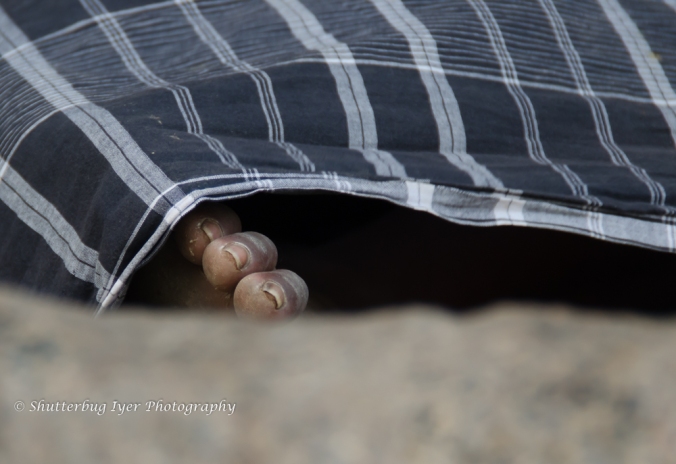 When we reached the Valiankuttai ratham, a man was peacefully sleeeping in the niche, oblivious of the visitors.

Meenakshi Sundareswarar thirukalyanam. The wedding of Shiva with Parvati, one scene from many depicted on a temple gopuram at Thiruamazhisai, near Chennai.

Ellora – Ramayana Panel – Rama pierces 7 trees
In Kishkintha Kaandam, Sugreeva approaches Rama to help him overcome his brother Vaali, who has usurped his kingdom (and wife). Rama consents as he needs the vaanaras’ help in locating Sita.
Sugreeva needs some reassurance of Rama’s ability. To prove, Ram takes an arrow from his quiver and shoots into a sal tree. The arrow penetrates seven trees as well as some subterranean layers of the earth and returns to his quiver. Sugriva is very pleased and prepares to call Vaali for a duel. The above scene is depicted in miniature in Cave 16 of Ellora (Kailash cave) in the Ramayana Panel. 8th Century CE
What follows Vaali vadham – a highly debated episode in the Ramayana. That is for another post.
Ravana and Mount Kailash 3
Another image of Raavana shaking Kailash
This is another image of Raavana shaking mount Kailash.This was near the left side steps (Northern side) of the temple in Cave 16 – See earlier postings for description. and this

Three faced nandi at Hampi
This unique three-headed nandi is in the Virupaksha temple, Hampi, Karnataka. I have not seen such nandi anywhere else. The three faces are supposed to symbolize three kaalaas – the past, the present, and the future. Or do they represent the Trinity?
Your views, please.

Durga as Mahishasuramardini Ellora Cave 16 Inner wall near the entrance
Specially selected for women’s day.
Other Mahishasuramardhinis:
At Salavankuppam,Mahabalipuram: https://stonestoriessite.wordpress.com/2011/09/27/mahishasuramardhini/
At Kanchipuram and Baijnath: More Mahishasura mardhinis

Ravana offering his heads
Cave 16 (Kailasa) at Ellora.
Ravana, a great devotee of Shiva is doing severe penance to get ‘Atma Linga’ from Shiva so that his mother Kaikeshi could pray. Not getting any response initially from Shiva, Ravana cuts off his heads one by one. When he was about to offer the last head, Shiva appears and concedes his request.
Ravana’s heads are supposed to represent his intimate knowledge of the six Shastras and the four Vedas.
Another belief is that the heads symbolize the ten senses and emotions viz. Kaama (lust) Krodha (anger) Moha (delusion) Lobha (greed) Mada (pride) Maatsarya (envy) Manas (the mind) Buddhi (intellect) Chitta (will), and Ahamkara (ego)
Other Ravana tales:
https://wordpress.com/post/stonestoriessite.wordpress.com/151
https://stonestoriessite.wordpress.com/2016/03/02/ravana-lifting-mount-kailash/
Ravana trying to lift Kailash at Belur
Ravana at Halebidu
Earlier post on the same theme :https://stonestoriessite.wordpress.com/2016/03/02/ravana-lifting-mount-kailash/
Ravana lifting Mt.Kailash
This is the classic sculpture of Ravana lifting Mt Kailash at Ellora (Cave 16 -Kailash).I have been longing to see this iconic image for a long time. I have seen similar themes at Angkor Wat (Bantei Srei), Pattadakkal, Murudeshwar, etc.
For details about this episode, click here
For the theme in Belur Halebid click here
The highly talked about, but the
least understood feature at Lepakshi is the hanging pillar. the main
mandap has 70 pillars. One of them is unique.It appears to
hang from the top as it does not rest on the floor. One can draw a paper
or a piece of cloth under the pillar. The science behind this
architectural feature remains a mystery. A British official tried to
study this column but only succeeded in dislodging it from the original,
thus dangerously skewing the structure. Wisely, he abandoned any
further invasive investigation.
 |
| The hanging column of Lepakshi- an architectural mystery. |
The pillar in Belur is also an architectural curiosity. It
appears to be supported only on three sides. It is a stand-alone pillar
and not part of a mandapam.
 |
| Belur Pillar |
The murals of the roof of the Lepakshi temple is another
remarkable feature of this 700 year old Vijayanagara temple. Some of the
scenes are reproduced here.
 |
| In Paravati’s dressing room. Note the six attendants have distinct hairdo and dresses. |
 |
| Royals and staff offering prayers |
Bhikshatana murthy at Kailasanatha temple, Kanchipuram. – the 7th Century CE Pallava temple .
 |
| Bhikshatanar – showing the enchanted rishi patnis and the enraged rishi. |
Gopi Vastraaharan – Krishna stealing the clothes of gopis.
This pillar is from Sree parthasartathy Temple, Triplicane. For
narration and other pictures from Bhatkal, Karnataka and George Town,
Chennai see: http://stonestories.blogspot.in/2011/09/vastraapaharan-krishna-and-gopis.html
 |
At Sree Parthasarathy Temple, Thiruvallikkeni
There is another sculpture on the same theme at Sree Sundararaja Perumal Temple, Kanchipuram. See Bhusavali’s blog
The temple of Sree Ranganatha at Srirangam is famous for it
sculptures in the various locations. The Venugopalswamy shrine, the
Sesharaya Mandapam, the Garuda mandapam, the gopurams all provide
examples of the skills of the artisans.
This sculpture on a pillar in a small mandap near the pushkarani shows Hanuman coming out of crocodile.
The
story associated with this goes thus. Hanuman was on the way to bring
Sanjivani to restore Lakshmana. Ravana sent a demon Kala Nemi (Ravana’s
uncle?) to stop Hanuman at any cost. Kalanemi assumed the guise of a
sage and persuaded Hanuman to have a bath in a pond near the hill. On
entering the water, Hanuman was swallowed by a huge crocodile.
Hanuman, using his supernatural powers tore out the belly of the
crocodile and emerged unscathed. The crocodile happened to be an apsaras
who was cursed to take this form.

One more Narsimha on a pillar at Sreerangam Temple.

See other Narasimhars:

The Lepakshi temple was built
by the brothers Virupanna and Veeranna who were officers in the court
of Achyutaraya. After the death of Achyutaraya, his son-in-law assumed
the throne as the former had no sons. Some courtiers spread a rumour
that Virupanna embezzled the court funds to build the temple. The king
ordered Viurupanna to be blinded. Virupanna stung by the accusation and
sentence prempted and gouged out his eyes and flung them on the wall of
the temple. Even today one can see two spots with a blood like stain on
the walls withstanding centuries of wind and rain. According to our
guide, the British government in the last century did a chemical
analysis and confirmed that the stains were indeed from human blood! The
Kalyana mandap which was under construction at that stage remained
unfinished after this incident.
Bhikshatana murthy and Annapoorni


At Lepakshi one of the most exquisite carvings on pillar is the depiction of the Bhiskatana scene.
Lord shiva disguised as bhikshatanar approaches Parvati
and seeks alms. Parvati, rushes from her bath to offer the ‘mendicant’
some rice. To test her devotion, the Lord dislodges her attire. The
steadfast Parvati, is unaffected and continues with her task. The Lord
was highly impressed and Parvati came to be known as Annapoorneswari.
 |
It is interesting to note that it is the mendicant
Bhikshatanamurthy, also known as Kankala murthy, who wears the sandals.
Are there any other aspects of the Gods which are depicted with a
footwear?
I located another tiny image depicting the same episode from the roof beam of Nanguneri temple near Thirunelveli .
 |
Bhikshaatana scene in Nanguneri temple roof panel |
There is another version of the story of Bhishatanar.A group of
leading sages were performing great yagna and other austerities. While
doing this, they become very arrogant and egoistic. To teach them a
lesson, Shiva appeared as an attractive naked mendicant. The wives of
the sages while giving him alms, became enchanted and started following
him. The sages realised what was happening and apologized to the Lord.
The Nanguneri panel probably depicts this versions as there are more
than one woman.
 |
| I found this newly sculpted pillar with Bhikshatnar at Mahabalipuram school of craft. |
Srikalahasti
Besides the Nagalingam, there is a rock on which the three devotees of Shiva are seen to be offering prayers. A spider (Sri), a snake (kala) and an elephant (hasti) are making offering to a lingam.

 |
| Ganesha shrine adjoining Srikalahasti |
 |
| Naga Lingam at Lepakshi |
The naga lingam is another imposing sculpture iIn the Lepakshi temple. A 7 hooded naga rises over the lingam behind the sanctum sanctorum. . The guide narrated an interesting story about the naga lingam. A young sculptor was hungry and asked his mother who was working in the kitchen just opposite the present lingam, when meals would be ready. She replied that it would take at least another hour. To pass time, the sculptor built this naga lingam in just one hour. The mother, coming out of the kitchen was astonished . Because of her ‘drishti’ the sculpture developed three cracks. Therefore, no formal puja is performed for this lingam.
The lingam is flanked by a panel of Saptha maathas.
 |
| Women offering puja to the Saptha mathas – Indrani, Kaumari, Vaishnavi,Maheswari, Brahmi Varahi, & Chamundi |
The tip of the naga hood is visible from the nandi several metres away., in the outskirts of the town.
Lepakshi Nandi

The nandi is situated about 200 meters from the main temple. The sixth praakaram originally extended upto the nandi. Now streets and town houses (and an APTDC guest house) intervene.

The Granite nandi measuring 8 M length and 6 M high is considered to be the largest Nandi in the world. The one in Thanjavur is second. Even among monoliths, it stands on top, second only to Gomateswara. I did a rough calculation of the mass of the bull. At 8x5x 2.5 (aprox) it should weigh at least 250 tonnes considering density of granite to be 2.5 T/ Cu.M


The crouching bull is facing the Naga linga at the temple and strikes a very natural and elegant pose. The garlands, kaasu malai and mani malai are remarkable for their exquisite finish.

Lepaskhi is situated about 135 Kms North of Bangalore, in the District of Anantapur, Andhra Pradesh. It is an ideal one-day outing for those interested in history, heritage and archaeology in addition to the spiritually inclined.
The small town is famous for the Veerabhadra swamy temple and the monolithic Nandi.
The earliest inscription about the temple dates to 1533 C.E. Folklore takes it to the Treta Yuga when Lord Rama visited this site. It is here that Jatayu attained moksha . The name Lepakshi is said to be derived from ‘Laya Pakshi’ (unconscious bird). Another version attributes the etymology to ‘Le Pakshi’, meaning ‘Arise, Bird’ uttered by Rama. There are also a Ramalingam and a Hanuman Lingam installed by Rama and Anjaneya respectively.
The entire temple complex is built on a monolithic convex rock shaped like a tortoise.- Kurma Saila. The original temple had seven enclosures, but only two survive now. The rest are encroached by residents and part of the town. The Nandi was originally in the sixth praakaram.
Some of the attractions here are the Nandi, The balancing pillar, the murals on the ceiling, kalyana mandapam, Ganesha, Sri Kalahasti, Sita’s paadam, Naga Lingam, Bhikshatanar, Mohini, etc. I shall try to showcase some of these in these blogs, in installments.
We found the 16th century temples of Bhatkal rather serendipitously. We were driving from Udipi to Murudeshwar and wanted to stop at Bhatkal on the way to see some ancient mosques and other heritage sites. quite accidentally we saw the Jattappa Chandranath basadi on the way. This was being restored by ASI. The junior staff of ASI were very helpful and above all enthusiastic about the heritage. They guided us to the other temples too

ASI is in the process of restoring these temples. It must be an uphill task as they are in very bad condition. Some of them are inside private property where modern houses have come up.


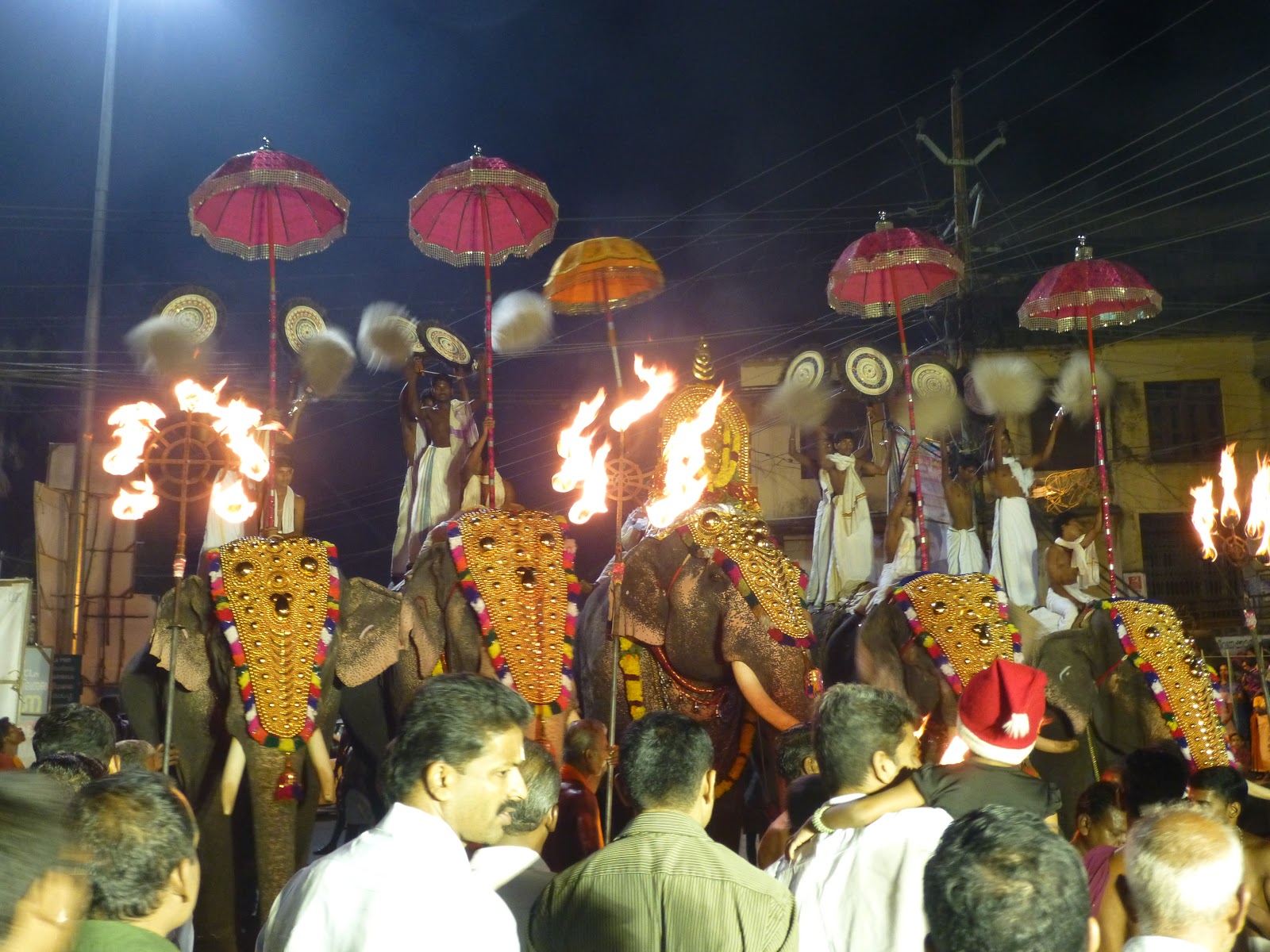
A boy in a Santa Claus cap, among others witnessing decorated elephants carrying Hindu idols, at Pala, Kottayam Dot.
We found the 16th century temples of Bhatkal rather serendipitously. We were driving from Udipi to Murudeshwar on NH 17 and wanted to stop at Bhatkal on the way to see some ancient mosques and other heritage sites. Quite accidentally, we saw an acient looking structure on the way. This was the Jattappa Chandranatheswara basadi, being restored by ASI. The junior staff of ASI were very helpful and above all enthusiastic about the heritage They guided us to the other temples in the town.
All temples were built around 1500 C.E. mostly funded by rich merchants or association of traders.
1. Jattappa Chandranatheswara basadi – this temple is located on one of the main roads close to commercial establishments and schools. There are two blocks connected by a columned porch. As you enter from the road you see the two tiered main block with sloping stone roof and another structure which looks like a bell tower.The entrance has ornate dwarapalakas, more like the Hoysala style. The three-celled Garbagriha had only the peethams. The steps to the upper tier were missing. The temple faces East and has a deepastambham in front. There are two tablets with inscriptions on either side of the porch. The compound was well maintained by the junior staff of ASI.
 |
| Dwarapalaka |
 |
| View of the temple from the roadside |
2. Parshwanath Jain temple.
Without proper guidance,we would have missed this temple as this was tucked in between shops in the commercial area.

 |
| Kailasanatha Temple, Kanchipuram 8th Century? |
|
| Baijnath Temple, Himachal Pradesh |

On a mandapam pillar at Thirukkurungudi, Azhagiya Nambi temple. Thirukkurungudi in Naguneri Taluk, 10 Kms from Vallioor and about 25 Kms from Thiunelveli. The entire temple has been renovated by the support of the TV Sundaram Iyengar family who hail from this village.

This is an exhibit from Keralam – a museum of History and Heritage, Trivandrum. This image of Yoga Narasimha murthy is made of Jack fruit wood (Varikka Plaavu) and was recovered while renovating the Kulathupuzha sastha temple. Dated 14th Century

Happy Durga Pooja to all.
The depiction of Mahishasura vadham is front of the Shiva temple in the Tiger Cave complex, Salavankuppam, near Mahabalipuram. (Pallava circa 6-8 century CE)


Figure of a two-headed cow feeding a shivalinga – a pillar carving at Talakadu, Karnataka (45 Kms from Mysore)
One has heard the story of a cow feeding an anthill several times and in several contexts.This time we heard it from a guide in Talakadu as the legend associated with this town and temple.
The story goes thus: The local chief had a cow which never yielded him any milk after grazing in the forest, eventhough it had a full udder before entering the forest. The chief sent two of his hunter assistants, Tala and Kada to investigate. They found the cow feeding an anthill in the forest. The hunters struck a blow on the anthill with an axe. The shivalingam which was inside split into 5 lingams and Lord shiva emerged with a bleeding cut on his body. The bewildered hunters pleaded to the Lord to forgive them. Shiv pardoned them and ordered them to bring some herbs from nearby plants and healed himself. Since he healed himself, the Lord here is known as Vaidyanatheswara. The other four temples nearby are called, Pathaleswara, Maruleswara , Arkeswara and Mallikarjuna. Devotees worship the panchalingas on specific days.
Another legend of Talakadu revolves round a curse of a noble lady. That story can wait for another day.

Shiva rescuing Markandeya from death – from a pillar in Sree
Mallikeswara Swami Temple, Linghi Chetty Street, Mannadi, Madras
(Chennai)
Mrikandu Rishi and his wife, Marudmati were devotees of Lord Shiva. They were childless for many years and prayed to Shiv to bless them with a son. Shiva offered them a choice of a virtuous and accomplished son who will have short life span or a dunce who will have long life. Mrikandu and wife opted for the former. Soon they were blessed with a son, who was named Markandeya.
Markandeya, too was a great devotee of Shiva. At the age of 16, Yama’s messengers came to take away Markandeya. Undaunted, Markandeya hugged the shivlinga and continued his prayers to shiva. As the messenger was unable to fulfil his task, Yama himself came to take away Markandeya. He threw his lasso to capture the boy. The rope looped around the shiva lingam. Shiva came out of the lingam in all his fury and smote Yama down. Shiva is also referred to as ‘Kaalaantaka’ (destroyer of death) for this reason and this episode is referred as Kaala Samhara.
Realising that there won’t be the natural cycle of life and death without Yama, Shiva revived him on the condition that the boy will live on in his youthful glory as if he is always 16.
The episode is belived to have taken place in
Tirukkadayur. (Thirukkadavur). People celebrate their birthdays,
shashtiabdapoorthi, Bheema santhi, Shatabhishekam etc in this place to
bestow longevity and good health.

Another pillar carving of the Markandeya and Yama episode from Sree Vaidhyanatheswara Temple, Talakad, Karnataka
 |
| This image is from Kheta Pai Narayana Temple, Bhatkal,Karnataka circa 1550 CE (click image for larger view) |

This image of Krishna and Gopis (Vastraapaharan) is from a pillar in Chenna Kesava swami temple, Devaraja Mudali Street, George Town,Chennai.
The temple was originally on the site where the High Court now stands.The temple was destroyed during the construction of the Highcourt. Sensing the mood of the people the British authorities agreed to fund the reconstruction of the temple elsewhere. The current temple on Devaraja Mudali street along with its twin Chenna Malleeswara temple were built by the then Dubash, Muthukrishna Mudaliar in 1762, with assistance from the British.
The above image represents the episode of Vastra apaharan. While the gopis were bathing in the river, Krishna steals their garment left on the shore.He climbs on a tree and refuses to return them despite the fervent appeal by the gopis. Many interpretations are given for this act.
1. It was just a boyish prank.
2. The gopis used to pray to have Krishna as their husband. Krishna knew this and this was a symbolic way of fulfilling their desire.
3. The garments represent ego and attachment. To attain the Lord one should forsake ego and attachment.
You may choose any of the above interpretations or have your own version depending on your religious / spiritual perspective.

The above image is from a sculpture on the pillars of the Cheluva Narayan temple, Melkote, Karnataka.
Hayagriva, the god with a horse face is considered as an avatar of Vishnu. The Lord took this form to rescue the vedas from the demons, Madhu and Kaitabha. Therefore, Hayagriva is considered the God of wisdom and knowledge. Marichi, is the consort of Hayagreeva.

A pillar carving at Cheluvanaryana temple, Melukote, Karnataka
Yashoda loses her motherly patience after a very naughty prank by Krishna. She ties him up in a heavy grindstone in the courtyard. Krishna appeals for mercy with fear and tears in his eyes. Unable to bear the sight, Yashoda goes inside to attend to her domestic chores. Left alone, Krishna happily and effortlessly drags the grindstone and passes through the gap between two large trees. The grindstone gets stuck in between. With one yank, Krishna brings down the trees. The trees transform into two Gandharvas, the sons of Kubera, who were cursed by Narada. The gandharvas, having been released from the curse thank Krishna (seen above ). Yashoda, not aware of the full story, was shocked at seeing the fallen trees but was relieved that her son was not hurt.

This image of Narasimha killing Hiranyakasipu is on a pillar at the Cheluvanarayana temple at Melukote (Melkote) in Karnataka. In the same town there is a hill on which stands a majestic temple of Yoga narasimha.
 |
| Pediment of Northern Long room – Narasimha slaying Hiranyakashipu |
The story of Prahalad and Hiranyakasipu which forms the background for the fourth avatara, of Lord Vishnu, is well known to most Indians. However, a brief account of this will be in order here.
Hirayankashipu was a demon king ruling over the three worlds. After severe penance, he had sought a boon of immortality from Brahma. As absolute immortality was not possible, Brahma had granted a boon by which he would not be killed by either man or beast, in the day or in the night, inside the palace or outside. Confident of his immortality he continued his tyrannical rule over all.
Hiranyakashipu abhorred Vishnu as Vishnu had killed his brother in the Varaha avatara. He proscribed all religious activities, especially Vishnu worship. Hiranyakashipu’s son, Prahalad was, however, an ardent devotee of Vishnu. The father’s several attempts, including death threats, to wean the son away from Vishnu worship, did not deter the son from his devotion.
Infuriated, Hiranyakashipu asked his son if his Lord was everywhere, including the pillar in front. On Prahalad’s affirmative answer, Hiranyakashipu split the pillar with an axe. Out emerged Narasimha, a half-man, half-lion avatar of Vishnu, took Hirnayakshipu on his lap, sat on the threshold and killed him by splitting his torso and pulling out the entrails.
The unabated fury of Narasimha worried the devas and the devotees. The ardent appeal by Prahalad and the presence of Lakshmi calmed Narasimha and he appeared as lakshmi Narasimha or Shantha Narasimha.
Banteay Srei in Siem Reap,Cambodia is a unique temple. It is perhaps the only one not built by a king. It was built in the 10th century by a Rajguru, Yajnavaraha. It is called the jewel of Khmer architecture and represents a true blend of Khmer and India culture. Several stories from Indian epics are carved in the pink sandstone lintels and pediments of this small but exquisite temple, situated a little away from the Angkor Thom complex.Banteay Srei stands for ‘citadel of women’.
The Eastern pediment in the Southern library has the carving of Ravana shaking Mount Kailash the abode of Lord Shiva.

One of my earlier posts on Pattadakkal is reproduced below:
Ravana shaking Mount Kailash
|
|
|
|
Ravana Shaking Kailash, a pillar in Virupaksha Temple, Pattadakkal. |

After severe penances and conquests, Ravana became very strong and arrogant. He went to Himalaya, defeated his half-brother, Kubera and usurped his Pushpaka Vimana . On his return, he was overflying Mt. Kailash. Nandi advised Ravana to circumambulate Kailash so as not to disturb Shiva and Parvati.
The arrogant Ravana said, “Who is Shiva?” and tried to shake the mountain. Though Parvati and her entourage were frightened, Shiva nonchalantly pinned down Ravana with his toes. Ravana wailed for mercy. Having humbled Ravana, Shiva released him. After this experience, Ravana became a great devotee of Shiva.
In another version, it is believed that Ravana’s mother, Kaikasi, herself a great devotee of Shiva, wanted to go to Mt.Kailash. Arrogant Ravan said that he could bring Kailash to her and attempted to lift it and transfix it in Lanka.
Epilogue: Ravana after becoming a devotee of Lord Shiva sang in His praise. Since he had no musical instruments to accompany his singing, some believe, he cut off one of his heads and an arm to make a stringed instrument with his thigh nerves. This is also believed to be the origin of musical instruments. In fact, an instrument called Ravanahatta (Ravan’s hand) is still in use in some parts of Rajasthan.
Other sculptures: the other famous figure of Ravana and Mt. Kailash is in Ellora (Cave 16)
When I wrote about Bhishma on the bed of arrows at Pattadakkal, (click here) I had heard about a similar image at Angkor Wat. My dream of seeing this came true last fortnight, when I visited Bali and Angkor Wat with my batchmates at IIM, Ahmedabad .
This is on the Southern Gallery at the Western entrance to Angkor Wat.

Angkor wat is perhaps the largest temple in the world. It was built in the 12th century by Suryavarman II of Cambodia and was dedicated to Lord Vishnu. Later, it was converted to a Buddhist temple. Like other monuments in Cambodia, Angkor Wat blends Buddhist and Hindu imagery and legends.
Incidentally, image of this temple appears in the country’s flag
Mahabalipuram
A Tamil scholar has published a book on ‘Arjuna’s penance’ – the bas-relief at Mamallapuram. He wants to set at rest the controversy about it by asserting that the work indeed depicts Arjuna’s penance in the Himalayas. more details at : http://tinyurl.com/yln9tnx
Lingothbhavar
In many Shiva temples, one can see the image of Shiva emerging from a lingam, with images of a swan on the top and a boar at the bottom. Shiva in this form, is called Lingothbhavar. Usually, this image is seen behind (on the Western side) the Garbha Griham.

Lingothbhavar, Airavateeswara Temple, Darasuram, Tamil Nadu. Chola – 12th Century A.D
The story as per Shivapurana:
Shiva emerged from a lingam in his full form –
viz, spanning the entire Universe. Brahma and Vishnu wanted to see the
extremities of Shiva. Brahma took the form of a swan (Hamsa) and
travelled skywards to see His head. Vishnu took the form of a boar and
went underneath to see His feet. While Vishnu came back and admitted his
defeat, Brahma lied to the assembled Devas that he had seen Shiva’s
head. Angered by this lie, Shiva plucked the fifth head of Brahma. This
being major sin (Brahma hathi) the skull stuck to his hand. According
the Vaishnaviites, Shiva had to pray to Lord Vishnu to get over this
curse.
While the Lingothbhavar is normally on the back
(West) of the sanctum sanctorum, at Virupaksha Temple, Pattadakkal,
(Chalukya – 8th century AD) it is on the front (East) wall. I
do not have a picture of this, but in the photo above it is behind the
priest’s shoulder (you can see only the crown).
Here is another Lingothbhavar at Kailasanatha Temple, Kanchipuram

Click on thumbnail for more pictures of Temples of India
by harisub
Thiruchendur: This image of Lingothbhavar with Brahma and Vishnu on either side is one of the myriad images on the gopuram at Thiruchendur.

Bhishma on a Bed of Arrows.
The area consisting of Aihole, Pattadakkal and Badami served as a crucible of temple architecture during the reign of Chalukyas.
The picture below is one of the many scenes sculpted on the pillars of the Virupaksha temple at Pattadakkal, Karnataka. The Virupaksha temple was built by Queen Lokamahadevi in AD. 745 to commemorate her husband, Vikramaditya II ‘s victory over the Pallavas.. The temple resembles the Kailashnatha temple in Kanchi which served as a model for this temple. The Virupakhsa temple in turn served as an inspiration for the Kailashnatha temple at Ellora (Cave 16) by the Rashtrakuta.

Bhishma or Bhishma Pitamaha was the grand old man of Mahabharata. He was the grand sire who was respected by both the Kauravas and the Pandavaas. Due to circumstances, he had to fight along with the Kauravas in the Kurukshetra war against the Pandavas. Though physically he was with the Kauravas, his heart was with the Pandavas. Yet he discharged his duties as Commander of the Kaurava forces creditably.
Bhishma’s original name was Devavrata and he was the son of King Shantanu and Ganga . His father wanted to marry a fisherwoman, Stayavati, who insisted that only sons born to her should succeed Shantanu to the throne. To facilitate this, Devavrata took a vow of celibacy for life and also pledged to serve anyone who ascended the throne of Hastinapura. Due to this stringent vow, he came to be known as ‘Bhishma’. His father also gave him the boon of ‘Ichcha Mrityu’- the ability to choose one’s time of death.
Even on the tenth day of the battle of Mahabharata, the Pandavas are unable to make any headway., mainly due to the skill and valour of Bhishma. At this point, Shikhandi, who was born a woman, takes arm in front of Arjuna against Bhishma. Bhishma knew that Shikhandi was born a woman, who had a grudge against Bhishma because he had interfered in her marriage. Seeing Shikhandi, Bhishma refused to fight and is felled by Arjuna’s arrow. (It is believed that Bhishma himself had hinted at this ploy while Arjuna and Krishna met him the previous night.)
Arjuna’s arrows had already formed a bed and Bhishma did not fall to the ground. Arjuna used more arrows to form a pillow. Bhishma also requested for water. Arjuna sent an arrow into the earth and a fountain of pure water sprang up which Bhishma relished as Mother Ganga jal. Bhishma also advised Duryodhana to give up the fight and render justice to the Pandavas. Duryodahana did not comply.
As the battle raged, Bhishma held on till Uttarayana (winter solstice) – the auspicious time to die. Only after the victory of Pandavas did Bhishma breathe his last.
It is during his lying on the bed of arrows (called ‘Shara Shayya’) that he composed the Vishnu Sahasranamam- a prayer comprising the 1008 names of Lord Vishu which is recited in many Hindu homes, temples and religious occasions.
There is also a sculpture of Bhishma on a bed of Arrows in Angkor Vat. A beam of sunrays fall on the image of Bhishma on Winter solstice.
The mind of Bhishma is beautifully penned in the Bengali poem ‘
Bhishma’s Bed of Arrows’ by Jatindra Mohan Sengupta. A transcreation in
English by Pradip Bhattacharya is available at: https://www.boloji.com/poem/92/bhishmas-bed-of-arrows
More pictures at: http://www.flickr.com/photos/shutterbug_iyer/
and
http://community.webshots.com/user/harisub
Ravana shaking Mount Kailash
|
|
|
|
Ravana Shaking Kailash, a pillar in Virupaksha Temple, Pattadakkal. |
After severe penances and conquests, Ravana became very strong and arrogant. He went to Himalaya, defeated his half-brother, Kubera and usurped his Pushpaka Vimana . On his return, he was overflying Mt. Kailash. Nandi advised Ravana to circumambulate Kailash so as not to disturb Shiva and Parvati.
The arrogant Ravana said, “Who is Shiva?” and tried to shake the mountain. Though Parvati and her entourage were frightened, Shiva nonchalantly pinned down Ravana with his toes. Ravana wailed for mercy. Having humbled Ravana, Shiva released him. After this experience, Ravana became a great devotee of Shiva.
In another version, it is believed that Ravana’s mother, Kaikasi, herself a great devotee of Shiva, wanted to go to Mt.Kailash. Arrogant Ravan said that he could bring Kailash to her and attempted to lift it and transfix it in Lanka.
Epilogue: Ravana after becoming a devotee of Lord Shiva sang in His praise. Since he had no musical instruments to accompany his singing, some believe, he cut off one of his heads and an arm to make a stringed instrument with his thigh nerves. This is also believed to be the origin of musical instruments. In fact, an instrument called Ravanahatta (Ravan’s hand) is still in use in some parts of Rajasthan.
Other sculptures: the other famous figure of Ravana and Mt. Kailash is in Ellora (Cave 16)
An Exquisite Unfinished Saraswati Image from Bijamandal, Khajuraho

Bijamandal Temple, Khajuraho (Source: asijabalpur.gov.in)
Dr. Phani Kanta Mishra
Dr. Kumkum Bandyopadhyay
Bijamandal temple, also regarded as Vaidyanath temple, is situated near the Jatkari village of Khajuraho in Madhya Pradesh. This temple is located nearly 300 mt. away from the Chaturbhuja temple of Khajuraho. The site was first discovered and excavated by the first author in 1998-2000. This temple, buried under the mound was 7.5 mt. in height and about 40 mt. in length and thus considered to be the biggest of all Khajuraho group of temples. A large number of architectural objects were found scattered near the temple site. The mound was surrounded by a small platform of coarse and dressed stones, and topped with a marble Sivalinga with Yonipatta. The entire architectural plan of the garbhagriha, antarala, mahamandapa, mandapa and ardhamandapa of the temple has been unearthed from the debris of the partly hidden and exposed structures.
The sculptures from Bijamandal belonged to three distinct phases. Figures of the earliest phase were simpler with fewer attributes and somewhat rotund in appearance. The next phase was marked by the iconographically elaborate sculptures, while sculptures of the last phase were more elongated and slenderer with a triangular ornamented head-dress, typical of the Kalachuri period. These sculptural variations clearly indicate that in all probability the construction process of the temple continued for two or three centuries with intermittent stages of abandonment.
The Saraswati figure under purview is considered to be the best sculpture discovered during the excavations. The image, carved in red sandstone is seated in lalitasana on a high plinth. The right leg of the deity is folded and resting on a half-blown lotus, while the left leg is hanging down and placed on the lower part of the tri-ratha pedestal. The four-armed deity holds a veena with her two front hands. The lower end of the veena is designed like a horned animal face or a scorpion. In the upper left hand, she holds a pustaka, i.e. manuscript tied with a thread, while the attribute in the upper right hand is broken out. Possibly in the upper right hand she held a lotus, as the stalk of the lotus is visible in between her right arm. The figure has a round, calm facial expression with delicately chiselled half-closed eyes, nose, lips, long ear lobes, pronounced breasts, and artistically represented fingers (much longer than usual ones). The goddess is attired with a decorated diaphanous lower garment reaching down her ankles, another piece of cloth round the decorated girdle with ornamental hangings coming down on the thigh (urujalaka).

Saraswati Image from Bijamandal, Khajuraho (Source: Dr. P. K. Mishra)
Her hair is arranged in a two-tiered elegant bun with tresses of hair falling down and resting on her shoulders. Parting of hair (simanta) is clearly visible in the middle of the hair. She is bedecked with two elaborate necklaces (one broad rounded and another three-stringed necklace coming down up to her belly), round earrings (karnakundala), armlets, bangles, ratnachura on the upper side of the palms, designed anklets (nupura), and a three lined vertical coronet in the middle of the hair bun. A faint carved image of a bird (possibly swan, her vahana) is visible between her left thigh and right toe. However, the bird image is quite unmatched with the usual representations of swans found in the Saraswati images. The deity is flanked by two small standing figures (both females) in tribhanga pose. As these figures are placed in two lower corners, it is difficult to discern their details and iconic features. Possibly, the right one is holding a cauri, while the left one is holding a full-blown lotus in the upper right hand. The whole figure is in all probability a part of a door lintel/doorway bordered with rounded pillars on two sides. Here, the Saraswati figure appears to be incomplete and unfinished. Combing of hair, the carving of the fingers of the left foot, carving of the stella with a halo behind the head, outlining of the gems in the jewellery, completion of the other secondary deities, and proper feature of the vahana were required to complete its rendition. However, the carving of the deity with proportionate body, elaboration in dresses and ornaments throw some light on the efficiency of the craftsmanship. Stylistically, this image could be dated to circa 10th- 11th centuries CE.
 |
| Visitors enjoying the Bijamandal Temple site after excavation |
Apart from this Saraswati image, during excavations in 1999-2000, the first author discovered some more sculptures from the debris of the mound, which also appeared to be incomplete. The carving on them has not been done to the perfection and a majority of these sculptures are depicted without or different kinds of attributes and vahanas usually found to be associated with them. Thus, we can conclude that, the Bijamandal temple was in the process of completion, however, the construction activity could not be sustained for some reasons, and finally the project was shelved.
 |
| The marvelous Western group Kandariya Mahadev temple at khajuraho |
Dr. Phani Kanta Mishra is the Director of Heritage Cell, MAKAUT, WB. He is the Ex-Regional Director, East, of Archaeological Survey of India
Dr. Kumkum Bandyopadhyay is an Assistant Professor in History,
Krishna Chandra College, Birbhum, West Bengal
An Important Archaeological Site Ghorakatora, IN Rajgir, Bihar

Figure 1: Location of Ghorakotara
Dr. Phani Kanta Mishra
Location : 25° 01’37” N; 85° 31’ 31”E
District : Nalanda
State : Bihar
Excavation years : 2007-09
Ghorakatora archaeological site was approved by the Central Advisory Board of Archaeology (CABA) for the excavation in 2007. The site has much archaeological value, and the potteries discovered were from Northern Black Polished Ware ( NBPW) culture. During our excavation, we had evidence of black and red ware (BRW) of chalcolithic culture dated from C.1500 B.C. and going beyond the NBPW culture. In my view, the site needs a thorough investigation. The area is approximately 22.74 acres. It needs extensive horizontal excavation. After the detailed excavation, only the findings can be confirmed with certainty.
The rich and diverse nature of antiquarian remains reported from the mound led to the excavation of the site for two seasons (Figure 2 and Figure 3). The excavations led to the unearthing of a continuous five-fold cultural sequence at the site beginning with the Chalcolithic through NBPW culture, Śunga-Kuṣāṇa, Gupta and post-Gupta to the Pāla period. Chronologically, the site is dated from c. 1500 BC to 1200 AD.
The Archaeological Survey of India, Patna Excavation Branch under Dr. Phanikanta Mishra, took up the excavation of an ancient habitational mound at Ghorakatora in 2007. The place is situated at a distance of 800m west of Giriyak Police Station in District Nalanda on National Highway 31. The modern village of Ghorakatora lies between Biharsharif and Nawada. The site is 8 km west of Rajgir and 19 km north-west of Nalanda (Figure 1). The huge mound stands along the eastern bank of the river Panchane (Figure 1A) and has an approximate area of 22.74 acres. Five more rivers join here: Khuri, Teliaya, Dhandara, Dhanarje, and Mangura. It measures 900m north to south and 500m east to west.
 |
Figure 1A; General view of the river Panchane. |
Period I: Chalcolithic Culture (c. 1500 B.C to 800 B.C)
Period II: NBPW Period (c. 800-200 B.C)
Period III Sunga-Kushana Period (c. 200 B.C to 300 A.D)
Period IV Gupta and Post Gupta Period (c. 300 A.D to 800 A.D)
Period V Pala Period (c. 800 A.D to 1200 A.D)
The mound (Figure 4) was first noticed by Buchanan, and he reported the find of numerous fragments of stones and Buddhist and Brahmanical sculptures scattered over the site. He also reports the presence of a modern Shiva temple at the northern end of the mound and a collection of ancient sculptures preserved in it. He noticed sculptures were scattered all over the site. Kittoe's description of the mound was more or less that was given by Buchanan. Cunningham also inspected the site in 1861-62, and he, too, refers to the sculptural wealth of the mound. He found brick and brick butts on the surface of the mound, which is round in nature and situated beside the river Panchane. He also reported brick stupa in this region. In 1987, K.K. Sharma also visited the site and recovered potsherds of NBPW, Grey Ware (GW), Black and Red Ware (BRW), Red Ware (RW), and glazed ware. He also noticed the remains of brick structures having a brick size of 41x28x6cm. The Excavation Branch III, Patna conducted an extensive exploration of the mound in 2007 and noticed archaeological remains such as ancient structures, pottery, diverse antiquities, and a large number of sculptures.
 |
| Figure 2: Excavation at the Ghorakotara mound |
Chalcolithic culture of Ghorakatora Period I exposed remains of the chalcolithic period resting on the natural soil. The structure found from this level is a wattle and daub structure. The people of that age were living in huts made of reeds frame and mud plaster. The findings of the burnt daub structure revealed from the excavation substantiate the fact that it was from the pottery period (1500 B.C to 800 B.C). The assemblage of this chalcolithic period at this site is classified as black and red ware, and black slipware. Here it is pertinent to say that the above pottery may be compared with that of Chirand (dist. Saran) and Sonpur (dist. Gaya). The fabric of these wares varies from coarse to fine. The type includes dish on the stand, vases, bowls, dish basin, tipped basin, storage jar, handi carinated on shoulder, long neck jar, suspended jar, and perforated basins. Vases, bowls, dish, lid cum bowl, deep bowls, basins, and dish are the common types in the BRW that belong to the pre-NBPW phase. Paintings have been observed in red ware and grey ware. The fabrics range from coarse to medium. The types included narrow mouth vases within a wide mouth, carinated handis, bowls, lids, basins, and storage jars. Polished stone tools, fragments of bone querns, pestles, sling balls, terracotta beads, hopscotches, bone points, fragments of copper antimony rods, and structures are also found.
 |
| Figure 3: Excavation at the site Ghorakotara |
The succeeding NBPW Period II (c. 800-200 BC) did not reveal much in terms of structural activities except for a ring-well (Figure 7), of which only two rings were extant. Potsherds of RW and some elongated jars, also of RW, were recovered from the deposit of the well. As the name suggests, the period is identified with the appearance of the distinct NBPW. The pottery types of the earlier period continued their existence along with the advent of another new pottery, the GW. Similarly, some early shapes like vases, bowls, dishes, bowls with lids, etc. A fairly good (Figure 13) number of painted potsherds was found in RW and GW. The painted motifs consist of loops and intersecting loops, vertical strokes from different angles, and mat designs. The paintings were executed predominantly in cream pigment on the outer surface of the pots. Dishes and bowls were generally painted on the inner surface. The associated antiquities include corroded copper coins, terracotta human figurines, ghat-shaped beads, wheels, etc.
 |
| Figure 4: Antiquities found from the excavation of Ghorakatora |

 |
| Figure 5: Antiquities found from the excavation of Ghorakatora |
 |
| Figure 6: Antiquities found from the excavation of Ghorakatora |
 |
| Figure 7: Antiquities found from the excavation of Ghorakatora |
 |
| Figure 8: The Mound at Ghorakatora |
Period III (c. 200 BC to 300 AD) at the site is designated as belonging to the Śuṅga-Kuṣāṇa period owing to the presence of distinct terracotta figurines of Śuṅga-Kuṣāṇa style (Figure 4), cast coins, inscribed sealing in Kuṣāṇa characters and typical Kuṣāṇa sprinklers bearing red slip. Of the structural activities, mention may be made of burnt-brick structures having bricks measuring 36x26x5.5cm and 38x27x6cm. A ring-well of this period was found to have a height of 24 rings (Figure 12). The ceramic assemblage included slipped and un-slipped RW and GW. Storage jars, spouted vessels, etc. are found.
 |
| Figure 9: Excavated Wall, Ghorakatora |
The Gupta-post Gupta phase of occupation at the site is designated by Period IV. This period is dated from c. 300-800 AD. The structural remains at the site are dominated by two large walls. The first wall ran from east to west and the second from north to south. The first wall was traced to a height of 18 brick courses, while the latter had 10 courses. They formed part of a housing complex. Two more walls, intersecting each other, were also found during this period. It appears that these walls were constructed in two phases; the first phase corresponding to the Gupta period gave evidence of less use of mortar (combination of mud and sand) while, in the second phase, mud mortar was used as cementing material. The pottery repertoire of period IV bears close affinity to that of the preceding period III.
 |
| Figure 10: Excavated floor, Ghorakatora |
Period V at the site belongs to the Pala period and is dated from c. 800-1200 AD. This period brought to light many structural activities in the form of parallel walls (Figure 5), house complexes, rammed floors (Figure 6), drains, storage jars, etc. The excavated remains suggest that at least three structural phases can be clearly delineated. Corresponding to the first phase of construction are a number of burnt-brick walls that continued their existence even in the succeeding second phase. The third phase was the most structurally proliferate phase. It comprised of two residential complexes with a wide passage in between, three parallel walls running east to west and seven storage jars aligned in between the two western-most walls, remains of successive lime and surkhi jelly floors, etc. Another interesting structural feature was the covered drain running east to west. A remarkable finding of the excavation was a sculptor’s workshop. The brick-paved area had a stone anvil, an earthen pot, and an unfinished basalt stone block. Mud mortar was used as a binding material in all the structures. Some broken moulded bricks with floral designs were also recovered from the upper layers.
 |
| Figure 11: Ring Well, Ghorakatora |
 |
| Figure 12: Ring Well, Ghorakatora |
 |
| Figure 13: Potteries found from Ghorakatora Excavation |
 |
| Figure 14: Potteries found from Ghorakatora Excavation |
Red Ware was the dominating industry of Period V. Most of the sherds are well-fired and almost devoid of any surface treatment except for a red slip on some of them. The pottery types include vases, carinated handis, bowls, lamps, lids, basins, and storage jars (Figure 14). Storage jars were found in large numbers. A storage jar filled with cowries (Figure 5) covered with a lid was also found. Few sherds of glazed ware were recovered from upper levels.
The site yielded approximately 300 diverse media like terracotta, stone, metal, glass, iron (Figure 6), bone, and shell. Mention may be made of polished stone celts (Figure 5), hopscotches, pottery wheels, bone terracotta human and animal figurines, stoppers, gamesman, sling balls, wheels, discs, earlobes, amulets, bangles, dabbers, rattles, seals and sealings, skin rubber, beads, stone pestle & mortar, plaques, bead sharpener, iron spearhead, bell, ring, utensils and copper coins (Figure 7).
Of the sculptural remains, notable findings are a bronze image of crowned Buddha, stylistically dated to the 10th century AD, and small stone sculptures of Gaṇeśa, Viṣṇu, and Tara.
References:
Kittoe M., (1847) Notes On Places In The Province Of Behar, Supposed to Be Those Described By Chy-Fa-Hian, TheChinese Buddhist Priest Who Made A Pilgrimage to India at The Close Of The Fourth Century
A.D., .Journal of Asiatic Society of Bengal , Calcutta, vol. XVI.
Buchanan, Fraancis, (1925). Journal of Francis Buchanan Kept during the survey of the districts of Patna and Gaya in 1811-1912. Edited by V.H. Jackson. Superintendent Government Press, Bihar and Orissa.
Cunningham, A. 2000 (Reprinted first edition 1871). Four Reports during the year 1862-63-64-65. Volume 1.
Archaeological Survey of India.Dr. Phani Kanta Mishra is the Director of Heritage Cell, MAKAUT, WB. He is the Ex-Regional Director, East, of the Archaeological Survey of India
For more information on the university please visit: https://www.makautwb.ac.in/


No comments:
Post a Comment